Social ladder · 960–1279 (the Northern and Southern Song)
Social Hierarchy of Song China
From Emperor to Bondservants

In Song China rank came above all from office, and office came, more than ever before, from the civil service examinations. The emperor stood alone at the top; his kin, the imperial clan, were honoured but kept from power. Some 20,000 officials governed a population of 90 to 100 million and enjoyed privileges at law, while a wider gentry of candidates and landowners led local society. The Confucian scheme of four occupations, with scholars first, then farmers, artisans and merchants, was an ideal rather than a law, and merchants in the booming cities could be richer than officials. The state registered commoners as landowning “main households”, graded by property, or landless “guest households”, most of them tenants. Soldiers, a million strong at the army’s height, stood outside the scheme and were little respected, and bondservants and slaves, fewer than in earlier centuries, were at the bottom.
Period 960–1279 (the Northern and Southern Song)People 90–100 millionRanks 10Profile Song Dynasty
The ladder
By rank, the ladder is drawn as a pyramid. To scale, each bar is as wide as that rank’s share of the people. Shares marked est. are estimates where no count survives; their boxes and bars are dashed.
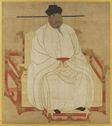
Ruler · One ruler
Huangdi (The emperor)
tianzi
The Song emperor was called the Son of Heaven, and he chose the officials who ran the empire.
The emperor (huangdi), the Son of Heaven (tianzi), was always a man of the Zhao family. The founder, Zhao Kuangyin, was a general whose troops proclaimed him emperor in the Chenqiao Mutiny of 960; as Emperor Taizu he placed the army under civil officials. The emperor appointed and dismissed every official, was the final judge, and from 973 presided over the palace examination that ranked the successful candidates. In practice he governed with his ministers: when Emperor Shenzong said in 1071 that the New Policies were meant to benefit the people, his minister Wen Yanbo replied that the emperor governed with the officials, not with the people. Child emperors were ruled by empress dowagers, as Zhezong was by his grandmother, the Grand Empress Dowager Gao, from 1085. In 1127 the Jurchens captured the retired Emperor Huizong and Emperor Qinzong at Kaifeng; Huizong’s son Gaozong refounded the dynasty in the south, and in 1279 the last emperor, a boy of seven, drowned at the Battle of Yamen.
Moving in or out. The throne passed to a son or, when an emperor had none, to a kinsman: Gaozong, whose only son died young, adopted a distant descendant of Taizu, the future Emperor Xiaozong. Taizu himself had won the throne as a general.
How many? One man, with the imperial family: the empress, the consorts and the emperor’s children.
Nobility and officials · Fewer than 1 in 1,000 (est.)
Zongshi (The imperial clan)
Relatives of the Song emperor were given titles and money, but they were kept out of important government jobs.
The descendants of the founder Taizu, of his brother and successor Taizong and of their younger brother Zhao Tingmei formed the imperial clan, the most honoured family in the empire after the emperor’s own. Earlier dynasties had seen princes seize thrones and fight civil wars, and the Song gave its princes titles, residences in Kaifeng and stipends, but no posts of substance: the clan was kept from power. As it grew, the cost of supporting it rose, and Emperor Shenzong’s reforms of the late 1060s cut off the distant kin from titles and stipends while allowing them to sit the examinations and marry more freely. In the Southern Song clansmen took the examinations and served as officials like other scholars, and many settled in Fujian, at Fuzhou and Quanzhou. Clanswomen married into official and even merchant families: between 1086 and 1093 one married a man from the foreign quarter of Guangzhou, and the Pu, a family of foreign merchants, sought marriages with the clan.
Moving in or out. Birth alone made a clan member. The distant kin cut off by Shenzong’s reforms had to make their way like other gentry, by study, office or land.
How many? Estimate: the emperor’s kin grew more numerous with every generation, some tens of thousands by the 12th century.
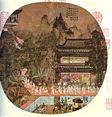
Picture: Han Palace, a fan painting by Zhao Boju, a member of the Song imperial clan, 12th century · Zhao Boju · Public domain · Wikimedia Commons

Nobility and officials · 0.1–0.2%
Shidafu (Scholar-officials)
guanhu (official households)
Most Song officials got their jobs by passing very hard written exams.
The scholar-officials (shidafu) governed the empire, and their households formed the privileged “official households” (guanhu), largely spared labour service. Office came above all through the civil service examinations, which took years of costly study and were held every three years at the prefectural, metropolitan and palace levels; papers were anonymous and recopied by clerks so that examiners could not recognise a candidate’s hand. Active holders of the highest degree, the jinshi, numbered 5,000 to 10,000 and filled 7,085 of the 18,700 posts in 1046. Sons and kinsmen of high officials could still enter office by “protection” (yin) without examination, but the examinations were the main road to the higher posts. Officials were ranked in grades marked by the colour of their silk robes; they began their careers in counties outside their home prefecture and served three or four years in each post. In the late 11th century they split into factions over Wang Anshi’s New Policies, and the losers were sent to govern malarial regions of the south.
Moving in or out. Most entered through the examinations: in the lists of 1148 and 1256 about 57 per cent of the graduates had no father, grandfather or great-grandfather in office, though most had other relatives in the bureaucracy. Demotion and exile awaited those on the losing side of a faction.
How many? About 20,000 officials in the 11th century (18,700 posts in 1046, and 38,870 by 1213); with their families roughly 0.1–0.2 per cent of some 90–100 million people.
Nobility and officials · c. 3–6% (est.)
Shi (Local gentry and landlords)
Educated landowning families led their local areas, ran schools and helped the government officials.
Below the officials stood a wider local elite: examination candidates, degree-holders still waiting for a post, retired officials and teachers, and the landowning families that supplied them. Some 79,000 men sat the prefectural examinations around 1100 and about 400,000 by the 13th century, when only one in 333 passed; with about 20,000 posts, most never held office. Their education in the Confucian classics still set them apart. They sponsored schools, academies and other local works, organised relief and wrote local histories, and county magistrates, who were few, relied on their cooperation. Their wealth lay in land: in the 11th century, by one estimate, landowners who held four-fifths of the farmland lent to small farmers at rates of interest that the state capped at 100 per cent a year. In the Southern Song such families married within their own regions and put down local roots, and the teaching of Zhu Xi gave them an ideal of self-cultivation and service to their communities.
Moving in or out. Families rose by buying land and educating their sons for the examinations. Property was divided equally among sons, so a family that produced no official for a few generations could sink back among ordinary landowners.
How many? Estimate: some 79,000 men sat the prefectural examinations around 1100 and more than 400,000 by the 13th century; with the upper-grade landlord households who never sat them, a few per cent of the people.
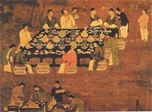
Picture: Scholars at a banquet, from An Elegant Party, attributed to Emperor Huizong, early 12th century · Emperor Huizong of Song · Public domain · Wikimedia Commons
Free commoners · About 49% (the rest, est.)
Zhuhu (Landowning farmers)
nong (farmers)
Most people in Song China were farmers, and in the warm south many grew two crops of rice a year.
Most Song people were farm families who owned some land, and in 1034 four households in five were rural. The state registered landowning families as “main households” (zhuhu), graded in five classes by their property, and they paid the land tax, collected in summer and autumn and amounting to roughly a tenth of income, though surcharges raised it. Labour service also fell on them until Wang Anshi’s New Policies (1069–1076) let them pay cash for hired labourers instead, and his Green Sprouts loans offered cheaper credit than private lenders, though officials sometimes forced the loans on farmers. Farming changed fast: early-ripening Champa rice allowed two crops a year in the south, dams and chain pumps opened new fields, and families made wine, charcoal, paper and silk to sell at local markets. Small farmers were vulnerable. In the 11th century perhaps half of rural households were small owners holding only a fifth of the land, and a bad harvest or a debt could turn them into tenants.
Moving in or out. Study could carry a farmer’s son through the examinations into office. Debt, taxes and bad harvests pushed others into tenancy, and some indebted farmers fled their land to join the army.
How many? Everyone not counted in the other tiers: chiefly the landowning farm families. Several of the other ranks are estimates, so this share is one too.
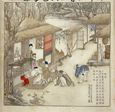
Picture: A farming household, from Pictures of Tilling and Weaving (Gengzhi tu), a Song series of the 1140s re-created for the Kangxi emperor in 1696 · Zhu Gui / Jiao Bingzhen · Public domain · Wikimedia Commons

Free commoners · 30–35%
Kehu (Tenant farmers)
dianhu (tenants)
Many Song farmers rented their fields and paid part of their harvest to the landowner.
Tenants farmed land owned by others. The state registered landless families as “guest households” (kehu), and in the late 11th century they made up roughly a third of all households, more in some regions and fewer in others. Rents were heavy, often about half of the harvest, and tenants borrowed seed and food from their landlords at high interest. Conditions varied greatly. In the rice lands of the south-east, where most farms were small family holdings, landlords set fixed rents by contract, and a tenant could generally leave when his contract ended. In frontier regions such as Sichuan and Hunan, owners of great estates kept tenants bound to the land and to themselves, and historians have long debated whether such tenants should be called serfs. From the late 11th century the law treated tenants as inferiors of their landlords, punishing a tenant who struck his landlord more heavily than one commoner who struck another. Tenants owned no land and so paid no land tax, but most lived close to subsistence.
Moving in or out. A tenant who saved enough to buy a plot could be registered among the main households, while many small owners sank the other way into tenancy.
How many? The Song household registers of the late 11th century counted roughly a third of all households as landless “guest households” (kehu), most of them tenants.
Picture: Work at the flooded rice fields, from Pictures of Tilling and Weaving, a Song series of the 1140s redrawn for the Kangxi emperor in 1696 (Chester Beatty) · Zhu Gui / Jiao Bingzhen · Public domain · Wikimedia Commons

Free commoners · c. 4–8% (est.)
Gong (Artisans)
Song craftspeople made fine porcelain, silk cloth and printed books.
Artisans ranked third in the Confucian scheme, below farmers but above merchants: scholar-officials saw them as essential producers rather than parasites. They made the porcelain, silks, iron tools, waterwheels and chain pumps, ships and printed books of the Song economy. Many worked in their own shops, organised by trade in guilds through which the state requisitioned goods and assessed taxes; others worked in state workshops and mines, or in private works such as the iron foundries of Hancheng, where some 700 smelting households hired local labourers. Skills passed from father to son by word of mouth, though the official Li Jie’s building manual, sponsored by Emperor Huizong, was printed for literate craftsmen across the empire. Around 1040 the artisan Bi Sheng invented printing with movable clay type, as the scholar Shen Kuo recorded in his Dream Pool Essays. Skill could bring prosperity, but artisans could not sit for the jinshi examination.
Moving in or out. A skilled craftsman could prosper and pass his trade to his sons, but artisans themselves were barred from the jinshi examination, so high office was closed to them.
How many? Estimate: the historian Xie Qia estimates that over 100,000 households worked in textile production alone, and about 12 per cent of the people lived in towns.

Soldiers, merchants and craftsmen · c. 3–6% (est.)
Shang (Merchants)
Song merchants sent great ships to faraway lands and used some of the world’s first paper money.
Merchants came last of the four occupations, scorned by scholar-officials as parasites, yet trade grew as never before. The cities teemed with wholesalers, brokers, shippers, warehouse keepers, shopkeepers and peddlers, and in Kaifeng, after the curfew was lifted in 1063, the markets traded at all hours. Merchants formed guilds that set prices, pooled capital in partnerships, and invested in ships that sailed from Quanzhou and Guangzhou to South-east Asia, India and East Africa; a large ship could carry several hundred men. Paper money, which began as merchants’ deposit receipts in Sichuan and was issued by the government from 1024, eased their trade. The state taxed commerce at about 2 per cent but kept salt, tea and wine under monopoly, and salt merchants had to deliver grain to the state before they could sell salt. Their wealth often rivalled that of officials, who did business through agents and married into rich merchant families, but merchants could not sit for the jinshi examination.
Moving in or out. Barred from the jinshi examination themselves, merchants turned their wealth into land and into marriages with official families: in 1137 a military official was denounced for marrying his sister to the great merchant Pu Yali.
How many? Estimate: the merchant households, from great shippers to street peddlers, in an economy of busy markets and paper money.
Picture: The Zhao Taicheng herbal shop, detail of Along the River During the Qingming Festival, by Zhang Zeduan, early 12th century · Zhang Zeduan · Public domain · Wikimedia Commons
Soldiers, merchants and craftsmen · 0.9–1.1%
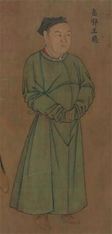
Bing (Soldiers)
jinjun (imperial army), xiangjun (prefectural army)
Song soldiers were paid professionals, but people did not respect them very much.
The Song kept a huge standing army, about a million men at its height, and in the 1060s defence consumed some 83 per cent of the state’s cash income. Soldiers were professionals, recruited for pay from poor peasants, debtors fleeing their creditors, amnestied bandits and vagrants, and many were tattooed, often on the face, as convicts also were. They stood outside the four occupations and were held in low esteem: a proverb said that “good iron isn’t used for nails; good men aren’t used as soldiers”. Mindful of the 10th-century generals who had made and unmade dynasties, the Song placed the army under civil officials: civilians headed the Bureau of Military Affairs and commanded on the front line, commanders were moved after each campaign, and successful generals were distrusted, as Yue Fei, executed in 1142, discovered. Ordinary soldiers drew small pay and were often set to menial labour, while in the early 12th century corrupt generals kept for themselves the funds drawn for the troops on their rolls.
Moving in or out. For a man without education the army was the quickest road up. Di Qing, born to a poor family and tattooed on the face, rose to the Bureau of Military Affairs, and Yue Fei rose from the ranks to command the armies that fought the Jin.
How many? About a million soldiers at the army’s height, and fewer than 900,000 after Emperor Shenzong’s cuts, in a population of some 90–100 million: roughly 1 per cent, counting the men alone.


Enslaved · c. 1–3% (est.)
Nubi (Bondservants and slaves)
jianmin ("mean people")
Enslaved people and bound servants had to work for rich families, but there were fewer slaves than in earlier times.
At the bottom stood the “mean people” (jianmin), whom the law, largely inherited from the Tang code, ranked below all commoners. Slaves had been numerous in earlier centuries, but slavery declined under the Song: with the economy booming and land scarce, slaves ran away to find better work, and the law forbade enslaving free people, though criminals could still be enslaved. Most servile work was now done by bondservants and maids, bought or hired, often for a term of years, who cooked, cleaned and served in the households of officials, merchants and landowners; brokers in the cities offered young women as maids, concubines and singing girls. The law protected masters far more than servants: under the Tang code a servant who killed his master could be put to death, while a master who killed a servant faced a year of hard labour. The wars with the Liao, the Western Xia and the Jin brought captives into bondage on both sides, though the Song eased their way to freedom.
Moving in or out. A bondservant hired for a term went free when it ended, and a maid might become her master’s concubine; many slaves ran away to work for wages.
How many? Estimate: slavery declined under the Song, and servants who were bought or hired worked mostly in rich households.
Picture: A maidservant serves her master and mistress, wall painting in a Song tomb at Tengfeng, Henan · Unknown author · Public domain · Wikimedia Commons

Born into history
Where would you have stood? Chance places you on the ladder, as birth placed most people: weighted by how many each rank held.
Moving up and down
Song society was more open at the top than earlier Chinese societies. The examinations carried many men from outside the old elite into office: in the lists of 1148 and 1256 about 57 per cent of the graduates had no father, grandfather or great-grandfather in office, though most had kinsmen in the bureaucracy, and historians such as Robert Hartwell and Robert Hymes stress how much family, marriage and wealth still counted. Ouyang Xiu, whose father died when he was three and whose mother taught him herself, passed the jinshi in 1030 at his third attempt and rose to assistant councillor; Fan Zhongyan, who lost his father as a baby, studied in austerity, passed in 1015 and led the Qingli reforms of the 1040s. The army offered another road: Di Qing, a soldier from a poor family with tattoos on his face, reached the Bureau of Military Affairs. Movement ran downwards too: property was divided equally among sons, so families that produced no official for a few generations declined, and debt turned small owners into tenants.
Women on the ladder
A woman’s life depended on her family’s rank. Confucian ethics placed women below men, and wealthy wives spent their days indoors managing the household, yet Song women had considerable rights at law. Larger dowries strengthened their claims to property: in some circumstances an unmarried daughter with no brothers could inherit half of her father’s share of the family property, and a widow with no son could choose the family’s heir. Divorce by mutual consent was allowed and widows often remarried, though the philosopher Cheng Yi taught that it was better for a widow to die than to lose her virtue by remarrying. Women of the lower and middle classes ran inns and restaurants, wove and sold mats and worked as midwives and nurses; others were sold as maids and concubines. Educated mothers taught their sons, and Li Qingzhao became one of China’s greatest poets. Foot binding became a new fashion among elite women in the Southern Song.
Compare with another society
Test yourself
4 questions on the ladder of Song China.
The questions open here once the page has loaded.
Sources and further reading
- Chaffee, J. W. (1985) The Thorny Gates of Learning in Sung China: A Social History of Examinations. Cambridge: Cambridge University Press.
- Chaffee, J. W. (1999) Branches of Heaven: A History of the Imperial Clan of Sung China. Cambridge, MA: Harvard University Asia Center.
- Ebrey, P. B. (1993) The Inner Quarters: Marriage and the Lives of Chinese Women in the Sung Period. Berkeley: University of California Press.
- Hymes, R. P. (1986) Statesmen and Gentlemen: The Elite of Fu-chou, Chiang-hsi, in Northern and Southern Sung. Cambridge: Cambridge University Press.
- Kuhn, D. (2009) The Age of Confucian Rule: The Song Transformation of China. Cambridge, MA: Belknap Press of Harvard University Press.
- Twitchett, D. and Smith, P. J. (eds) (2009) The Cambridge History of China, Volume 5, Part One: The Sung Dynasty and Its Precursors, 907–1279. Cambridge: Cambridge University Press.
The shares are of the whole population, children included. Where a scholar has counted or estimated a rank, its share follows that work, named on the rank; where no count survives, the share is an estimate, marked est. and drawn dashed, made from what the rank was and did, from related figures and from the same rank in comparable societies, and its note says what it rests on. Population: about 1100, when the Northern Song census recorded some 20 million households; modern estimates put the population at about 90 million, others at more than 100 million.
Cite this page
- APA
- The Epoch Institute. (2026). Social Hierarchy of Song China. In Social Ladders. https://the-epoch-institute.org/societies/song-china
- MLA
- “Social Hierarchy of Song China.” Social Ladders, The Epoch Institute, 2026, https://the-epoch-institute.org/societies/song-china. Accessed .
- Chicago
- The Epoch Institute. “Social Hierarchy of Song China.” Social Ladders. 2026. https://the-epoch-institute.org/societies/song-china.
- Harvard
- The Epoch Institute (2026) ‘Social Hierarchy of Song China’, Social Ladders. Available at: https://the-epoch-institute.org/societies/song-china (Accessed: ).