Social ladder · 1509–1665 (from Afonso I to the Battle of Mbwila)
Social Hierarchy of the Kingdom of Kongo
From King to Enslaved
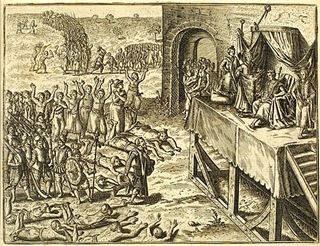
Kongo ranked its people by royal descent, by office and by freedom. Its king was elected for life from among the royal kin and ruled from Mbanza Kongo, renamed São Salvador under Álvaro I. A nobility gathered in the capital governed the provinces and held lesser posts at the king’s pleasure: land was never sold, and a noble lived on the share of the head tax that his office brought. After Afonso I, king from 1509, made Catholicism the royal faith, nobles learned to read in royal schools and took Portuguese names and, later, titles such as duke and count. Most people were free villagers who paid the head tax. War captives were enslaved and settled around the capital, and the Atlantic slave trade grew through the period. The evidence comes largely from Afonso’s own letters, missionaries’ reports and the reconstructions of the historian John Thornton.
Period 1509–1665 (from Afonso I to the Battle of Mbwila)People 500,000–780,000Ranks 6Profile Kongo Empire
The ladder
By rank, the ladder is drawn as a pyramid. To scale, each bar is as wide as that rank’s share of the people. Shares marked est. are estimates where no count survives; their boxes and bars are dashed.

Ruler · One ruler
Mwene Kongo (The king)
manikongo
The king of Kongo ruled from the city of Mbanza Kongo and was chosen from the royal family.
The king of Kongo, the mwene Kongo or manikongo, was chosen for life by a small group of electors and senior officials from among the royal kin. No fixed rule settled the succession, and rival branches of the royal family often fought for the throne. He ruled from Mbanza Kongo, renamed São Salvador under Álvaro I, where war captives settled around the capital fed the court. He appointed the provincial governors and many lesser officials, received a share of every province’s taxes, kept the nzimbu shells that served as money as a royal monopoly and commanded the army. João I was baptised in 1491 but turned away from the new faith; from Afonso I’s victory over his brother in 1509 the kings were Catholics. They paid the church from royal revenues, wrote to the kings of Portugal and to the popes as fellow Christian rulers, and resisted Portuguese claims to choose Kongo’s kings.
Moving in or out. Election, not birth order, made a king, so any man of the royal kin with enough support could hope to reign: Álvaro I, not directly descended from a previous king, took the throne in 1568 and founded a new line. Kings could also fall in battle, as António I did at Mbwila in 1665.
How many? One man, with the royal household.

Nobility and officials · c. 0.5–1.5% (est.)
Mwissikongo (Royal kin and great nobles)
duque, marquês, conde
Kongo’s great nobles governed its provinces, and some took Portuguese titles such as duke or count.
The great nobles were the core of the mwissikongo, the ruling nobility of the capital: the royal kin, the electors and the governors of the great provinces, which had once been separate kingdoms. By the 16th century the king gave the governorships to members of the royal family or other noble houses for terms he set, though Mbata stayed with the Nsaku Lau lineage, and in the 17th century Soyo was often held by one lord for very long terms. A governor named his own clients to lower posts, collected the head tax and sent part of it to the king: Dutch visitors of the 1640s put the royal share at twenty million nzimbu shells. Under Álvaro I and Álvaro II the lords of Nsundi and Mbamba became dukes, the lord of Mpemba a marquis and the lord of Soyo, the coastal province, a count. Strong governors made kings: António da Silva, Duke of Mbamba, chose Bernardo II in 1614 and set him aside for Álvaro III in 1615.
Moving in or out. Noble birth was needed, but office came from the king, who could in principle dismiss a governor; a province whose lord misbehaved could be raided by royal forces and some of its people enslaved.
How many? Estimate: the great houses of the royal kin, with their households and dependants.
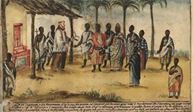
Picture: A Capuchin missionary received by a Kongo lord, watercolour from Bernardino d'Asti's manual, c. 1740 · Unknown author · Public domain · Wikimedia Commons
Nobility and officials · c. 2–4% (est.)
Mwene (Lesser nobles and officials)
fidalgos
Young nobles in Kongo went to royal schools and learned to read and write.
A wider nobility of lesser lords and office-holders lived in the capital and the provincial towns. Groups of villages formed small lordships, each under a lord, a mwene (the Portuguese wrote mani), who lived in a mbanza, a small town, and whom the higher nobility usually chose. The king appointed other officials, typically for three years. Land in Kongo was never sold, and these nobles lived not on estates of their own but on revenue assignments drawn from the head tax, reporting every year to their superior’s court to have them renewed. Afonso I’s schools made this class literate: by 1516 the royal school had more than 1,000 pupils, and schools were not built for ordinary people. Nobles took Portuguese names, coats of arms and dress. In war they formed the heavy infantry, armed with swords and shields, whom Portuguese writers called fidalgos; some 5,000 of them fought at Mbwila in 1665.
Moving in or out. Noble birth opened the way, but posts were held at a superior’s pleasure and renewed year by year, so a lord’s standing rose and fell with his patrons and his faction.
How many? Estimate: some 5,000 heavy infantry, counted as nobles, fought at Mbwila in 1665; with their families perhaps 15,000–25,000 people among 500,000–780,000.
Religious and learned · c. 0.1–0.3% (est.)
Mestres (Clergy and lay teachers)
alongi a aleke
Kongo had few priests, so Kongolese teachers, often nobles, taught people the Christian faith.
From 1491, and above all under Afonso I, Kongo built a Catholic church of its own, paid for from royal revenues and from baptism and burial fees. Ordained priests were always too few, and most were foreigners: Portuguese priests, Jesuits from the late 1540s and Italian Capuchins from 1645. Afonso I’s son Henrique, educated in Portugal, was made a bishop in 1518 and served in Kongo from the early 1520s until his death in 1531, and in 1596 São Salvador became the seat of a diocese whose bishops the king of Portugal named. The church rested on lay schoolmasters, the mestres, recruited from the nobility, trained in the royal schools and paid and appointed by the crown, who taught the faith and led worship. They put it into Kikongo words, calling the Bible the nkanda ukisi, the holy book, and a church the nzo a ukisi, the holy house. When bishops favoured Portuguese interests, kings withheld their income.
Moving in or out. The lay teachers came from noble families and were trained in the royal schools; a few Kongolese, such as Henrique, were ordained, but the priesthood stayed largely foreign.
How many? Estimate: ordained priests were always few; the lay teachers who taught and baptised in the villages numbered in the hundreds.
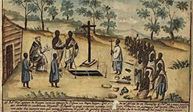
Picture: A Christian wedding in the kingdom of Kongo, watercolour from Bernardino d'Asti's manual, c. 1750 · Bernardino D'Asti · Public domain · Wikimedia Commons
Free commoners · About 81% (the rest, est.)
Free villagers
Most people in Kongo were farmers who lived in small villages and paid taxes to their lords.
Most people of Kongo were free villagers. They lived in villages (libata) of one to two hundred people under a headman, the nkuluntu, and moved them every ten years or so as the soil wore out; land was held in common and never sold. The countryside was thinly peopled, perhaps no more than five people to the square kilometre, while the kings drew people and wealth into the capital. Each villager owed a head tax, paid in nzimbu shells or perhaps in goods, which supported the lords above; taxes were collected and the troops reviewed on Saint James’s Day, 25 July. In war the men served as archers in a mass levy: some 15,000 peasant archers fought at Mbwila. Kongo law forbade the enslavement of the freeborn, but Afonso I complained in 1526 that nobles were kidnapping free subjects for the Portuguese trade, and by the mid-17th century villagers convicted of crimes could be enslaved and sold with their families.
Moving in or out. Rank came by birth and office, and the schools that made nobles literate were not built for commoners. War, kidnapping or a court’s sentence could make a free villager a slave.
How many? Everyone not counted in the other tiers: the great majority, most of them villagers. The other ranks are estimates, so this share is one too.
Picture: A Christian funeral in the kingdom of Kongo, watercolour from Bernardino d'Asti's manual for missionaries, c. 1750 · Bernardino D'Asti · Public domain · Wikimedia Commons


Enslaved · c. 10–20% (est.)
Enslaved people
Enslaved people were owned by others and made to work without pay; many were captured in wars.
Slavery in Kongo was older than the Atlantic trade. Kongo’s wars of expansion produced captives, many of them from Ndongo to the south, and kings settled them in large numbers around Mbanza Kongo, where they farmed and laboured for the court and the nobility and were integrated into the population of the capital. They could be bought and sold in Kongo’s markets, but the law set limits: freeborn Kongolese could not be enslaved or sold, and neither convicts condemned to slavery nor enslaved women could be exported. The Atlantic trade was different: people sold to the Portuguese were carried overseas, first to the sugar plantations of São Tomé, for which Kongo became a major source, and later to Brazil and the rest of the Americas. A Portuguese map of 1502 still called the slaves from Kongo few, but in 1526 Afonso I protested that traders were seizing free people, and he set up a committee to check that everyone sold had been lawfully enslaved.
Moving in or out. People entered slavery as war captives, by kidnapping or by a court’s sentence, which by the mid-17th century could fall on a convict’s whole family. Runaways from Portuguese Angola found refuge with the lords of southern Kongo, but the sources say little about how slaves inside Kongo won their freedom.
How many? Estimate: war captives were settled in large numbers around the capital, whose region held about 100,000 people by the 1620s, and nobles kept enslaved dependants on their estates.
Picture: A person of rank in Kongo carried by his slaves, engraving after William Marshall Craig, 19th century · Henry Wallis, after William Marshall Craig · Public domain · Wikimedia Commons
Born into history
Where would you have stood? Chance places you on the ladder, as birth placed most people: weighted by how many each rank held.
Moving up and down
Rank in Kongo rested on birth and, above all, on office, which the king and the great lords gave and took away. Noble houses rose and fell with their factions: the House of Kwilu came to the throne with Álvaro I in 1568, the House of Nsundi with Pedro II in 1622, and the Kinlaza with Álvaro VI in 1636. Schooling and the church opened careers to young nobles, and some saw Europe: Afonso I sent his children and nobles there to study, and Antonio Manuel set out for Rome as Kongo’s ambassador in 1604. Commoners had little chance to rise, and the slave trade made falls steeper. Afonso protested in 1526 that free people were being kidnapped; after the Jaga invasion of 1568 an economic crisis drove some to sell members of their own families; and by the mid-17th century courts condemned convicts and their families to slavery and sale. After Mbwila in 1665, nobles and members of the royal family were among the captives shipped to Brazil.
Women on the ladder
A woman’s standing followed her family’s rank. At the top, royal women held real power: on Anne Hilton’s reading of the sources, four women sat on the royal council, led by a queen mother, usually the king’s paternal aunt, followed by the king’s principal wife, who came from the Nsaku Lau lineage that ruled Mbata. Afonso I owed his throne in part to his mother, who kept King João I’s death secret until her son had reached the capital. Marriage bound noble houses together, and the church’s demand for monogamy met stiff resistance, because taking several wives was woven into Kongo’s alliances. Thousands of women followed the armies, carrying food and baggage. Kongo’s law forbade the export of enslaved women. In the civil wars after 1665 noblewomen came to the fore: Ana Afonso de Leão founded a centre of her own and worked to reconcile the warring factions.
Compare with another society
Test yourself
3 questions on the ladder of the Kingdom of Kongo.
The questions open here once the page has loaded.
Sources and further reading
- Fromont, C. (2014) The Art of Conversion: Christian Visual Culture in the Kingdom of Kongo. Chapel Hill: University of North Carolina Press.
- Heywood, L. M. (2009) "Slavery and Its Transformation in the Kingdom of Kongo: 1491–1800". Journal of African History 50 (1): 1–22.
- Heywood, L. M. and Thornton, J. K. (2007) Central Africans, Atlantic Creoles, and the Foundation of the Americas, 1585–1660. Cambridge: Cambridge University Press.
- Hilton, A. (1985) The Kingdom of Kongo. Oxford: Clarendon Press.
- Thornton, J. K. (1983) The Kingdom of Kongo: Civil War and Transition, 1641–1718. Madison: University of Wisconsin Press.
- Thornton, J. K. (2020) A History of West Central Africa to 1850. Cambridge: Cambridge University Press.
The shares are of the whole population, children included. Where a scholar has counted or estimated a rank, its share follows that work, named on the rank; where no count survives, the share is an estimate, marked est. and drawn dashed, made from what the rank was and did, from related figures and from the same rank in comparable societies, and its note says what it rests on. Population: John Thornton's estimates from church baptism figures: over half a million at the end of the 16th century, some 780,000 in the early 17th.
Cite this page
- APA
- The Epoch Institute. (2026). Social Hierarchy of the Kingdom of Kongo. In Social Ladders. https://the-epoch-institute.org/societies/kongo
- MLA
- “Social Hierarchy of the Kingdom of Kongo.” Social Ladders, The Epoch Institute, 2026, https://the-epoch-institute.org/societies/kongo. Accessed .
- Chicago
- The Epoch Institute. “Social Hierarchy of the Kingdom of Kongo.” Social Ladders. 2026. https://the-epoch-institute.org/societies/kongo.
- Harvard
- The Epoch Institute (2026) ‘Social Hierarchy of the Kingdom of Kongo’, Social Ladders. Available at: https://the-epoch-institute.org/societies/kongo (Accessed: ).