Social ladder · c. 600–371 BCE (to the defeat at Leuctra)
Social Hierarchy of Ancient Sparta
From Kings to Helots
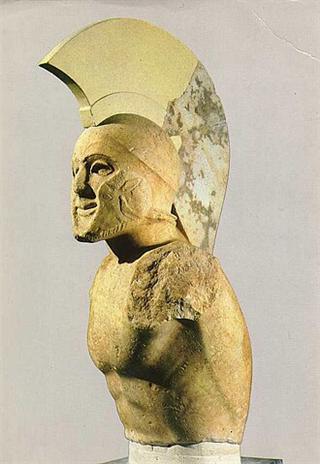
Classical Sparta was ruled by a small body of full citizens who lived from the labour of a far larger subject population. Rank rested on birth and law. A man of Spartiate birth who passed through the state upbringing (the agoge) and paid his dues to a common mess became one of the homoioi, the “equals”; poverty or cowardice could cost him that place. Two kings stood at the head of the state. Around the citizens lived the free perioikoi in their own towns and several in-between groups: inferiors who had lost citizenship, foster brothers raised beside Spartiate boys, and freed helots. At the bottom the helots, bound to the land of Laconia and Messenia, outnumbered the citizens many times over. The ladder was steep and almost closed: the citizen body shrank from about 8,000 men in 480 BCE to fewer than a thousand by Aristotle’s day.
Period c. 600–371 BCE (to the defeat at Leuctra)People c. 250,000–350,000 (est.)Ranks 7Profile Sparta
The ladder
By rank, the ladder is drawn as a pyramid. To scale, each bar is as wide as that rank’s share of the people. Shares marked est. are estimates where no count survives; their boxes and bars are dashed.

Ruler · A handful
Basileis (The two kings)
archagetai
Sparta had two kings at the same time, who led the army and offered sacrifices to the gods.
Sparta had two kings at once, one from each of two hereditary houses, the Agiads and the Eurypontids, both claiming descent from Heracles. The kings commanded the army in war, a kingship Aristotle called “a kind of unlimited and perpetual generalship”, and were the state’s chief priests, offering its sacrifices and keeping its links with the oracle at Delphi. Both sat in the council of elders, the Gerousia. At home their power was limited. By Herodotus’ time their judicial role covered only heiresses, adoptions and the public roads, and the five ephors, elected every year, watched over them; two ephors went with a king on campaign. A king could be put on trial before the elders, the ephors and the other king, as King Pausanias was in 403 BCE. Kings were honoured as heroes after death, and the heirs to the two thrones were the only Spartan boys exempt from the agoge.
Moving in or out. The throne passed by birth within the two royal houses, but a king could be deposed: in 491 BCE Demaratus lost his throne after his fellow king Cleomenes I bribed the oracle at Delphi to declare him illegitimate, and he fled to Persia.
How many? Two kings at a time, one from each royal house, with their families.

Nobility and officials · 3–10%
Spartiatai (Spartiates)
homoioi
Spartiates were the citizens of Sparta, men who trained from boyhood to be soldiers.
The Spartiates, or homoioi (“equals”), were the full citizens. A Spartiate was born to Spartiate parents, passed through the agoge, the state upbringing that took boys from the age of seven, and was elected to a common mess (syssition) of about fifteen men, to which he owed a fixed contribution of food. Each held an allotment of land (kleros) worked by helots. The law barred Spartiates from trade and crafts so that they could be full-time hoplites, liable to serve until sixty, and a man could not live with his family until he was thirty. Together they formed the assembly, which elected the five ephors each year and, by shouting, the 28 elders of the Gerousia, men over sixty who served for life. Their equality was an ideal: wealth was unequal from early on. Their numbers fell steeply: Herodotus reckons about 8,000 men in 480 BCE; at Leuctra in 371 BCE about 400 of the 700 Spartiates present were killed; and Aristotle put them at fewer than a thousand.
Moving in or out. Birth, the agoge and election to a mess made a Spartiate. A man who could no longer pay his mess contributions, or who was judged a coward in battle, lost his full rights and fell among the inferiors.
How many? Paul Cartledge puts those of Spartiate status at between a tenth and a thirty-second of the population, a share that fell as the citizen body shrank from about 8,000 men in 480 BCE (Herodotus) to fewer than 1,000 in Aristotle’s day.
Picture: A warrior in a crested helmet, Laconian bronze from Sparta, 6th century BCE (British Museum) · Mary Harrsch · CC BY-SA 4.0 · Wikimedia Commons

Free commoners · c. 1–3% (est.)
Hypomeiones (Inferiors)
Spartans who became too poor to pay for their shared meals lost their place as full citizens.
The inferiors (hypomeiones) were men of Spartiate descent who had lost, or never gained, full citizenship. Most had grown too poor: a citizen who could no longer pay his share to his mess lost his place among the equals, and a young man who was not elected to a mess never gained it. Cowardice in battle could also cost a man his rights. Inferiors remained free, but they had no vote in the assembly and could hold no office. The name is known from Xenophon’s account of the conspiracy of 399 BCE led by Cinadon, a young man “not one of the equals”. According to the informer who betrayed him, Cinadon had pointed out that only about forty of some 4,000 people in the agora were Spartiates, and counted on the hatred of helots, freed helots, inferiors and perioikoi. He was arrested and the plot crushed; asked why he had plotted, he said he wished to be inferior to no one in Lacedaemon.
Moving in or out. Men fell into this rank through poverty, failure to win a place in a mess or cowardice in battle; with no regular way back, their number grew as land passed into fewer hands.
How many? Estimate: Spartiates who had lost their full rights, chiefly for failing to pay their mess dues; they appear in Xenophon’s account of the conspiracy of Cinadon in 399 BCE.
Picture: A reclining banqueter, Laconian bronze, 530–500 BCE: Spartiates who could not pay their share of the common meals lost their full rights · Mary Harrsch · CC BY-SA 4.0 · Wikimedia Commons

Free commoners · c. 0.1–0.5% (est.)
Mothakes (Foster brothers)
Some boys who were not citizens were raised and trained with Spartan boys, and a few became famous commanders.
The mothakes, “foster brothers”, were boys of free birth but not of full Spartiate standing who were brought up in the agoge beside Spartiate boys, their costs usually paid by wealthy families. They are thought to have been sons of Spartiate fathers and helot mothers or sons of impoverished Spartiates, though the evidence is thin and debated. Unable to pay their own way into a common mess, they were not among the equals, but they fought in the army alongside the perioikoi, and according to Aelian some became full citizens. A few rose to the highest commands. Ancient writers name as mothakes Lysander, who destroyed the Athenian fleet at the Battle of Aegospotami in 405 BCE and blockaded Athens into surrender, Gylippus, who organised the defence of Syracuse and destroyed the Athenian expedition in 413 BCE, and Callicratidas. The term appears above all for the time of the Peloponnesian War (431–404 BCE).
Moving in or out. A wealthy family’s sponsorship brought a boy into the agoge beside its own sons; some mothakes later became citizens, while others remained soldiers without a vote.
How many? Estimate: a few hundred boys raised beside Spartiate sons; ancient writers name only a few of them.

Free commoners · c. 15–25% (est.)
Perioikoi (Dwellers around)
The perioikoi were free people who lived in their own towns and made the weapons for Sparta’s army.
The perioikoi, “those who dwell around”, were free Lacedaemonians who lived in their own towns, at least 33 of them in Laconia and Messenia. Their towns ran their own local affairs but had to follow Sparta’s foreign policy and send men to its army, and the perioikoi had no voice in the Spartan state. Because the law barred Spartiates from trade and crafts, the perioikoi were Sparta’s craftsmen and traders: they made the army’s weapons and armour, probably also the masks and figurines dedicated at the sanctuary of Artemis Orthia, and unlike the Spartiates they could travel abroad freely. They owned land, and like the Spartiates they held helots. They fought as hoplites, 5,000 of them at Plataea according to Herodotus, and as the Spartiates dwindled they filled a growing share of the phalanx. Their loyalty mostly held: of their towns only Thouria and Aithaia are known to have joined the great helot revolt of 464 BCE.
Moving in or out. Perioikoi were born to their status. Freed helots could be raised to a standing like theirs, but the agoge, and with it Spartan citizenship, was closed to their sons except by rare special permission.
How many? Estimate: they lived in at least 33 towns (Graham Shipley’s count) and, according to Herodotus, sent 5,000 hoplites to Plataea in 479 BCE, as many as the Spartiates.
Picture: A Laconian black-figure cup, 6th century BCE: Laconia's potters and bronze-workers lived in the towns of the perioikoi · ArchaiOptix · CC BY-SA 4.0 · Wikimedia Commons

Free commoners · c. 0.5–1.5% (est.)
Neodamodeis (Freed helots)
Some helots were set free after serving as soldiers in Sparta’s army.
From the late 5th century Sparta freed helots in return for service as hoplites. The 700 helots who marched with Brasidas to the Chalcidice in 424 BCE were later freed and known as the Brasidians, and freed helots in general were called neodamodeis, a name taken to mean something like “new members of the people”. They are attested from about 420 BCE and served in Sparta’s army, often far from home: 2,000 of them went with Agesilaus II to Asia Minor in 396 BCE. They never became citizens; their standing seems to have been close to that of the perioikoi. Freedom was also promised for single services: in 425 BCE helots who smuggled food to the Spartiates trapped on the island of Sphacteria were offered their liberty. The historian Moses Finley saw in the arming of helots a grave flaw in the Spartan system, since a hoplite’s place in the battle line was a mark of the citizen.
Moving in or out. Freedom came only by decision of the state, chiefly as the reward for service as a hoplite; it made a helot free, but never a citizen.
How many? Estimate: attested from about 420 to 369 BCE; 2,000 of them served with Agesilaus II in Asia Minor in 396–394 BCE.
Picture: A hoplite on the Vix krater, bronze of Laconian style, c. 510 BCE · Michael Greenhalgh · CC BY-SA 2.5 · Wikimedia Commons


Serfs and dependants · About 70% (the rest, est.)
Heilotes (Helots)
Helots were people conquered by Sparta and forced to farm the land for Spartan citizens.
The helots were the subject people of Laconia and Messenia, descended from Greeks conquered by Sparta, above all the Messenians. They were bound to the land and belonged to the Spartan state rather than to individual citizens. They worked the Spartiates’ allotments and handed over part of the harvest, a fixed amount according to Plutarch and half in the words of the poet Tyrtaeus, keeping the rest; they lived in families, kept some property and practised their own cults, and some served as household servants, nurses or attendants on campaign. At Plataea in 479 BCE there were, says Herodotus, seven helots for every Spartiate. Spartan rule rested on fear. Each year the ephors declared war on the helots, so that killing one brought no religious pollution, and in the Krypteia, according to Plutarch, young Spartiates were sent into the countryside to kill helots. Thucydides tells how about 2,000 helots promised their freedom were made to disappear. The helots answered with revolt, above all the great rising of 464 BCE.
Moving in or out. Helots were born into their condition. Freedom came only from the state, chiefly as a reward for service as soldiers, until the Theban invasion that followed Leuctra freed the helots of Messenia in 370–369 BCE.
How many? Everyone not counted in the other tiers: above all the helots, the great majority, whom Paul Cartledge puts at 170,000–224,000 people, women and children included, in the early 4th century BCE. Several of the other ranks are estimates, so this share is one too.
Picture: Labourers weigh and store goods for a king, on the Arkesilas cup, a Laconian vase of c. 565 BCE · Marie-Lan Nguyen · CC BY 2.5 · Wikimedia Commons

Born into history
Where would you have stood? Chance places you on the ladder, as birth placed most people: weighted by how many each rank held.
Moving up and down
Sparta’s ladder was nearly closed at the top. Citizenship came only through Spartiate birth, the agoge and a place in a mess, and the law made no regular provision for admitting outsiders; the few foreigners trained in the agoge, such as the two sons of the Athenian Xenophon, came by special favour. Movement was mostly downward. Spartiates who could not pay their mess dues or who showed cowardice lost their full rights, and as land passed into fewer hands the citizen body shrank. A narrow path led up from below: mothakes raised in the agoge could become citizens, and one of them, Lysander, won the Peloponnesian War for Sparta, while helots could be freed for service as soldiers, though never made citizens. The Spartiates feared pressure from below and met it with force, as when the ephors crushed the conspiracy of Cinadon in 399 BCE. After Leuctra the shrunken citizen body could no longer hold Messenia, and Sparta never recovered its former power.
Women on the ladder
Spartiate women had a freedom that startled other Greeks. Girls were fed as well as boys, exercised and ran races in public and were taught music, dance and poetry; they married at eighteen to twenty, to men near their own age, not at fourteen like many Athenian girls. With husbands living in barracks until thirty and often at war, wives ran the household and estate, while helot and slave women did the weaving and housework. Women could own and inherit land, and an heiress, unlike at Athens, did not have to divorce her husband to marry a kinsman. Aristotle complained that women owned nearly two-fifths of the land and blamed Sparta’s decline partly on their wealth. Gorgo, daughter of Cleomenes I and wife of Leonidas I, was remembered for her advice, and Cynisca, sister of Agesilaus II, became the first woman to win an Olympic chariot race, in 396 BCE. Of perioikic and helot women the sources say almost nothing.
Compare with another society
Test yourself
3 questions on the ladder of Ancient Sparta.
The questions open here once the page has loaded.
Sources and further reading
- Cartledge, P. (1987) Agesilaos and the Crisis of Sparta. London: Duckworth.
- Cartledge, P. (2002) Sparta and Lakonia: A Regional History 1300–362 BC. 2nd edn. London: Routledge.
- Ducat, J. (2006) Spartan Education: Youth and Society in the Classical Period. Swansea: Classical Press of Wales.
- Hodkinson, S. (2000) Property and Wealth in Classical Sparta. London: Duckworth and the Classical Press of Wales.
- Pomeroy, S. B. (2002) Spartan Women. Oxford: Oxford University Press.
- Herodotus (1998) The Histories. Translated by R. Waterfield. Oxford: Oxford University Press.
The shares are of the whole population, children included. Where a scholar has counted or estimated a rank, its share follows that work, named on the rank; where no count survives, the share is an estimate, marked est. and drawn dashed, made from what the rank was and did, from related figures and from the same rank in comparable societies, and its note says what it rests on. Population: Estimate: Paul Cartledge puts the helots at 170,000–224,000 people in the early 4th century BCE; with the perioikoi of at least 33 towns and the Spartiates, about 250,000–350,000 in all.
Cite this page
- APA
- The Epoch Institute. (2026). Social Hierarchy of Ancient Sparta. In Social Ladders. https://the-epoch-institute.org/societies/sparta
- MLA
- “Social Hierarchy of Ancient Sparta.” Social Ladders, The Epoch Institute, 2026, https://the-epoch-institute.org/societies/sparta. Accessed .
- Chicago
- The Epoch Institute. “Social Hierarchy of Ancient Sparta.” Social Ladders. 2026. https://the-epoch-institute.org/societies/sparta.
- Harvard
- The Epoch Institute (2026) ‘Social Hierarchy of Ancient Sparta’, Social Ladders. Available at: https://the-epoch-institute.org/societies/sparta (Accessed: ).