Europe
Sparta
At a glance
- A Dorian city-state of the Eurotas valley that conquered Messenia and lived off the labour of state-owned serfs, the helots.
- With two kings, five ephors and a citizen army trained from childhood, it was the leading land power of Classical Greece.
- Sparta led Greece against Persia, defeated Athens in 404 BCE, and lost its power for good at Leuctra in 371 BCE.
Rise & Fall
- c. 743–724 BCEFirst Messenian War: Sparta conquers Messenia and reduces its people to helots
- 480 BCELeonidas I and 300 Spartiates fall at the Battle of Thermopylae
- 479 BCEThe regent Pausanias leads the Greeks to victory at the Battle of Plataea
- 464 BCEAn earthquake strikes Sparta and the helots of Messenia revolt
- 404 BCEAthens surrenders to Sparta, ending the Peloponnesian War
- 371 BCEThebes defeats Sparta at the Battle of Leuctra
- 222 BCECleomenes III is defeated at the Battle of Sellasia
- 146 BCEAfter the Achaean War Sparta becomes a free city allied to Rome
Foundation

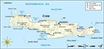
Sparta lay in the valley of the Eurotas River in Laconia, in the south-eastern Peloponnese, between the Taygetus and Parnon mountain ranges. The region had been important in the Mycenaean age: a palace at Ayios Vasileios and a mansion at the Menelaion near the later city date from the Late Bronze Age, and Homer made Lacedaemon the kingdom of Menelaus and Helen. After the collapse of Mycenaean civilisation the valley was thinly settled. Greek tradition explained the arrival of Dorian Greeks as the return of the Heraclidae, the descendants of Heracles, and the two Spartan royal houses, the Agiads and the Eurypontids, claimed descent from him. Archaeologically, the first Iron Age settlement at Sparta dates to the tenth century BCE. The city was formed by the union of four villages, Pitana, Mesoa, Limnai and Kynosoura, and probably in the eighth century BCE it absorbed Amyclae, a few kilometres to the south, as a fifth. Over the following generations the Spartans subjected the rest of Laconia, whose free inhabitants became perioikoi, dwellers around, with local self-government but no voice in Spartan policy. In the late eighth century BCE, by the traditional dating in the First Messenian War of c. 743–724 BCE, they crossed Mount Taygetus and conquered Messenia, a step that shaped Spartan society for the next four centuries.
Socioeconomy

Spartan society rested on a sharp division between a small body of full citizens, the Spartiates or homoioi, peers, the free but subordinate perioikoi, and the helots, state-owned serfs of Laconia and Messenia who worked the land. Each Spartiate drew his income from an estate farmed by helots, who handed over a fixed share of the harvest; citizens were thus freed from labour and barred from trade and crafts, which were left to the perioikoi. Helots greatly outnumbered citizens: at the Battle of Plataea in 479 BCE Herodotus counts seven helots for each of the 5,000 Spartiates. Fear of revolt shaped Spartan life. Each year the ephors formally declared war on the helots, and the krypteia, a body of young men, could kill helots without penalty. Every citizen had to contribute food to a common mess, the syssition, and those who could not lost full status. Sparta used iron bars rather than silver for internal exchange and struck no coins of its own until the third century BCE. Spartan women had unusual freedom, exercised in public and could own property; Aristotle claimed that they held about two-fifths of the land. Archaic Sparta was less austere than legend suggests: the poet Alcman composed choral songs there in the seventh century BCE, Laconian pottery and bronzes were exported widely and the sanctuary of Artemis Orthia received rich offerings.
Military
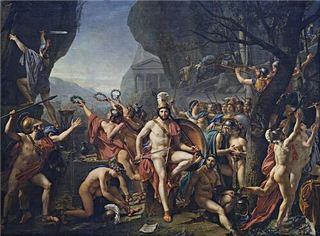
The Spartan army of hoplites, heavy infantry fighting in close formation, was the most respected in Greece. Boys entered the agoge, the state system of training, at the age of seven, and men served until sixty, devoting themselves to war like no other Greek citizens. In the sixth century BCE Sparta defeated Tegea, won the Battle of the Champions against Argos for the borderland of Thyreatis around 546 BCE, and under King Cleomenes I crushed the Argives at Sepeia in 494 BCE. In 480 BCE Leonidas I held the pass of Thermopylae with a small Greek force including 300 Spartiates until he was outflanked and killed, and in 479 BCE the regent Pausanias commanded the Greek army that destroyed the Persian land forces at the Battle of Plataea. In the Peloponnesian War of 431–404 BCE Sparta invaded Attica repeatedly, but the surrender of some 120 Spartiates on Sphacteria in 425 BCE shocked the Greek world. Victory at the Battle of Mantinea in 418 BCE restored its reputation, and with Persian money Sparta built a fleet with which Lysander destroyed the Athenian navy at Aegospotami in 405 BCE. Its fatal weakness was manpower: Herodotus put the citizen body at about 8,000 men in 480 BCE, but only about 700 Spartiates fought at the Battle of Leuctra in 371 BCE, and some 400 of them died.
Governance & Law
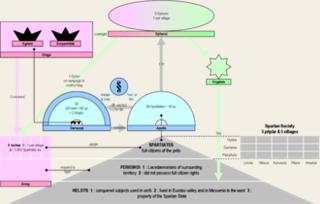
The Spartan constitution was admired in antiquity for its stability and its mixture of monarchy, aristocracy and democracy. Two hereditary kings, one from each royal house, commanded armies and held priestly duties. A council of elders, the gerousia, of 28 men over the age of sixty elected for life, sat with the kings, prepared business for the assembly and judged major cases. The assembly of all adult Spartiates, the apella, decided on proposals put to it and elected officials by shouting. Five ephors, chosen each year from the whole citizen body, supervised the kings, the training of the young and the control of the helots, and came to hold great power; two of them accompanied a king on campaign. The Spartans attributed this system and their whole way of life to the lawgiver Lycurgus, whose existence and date are uncertain, and Plutarch preserves an early text, the Great Rhetra, presented as an oracle setting out the roles of kings, elders and people. Abroad, Sparta led the Peloponnesian League, a network of alliances with Corinth, Tegea, Elis and other states formed from the mid-sixth century BCE, through which it supported friendly oligarchies, contained Argos and later opposed Athens. Its officials abroad, the harmosts, governed cities under Spartan control after 404 BCE.
Global & Regional Impact

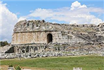
The victory over Athens in 404 BCE made Sparta, for a generation, the leading power in Greece, and the stand at Thermopylae became one of the most famous episodes in ancient history. Its deeper influence was as an idea. Ancient writers from Xenophon, in his Constitution of the Lacedaemonians, to Plato, Aristotle and Plutarch discussed Sparta as a model, or a warning, of a state that shaped its citizens through law and education. The French scholar François Ollier named this idealised picture the Spartan mirage, since much of it was projected by Spartans and their admirers. Plutarch's Life of Lycurgus influenced later political thinkers, including Machiavelli and Rousseau, and revolutionaries in eighteenth-century France cited Spartan austerity and civic virtue. In the nineteenth and twentieth centuries Sparta was held up as a model of military education, and Nazi ideologists admired its infanticide and racial hierarchy. The English words laconic, from Laconia, and spartan preserve its reputation for brevity and hardship. Sparta's only significant overseas colony, Taras, modern Taranto in southern Italy, was founded by tradition in 706 BCE. The sanctuary of Artemis Orthia, where in the Roman period visitors watched youths endure ritual whipping in a purpose-built theatre, shows how Sparta's traditions later became a spectacle for outsiders.
Decline & Fall

Spartan hegemony after 404 BCE proved short. Its rule through harmosts and narrow oligarchies alienated former allies, and in the Corinthian War of 395–387 BCE Thebes, Athens, Corinth and Argos fought Sparta with Persian support, while a Persian fleet destroyed the Spartan navy at Cnidus in 394 BCE. The King's Peace of 387/386 BCE restored Spartan dominance on the mainland under Agesilaus II, but the seizure of the Theban citadel in 382 BCE provoked a war that ended in disaster. At the Battle of Leuctra in 371 BCE the Thebans under Epaminondas defeated the Spartan army and killed King Cleombrotus I, and in 370–369 BCE they invaded Laconia, freed Messenia and founded the city of Messene, taking away half of Sparta's helot land. Sparta never recovered. It stayed out of the League of Corinth, and King Agis III's revolt against Macedon was crushed by Antipater at Megalopolis in 331 BCE. The reforming kings Agis IV and Cleomenes III tried to rebuild the citizen body by cancelling debts and redistributing land, but Cleomenes was defeated at Sellasia in 222 BCE by Antigonus III Doson and the Achaean League. After the rule of Nabis, Philopoemen forced Sparta into the Achaean League in 192 BCE. Sparta's attempts to leave the league helped provoke the Achaean War, and after Rome destroyed Corinth in 146 BCE Sparta became a free city allied to Rome.
Sparta was the leading land power of Classical Greece: its citizen soldiers, supported by an enslaved helot population, led Greek resistance to Persia and defeated Athens in the Peloponnesian War, and its idealised discipline shaped Western political thought long after its power collapsed at Leuctra in 371 BCE.
References
- Cartledge, P. (2002) Sparta and Lakonia: A Regional History 1300–362 BC. 2nd edn. London: Routledge.
- Cartledge, P. and Spawforth, A. (1989) Hellenistic and Roman Sparta: A Tale of Two Cities. London: Routledge.
- Forrest, W.G. (1968) A History of Sparta 950–192 B.C. London: Hutchinson.
- Kennell, N.M. (2010) Spartans: A New History. Chichester: Wiley-Blackwell.
- Herodotus, The Histories, trans. A. de Sélincourt, rev. J. Marincola (2003). London: Penguin.
- Xenophon, A History of My Times (Hellenica), trans. R. Warner (1966). Harmondsworth: Penguin.
Connections
Open the full connections map →