Central & East Asia
State of Qin
At a glance
- A western frontier fief of the Zhou kings that took over the old Zhou heartland in the Wei River valley.
- Shang Yang's reforms from 356 BCE built a state of registered farmers, ranks earned in war and appointed officials.
- King Zheng conquered the six rival states between 230 and 221 BCE and became China's First Emperor.
Rise & Fall
- 770 BCEDuke Xiang escorts King Ping of Zhou east and is raised to full ducal rank
- 645 BCEDuke Mu defeats Jin at Han and captures Duke Hui of Jin
- 356 BCEShang Yang begins his reforms under Duke Xiao
- 350 BCEThe capital moves to Xianyang
- 316 BCEQin conquers Ba and Shu in the Sichuan basin
- 260 BCEBai Qi destroys the army of Zhao at Changping
- 230–221 BCEKing Zheng conquers Han, Zhao, Wei, Chu, Yan and Qi
- 221 BCEZheng takes the title of First Emperor
Foundation

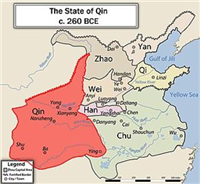
The State of Qin grew from modest beginnings on the western edge of the Zhou world. According to the Shiji of Sima Qian, the Ying clan descended from Feizi, a skilled horse breeder whom King Xiao of Zhou rewarded with a small fief at Qin, in the upper Wei and Xihan river valleys of eastern Gansu; tradition dates the grant to about 897 BCE. Excavations near Lixian, including large tombs at Dabuzishan attributed to early Qin lords, confirm that a Qin elite was established there by the eighth century BCE. Qin's early history was shaped by constant conflict with the Rong peoples, who killed the Qin leader Qin Zhong in about 822 BCE. The decisive step came in 770 BCE, when Duke Xiang of Qin escorted King Ping of Zhou eastward after the sack of the western Zhou capital. In return Qin was raised to the rank of a full regional lord and promised the old Zhou heartland if it could recover it from the Rong. Duke Wen of Qin defeated the Rong and took the lands around Mount Qi in the mid-eighth century BCE, and in 677 BCE Qin established its capital at Yong, near modern Fengxiang, which remained its ritual centre for nearly three centuries.
Socioeconomy
Qin's economy rested on millet and wheat farming in the loess lands of the Wei River valley, with stock raising. The states of the central plain long regarded Qin as semi-barbarian, close to the Rong in its customs, and its elite practised human sacrifice: the Shiji records that 177 people followed Duke Mu of Qin into death in 621 BCE, and the excavated tomb at Yong attributed to Duke Jing of Qin (d. 537 BCE), the largest known tomb of the Zhou period, contained more than 160 sacrificial victims. Duke Xian of Qin banned the practice in 384 BCE. Shang Yang's reforms from 356 BCE transformed society. Households were registered and grouped in fives and tens with collective responsibility for crimes, families with more than one adult son were taxed more heavily to break them into smaller units, and the old field boundaries were reorganised so that land could be allotted and brought under cultivation. Farming and war were declared the honourable occupations, while trade and itinerant scholarship were discouraged. Weights and measures were standardised; a bronze measuring vessel inscribed by Shang Yang in 344 BCE survives. Great water works followed, among them the Dujiangyan irrigation system in Shu, traditionally credited to the governor Li Bing, and the Zheng Guo Canal, begun in 246 BCE, which irrigated the plain north of the Wei.
Military

For centuries Qin's wars faced both west and east. Duke Mu of Qin (r. 659–621 BCE) defeated Jin at the Battle of Han in 645 BCE and captured Duke Hui of Jin, but a Qin army was destroyed by Jin at Xiao in 627 BCE, and he turned instead against the Rong. For the next two centuries Qin was overshadowed by Jin and later by the State of Wei, which seized the Hexi region west of the Yellow River in the late fifth century BCE. Shang Yang's reforms rebuilt the army on a system of twenty ranks of merit awarded for enemy heads taken, which brought land and status to successful soldiers. Qin armies of conscripted farmers, armed with crossbows, halberds and swords, then won repeatedly. King Huiwen's general Sima Cuo conquered Ba and Shu in 316 BCE, gaining the fertile Sichuan basin. Bai Qi defeated Han and Wei at Yique in 293 BCE and captured Ying, the capital of Chu, in 278 BCE. At the Battle of Changping in 260 BCE he destroyed the army of Zhao; the traditional claim that 400,000 surrendered men were then killed is probably exaggerated, but mass graves have been found at the site. After a failed siege of Handan in 259–257 BCE, between 230 and 221 BCE King Zheng's generals, among them Wang Jian, conquered the six remaining states.
Governance & Law

Early Qin was ruled by dukes of the Ying clan who performed Zhou-style rituals while building a more centralised state than many of their neighbours; the Shiji records that Duke Wu of Qin created counties (xian) in conquered territory in 688 BCE, among the earliest known in China. Foreign advisers were common: Duke Mu relied on Baili Xi, and many of Qin's great ministers came from other states, among them Shang Yang from Wey, Zhang Yi and Fan Ju from Wei, and Li Si from Chu. Under Duke Xiao of Qin (r. 361–338 BCE), Shang Yang organised the realm into counties under appointed officials who could be dismissed, and issued detailed written laws enforced with harsh punishments. The capital moved to Xianyang in 350 BCE. Although Shang Yang was executed after his patron's death in 338 BCE, his system survived, and Duke Huiwen took the title of king in 325 BCE. Bamboo-slip documents excavated at Shuihudi in Hubei in 1975 and at Liye in Hunan in 2002 reveal a bureaucracy that recorded granaries, tools, labour service and lawsuits in minute detail and held officials strictly accountable. The chancellor Lü Buwei dominated the court during the minority of King Zheng, who took personal power in 238 BCE after crushing the revolt of Lao Ai and dismissed Lü Buwei the following year.
Global & Regional Impact

Qin's unification of China in 221 BCE created the template for imperial government. The system of commanderies and counties, written statutes, household registration and a salaried bureaucracy accountable to the ruler, developed in Qin over the preceding century and a half, was extended to the whole empire and largely retained by the Han dynasty and its successors. The standardisation of script, weights, measures and coinage under the First Emperor generalised practices already in force in Qin; the round coin with a square hole, the banliang, remained the model for Chinese coinage until the twentieth century. Qin statecraft is associated with the school later called Legalism, preserved in the Book of Lord Shang and the writings of Han Fei, who died in Qin in 233 BCE; Confucian historians of the Han made Qin a byword for cruelty, a view that shaped Chinese political thought for two millennia. Qin's material culture is known from the inscribed Stone Drums usually attributed to Qin, the bronze bells of its dukes and the vast tomb complex of the First Emperor near Xi'an, with its terracotta army, begun when Zheng was still king of Qin. The name Qin, through Sanskrit Cīna, is the likely origin of the Western word China.
Decline & Fall

The State of Qin did not decline but ended by transforming itself into an empire. King Zheng, who came to the throne as a boy in 246 BCE, survived an assassination attempt in 227 BCE by Jing Ke, sent by Crown Prince Dan of Yan, and conquered the rival states one by one: Han in 230, Zhao in 228 (a rump state at Dai held out until 222), Wei in 225 after its capital Daliang was flooded, Chu in 223 after a first invasion under Li Xin had failed, Yan in 222 and Qi in 221 BCE. He then adopted the new title of First Emperor (Shi Huangdi), and the kingdom became the Qin dynasty, ruling all of China from Xianyang. The old regional state dissolved into the new empire, which refused to create new fiefs and divided the realm into 36 commanderies. The triumph proved brief: methods designed for a frontier kingdom geared to war were hard to apply to the whole of China. Heavy labour demands for walls, roads, palaces and the imperial tomb fuelled discontent, and after the First Emperor died in 210 BCE rebellion broke out. The dynasty fell in 207 BCE, when the last ruler, Ziying, surrendered to Liu Bang, and Xianyang was burned soon afterwards by Xiang Yu.
The State of Qin rose from a horse-breeding frontier fief to the most formidable power of the Warring States, and the bureaucratic, legal and military institutions it forged under Shang Yang became, through its unification of China in 221 BCE, the foundations of two thousand years of imperial government.
Test yourself
5 questions on this page, from its key events and facts.
The questions open here once the page has loaded.
References
- Lewis, M.E. (2007) The Early Chinese Empires: Qin and Han. Cambridge, MA: Belknap Press of Harvard University Press.
- Loewe, M. and Shaughnessy, E.L. (eds.) (1999) The Cambridge History of Ancient China: From the Origins of Civilization to 221 B.C. Cambridge: Cambridge University Press.
- Pines, Y., Shelach, G., von Falkenhausen, L. and Yates, R.D.S. (eds.) (2014) Birth of an Empire: The State of Qin Revisited. Berkeley: University of California Press.
- Pines, Y. (2017) The Book of Lord Shang: Apologetics of State Power in Early China. New York: Columbia University Press.
- Sima Qian (1993) Records of the Grand Historian: Qin Dynasty, trans. B. Watson. New York: Columbia University Press.
Connections
Open the full connections map →