Americas
League of Mayapan
At a glance
- From about 1220 to the 1440s the lords of northern Yucatán shared power in the walled city of Mayapan under the leadership of the Cocom.
- Its potters made god-shaped incense burners, and its canoe traders linked Yucatán with the Gulf Coast, Belize and Honduras.
- Around 1441 a Xiu-led revolt killed the Cocom lords; Mayapan was abandoned and Yucatán split into rival provinces.
Rise & Fall
- c. 1100Chichen Itza loses its dominance over northern Yucatán
- 1185–1204Chronicles place Hunac Ceel's overthrow of Chac Xib Chac of Chichen Itza in this katun
- c. 1220Mayapan emerges as the capital of a confederacy of northern Yucatec lords
- c. 1350–1400Mass graves of dismembered, burned bodies mark violence inside the city
- c. 1400A long drought begins as rivalry grows between the Cocom and the Xiu
- c. 1441Nobles led by the Xiu kill the Cocom ruler; Mayapan is sacked and abandoned
- 1536The Cocom of Sotuta massacre Xiu pilgrims at Otzmal
- 1542The Spanish found Mérida, and the Xiu lord of Maní makes peace with them
Foundation
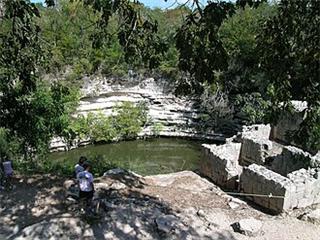
The League of Mayapan took shape in northern Yucatán after the decline of Chichen Itza, which archaeology shows had lost its regional dominance by about 1100. Its capital, Mayapan, lay some 40 kilometres south-east of present-day Mérida. The site had been occupied earlier, but around 1220 it was founded or greatly enlarged as the seat of a new political order; older chronologies based on the colonial chronicles put its founding at about 1263. The books of Chilam Balam, Maya chronicles written down in colonial times, tell how Hunac Ceel, head chief of Mayapan, drove Chac Xib Chac, ruler of Chichen Itza, from his city with the help of captains bearing Nahuatl names, an episode they place in a Katun 8 Ahau, which in the usual correlation ran from 1185 to 1204. The Franciscan Diego de Landa, writing about 1566, credited the city's foundation to Kukulcan, a lord identified with the feathered-serpent god, and said that the lords then gave the chief power to the Cocom family. These accounts mix history with prophecy and legend, and their dates conflict. The name 'League of Mayapan', used by nineteenth-century scholars such as Daniel Brinton, once described an alliance of Mayapan, Chichen Itza and Uxmal; since archaeology shows that the three cities did not flourish together, it now refers to the confederacy centred on Mayapan.
Socioeconomy
Mayapan was a crowded city of some 15,000 to 17,000 people. More than 4,000 structures stood inside a dry-stone wall about 9 kilometres long that enclosed 4.2 square kilometres, and houses spilled out beyond it. Families lived in walled patio groups linked by winding lanes and drew water from the many cenotes, natural sinkholes, in a land without rivers. They grew maize in fields outside the city, kept gardens and orchards at home, raised turkeys and dogs, and hunted deer. Craft workers made pottery and shell ornaments and shaped tools of local chert and imported obsidian, and archaeologists have identified a probable market plaza. The city's potters produced great numbers of effigy censers, incense burners modelled as gods, for temples and household shrines, and censers in the same style were used from the east coast of Yucatán to the Petén lakes and highland Guatemala. Canoe trade around the coasts carried out salt, honey and cotton cloth and brought back cacao, obsidian and other goods from the Gulf Coast, Belize and Honduras. According to Landa, each lord's steward, the caluac, kept accounts with his towns and drew from them birds, maize, honey, salt, fish, game and cloth, and the Cocom rulers owned plantations of cacao.
Military
Mayapan relied less on a standing army than on the warriors of its member lords, reinforced by hired troops. Landa reports that the Cocom brought into the city soldiers from the garrisons of Tabasco and Xicalango on the Gulf Coast, the Ah Canul, and says that the Maya of Yucatán learned from them the use of the bow, the lance and the axe, of shields and of jackets of quilted cotton. The chronicles remember the confederacy's birth in war, in Hunac Ceel's overthrow of Chichen Itza with his Mexican captains, and the wall around the capital, with twelve gates, gave it some defence. A study of the city published in 2022 describes a state that raided its enemies on the peninsula, but archaeology also reveals violence within: mass graves of dismembered and burned bodies, one of them beside the outlying temple of Itzmal Ch'en, date from about 1350–1400. Conflict in the city rose sharply between about 1400 and 1450, a time of prolonged drought, as the Cocom, allied with the Canul, quarrelled with their Xiu rivals. In the end Mayapan fell not to an outside enemy but to its own nobles, and the Chumayel chronicle records fighting with stones in the city and the breaking down of its wall.
Governance & Law
Mayapan was governed jointly. The Chumayel chronicle speaks of the multepal, the 'joint government' in the city, and a colonial report describes Mayapan as a kind of court where all the caciques and lords of the land resided and brought their tribute. The head of the Cocom lineage held the highest rank, but the Xiu, who traced their descent from the lords of Uxmal, stood close to him, and the Chel and other noble houses also sat on the ruling council. Landa writes that the walled precinct held only temples and the houses of the lords and of the high priest, the Ah Kin Mai, to whom the priests of the towns brought contributions. Each lord also built houses outside it for his servants and for people of his towns who came on business, ruled his province through governors he appointed, and kept a steward, the caluac, who carried a short thick staff as his badge of office and saw to the supplies owed by the towns. Seven or eight worn, inscribed stones stood in the city's plaza, and Landa's informants said that such stones had been raised every twenty years. The system rested on the lords' consent, and it broke down when a later Cocom ruler was accused of tyranny.
Global & Regional Impact

Mayapan was the last great capital of the northern Maya, and the political map that the Spanish found in the sixteenth century was its legacy. The provinces that emerged from its fall were ruled by lineages that had shared power in the city, the Xiu at Maní, the Cocom at Sotuta, the Chel at Ah Kin Chel and the Canul in the west, and their claims of descent from the lords of Mayapan and their old rivalries shaped the peninsula's politics until the conquest. Colonial writers derived the very name of the Maya language from the city. Its art joined Maya traditions to the international style of Postclassic Mesoamerica: its murals and sculpture share themes with the Mixteca-Puebla codices of southern Mexico, and temple groups and effigy censers in its style appear from the east coast of Yucatán to the Petén lakes and highland Guatemala. Landa wrote that the most important possessions the nobles took with them when they left Mayapan were the books of their sciences, and the Chilam Balam chronicles, written down by Maya scribes in colonial towns, preserved memories of the city. Work by the Carnegie Institution of Washington in the 1950s, and by Mexican and American archaeologists since the 1990s, has made Mayapan one of the best-studied cities of Postclassic Mesoamerica.
Decline & Fall
Mayapan fell in a Katun 8 Ahau, which in the usual correlation ran from 1441 to 1461. According to Landa, a Cocom ruler brought more Mexican troops from Tabasco into the city, began to play the tyrant and enslaved the poor, so the nobles joined the party of the Tutul Xiu and killed him together with all his sons except one, who was away trading in Honduras. A colonial report adds that the Xiu turned the lords against the Cocom by claiming that he was secretly selling people to foreign traders, and later tradition names the Xiu leader as Ah Xupan. The city was sacked and abandoned, and each lineage returned to its own lands: the surviving Cocom gathered his people at Tibolon in the province of Sotuta, the Xiu made Maní their seat, and the Canul troops settled in the west. Landa's reckoning places the abandonment around 1441 or 1446, and excavations show burning and violence in the city centre at a time when drought and conflict had already thinned its population. Northern Yucatán broke into some sixteen rival provinces, which Landa says suffered a great hurricane, epidemics and wars in the following decades. The feud endured: in 1536 the Cocom of Sotuta massacred Xiu pilgrims at Otzmal, and in 1542, as the Spanish founded Mérida, the Xiu lord of Maní made peace with them.
For some two centuries the League of Mayapan held the lords of northern Yucatán together in one walled capital under joint government; its violent breakup around 1441 left the rival provinces, lineages and feuds that the Spanish conquerors met, and its memory, kept in Maya chronicles, frames much of what is known of Postclassic Maya history.
References
- Masson, M.A. and Peraza Lope, C. (2014) Kukulcan's Realm: Urban Life at Ancient Mayapán. Boulder: University Press of Colorado.
- Pollock, H.E.D., Roys, R.L., Proskouriakoff, T. and Smith, A.L. (1962) Mayapan, Yucatan, Mexico. Washington, DC: Carnegie Institution of Washington.
- Roys, R.L. (1957) The Political Geography of the Yucatan Maya. Washington, DC: Carnegie Institution of Washington.
- Smith, M.E. and Berdan, F.F. (eds) (2003) The Postclassic Mesoamerican World. Salt Lake City: University of Utah Press.
- Tozzer, A.M. (ed. and trans.) (1941) Landa's Relación de las cosas de Yucatán: A Translation. Cambridge, MA: Peabody Museum of American Archaeology and Ethnology, Harvard University.
Connections
Open the full connections map →