
At a glance
- A kingdom of western Mexico centred on Lake Pátzcuaro, ruled from Tzintzuntzan by a king the Spaniards called the cazonci.
- In the late 1470s it routed an Aztec army led by Axayacatl, and the Aztecs never conquered it.
- Its smiths led Mesoamerica in copper and bronze; it submitted to Spain in 1522, and its last king was executed in 1530.
Rise & Fall
- c. 1350Tariácuri unites the communities of the Lake Pátzcuaro basin
- c. 1450Power is concentrated at Tzintzuntzan, the kingdom’s only true city
- c. 1478Purépecha forces rout the Aztec army of Axayacatl near Taximaroa
- 1520King Zuangua dies, probably of smallpox, and Tangaxuan II succeeds him
- 1522Cristóbal de Olid enters Tzintzuntzan and Tangaxuan II submits to Spain
- 1530Nuño de Guzmán has Tangaxuan II executed on 14 February
- 1536Vasco de Quiroga is appointed the first bishop of Michoacán
Foundation

The Purépecha Empire, called the Tarascan state by the Spaniards, grew up around Lake Pátzcuaro in the volcanic highlands of Michoacán, in western Mexico. Its early history is known chiefly from the Relación de Michoacán, compiled around 1539–1541, probably by the Franciscan friar Jerónimo de Alcalá, for Viceroy Antonio de Mendoza from the testimony of Purépecha nobles and priests. In this account a lineage called the uacúsecha, ‘eagles’, of Chichimec origin, entered the region near Zacapu and moved to the shores of the lake, where they contended with the other lords of the basin. In the fourteenth century their leader Tariácuri, lord of Pátzcuaro, brought the lake communities under his control through war and alliance. He divided his realm among three heirs, his son Hiquíngare at Pátzcuaro and his nephews Hiripan at Ihuatzio and Tangáxoan at Tzintzuntzan, who carried the conquests beyond the basin. Archaeology broadly agrees with this outline: the state took shape in the Pátzcuaro basin in the fourteenth century, when the population of the basin was growing rapidly, and its rulers fostered a new state religion and ideology to support their authority. By the middle of the fifteenth century power was concentrated at Tzintzuntzan, which remained the capital until the Spanish conquest.
Socioeconomy

On the eve of the Spanish conquest the kingdom covered some 75,000 square kilometres in Michoacán and parts of Guanajuato, Jalisco and Guerrero, with perhaps more than a million inhabitants. The Lake Pátzcuaro basin alone held some 80,000 people in about 90 settlements, and Tzintzuntzan, with perhaps 25,000 to 35,000, was the kingdom’s only true city. Besides the Purépecha, whose language is unrelated to any other in Mesoamerica, the kingdom included Nahua, Otomí, Matlatzinca and other peoples, who kept their own languages but owed tribute and, in war, warriors. Lake fishing, maize farming and the resources of mountains, forests and hot lowlands sustained the economy, and tribute brought cotton cloth, cacao, salt and feathers to the royal storehouses. The Purépecha were the foremost metalworkers of Mesoamerica. Using techniques that had reached western Mexico from South America centuries earlier, their smiths worked copper from the La Huacana area, silver from Tamazula and gold from placers in Michoacán and Colima, alloying copper with tin or arsenic to make bronze for bells, tweezers, ornaments and tools. Obsidian, worked into blades, earspools and lip plugs, was another prized resource. Religion centred on Curicaueri, a god of fire and the sun and patron of the royal lineage, and on goddesses such as Cuerauáperi, honoured at Zinapécuaro.
Military
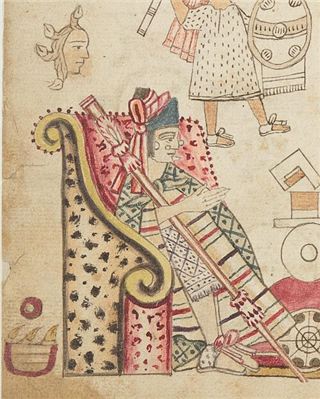
The kingdom was built by conquest. The Relación de Michoacán describes the campaigns of Tariácuri and his heirs, and by the late fifteenth century Purépecha armies had carried the frontier north to Acámbaro, near the Lerma River, west into Jalisco and south into the Balsas basin. From about 1460 this expansion met that of the Aztec Triple Alliance, and the two powers fought along a long frontier until the Spanish conquest. In the late 1470s (sources date the campaign between 1476 and 1479) the Aztec ruler Axayacatl led a large army into Michoacán and was routed near Taximaroa, now Ciudad Hidalgo; the chronicler Diego Durán recorded that some 20,000 of his men died. It is often described as the heaviest defeat the Aztecs suffered before the Spanish arrived. Both sides then fortified the border. The Aztecs built a great fortress at Oztuma, in the Balsas region, while the Purépecha held strongholds such as Acámbaro, Taximaroa and Cutzamala and settled Otomí and Matlatzinca groups on the border as frontier guards; a report of 1580 credits Cutzamala with a garrison of 10,000 warriors. Under Ahuitzotl (r. 1486–1502) the Aztecs renewed the pressure through allied peoples of the Balsas region, but King Zuangua held the frontier, and the Aztecs never conquered the kingdom.
Governance & Law
The Purépecha kingdom may have been the most centralised state of Postclassic Mesoamerica. At its head stood the king, called irecha in Purépecha and cazonci by the Spaniards, from a Nahuatl word, who ruled as the earthly representative of Curicaueri; kingship remained in the lineage of Tariácuri. Beneath him a hierarchy of royal kin, high nobles and lesser nobles held the offices of war, government and the royal household, while the high priest, the petámuti, headed a priesthood whose members wore tobacco gourds as a sign of office. Conquered towns were governed through local lords answerable to the king, and a tributary system, said to have been organised under Hiripan and Tangáxoan, channelled cloth, food, metals and labour to the capital. The state also controlled mines, forests, fisheries and many craft workshops. Tzintzuntzan was a royal and administrative city. On a great platform some 450 by 250 metres above the lake stood five keyhole-shaped temple platforms, the yácatas, each once crowned by a wooden temple, and the Relación de Michoacán mentions palaces, storehouses for grain and tribute, a prison, a zoo, baths, a ballcourt and a market. Royal funerals were great ceremonies at which servants were killed to accompany the dead king.
Global & Regional Impact

For more than half a century the Purépecha kingdom was the strongest of the states that resisted the Aztec Empire, and the Aztec advance into western Mexico stopped at its frontier, a heavily militarised border lined with fortresses on both sides. Its metallurgy, the most advanced in Mesoamerica, gave copper and bronze a place in ritual, warfare and daily life, and copperwork remains a craft of the region. The Relación de Michoacán, illustrated with 44 paintings by Purépecha artists and now kept in the royal library of El Escorial in Spain, is one of the richest indigenous histories of colonial Mexico and the main source for the kingdom’s past. After the conquest Vasco de Quiroga, sent to Michoacán as a royal inspector in 1533 and appointed its first bishop in 1536, founded hospital-towns for the Purépecha and encouraged villages to specialise in particular crafts, a pattern still visible in the guitars of Paracho, the pottery of Tzintzuntzan and the copper of Santa Clara del Cobre; he is still remembered in the region as ‘Tata Vasco’. The Purépecha people endure: some 140,000 people spoke their language in the 2020 census, and the yácatas of Tzintzuntzan and Ihuatzio are protected archaeological sites.
Decline & Fall

The kingdom fell to epidemic disease and Spanish coercion rather than to defeat in battle. When Mexica envoys came to Tzintzuntzan seeking an alliance against the Spaniards, King Zuangua sent no army, and in 1520 he died, probably in the smallpox epidemic that had spread from the Spanish expedition. His son Tangaxuan II, also called Tzintzicha, succeeded him; according to the Relación de Michoacán he had the members of a later Mexica embassy sacrificed so that they could carry their message to his dead father. After the fall of Tenochtitlan, Hernán Cortés sent Cristóbal de Olid into Michoacán, and in the summer of 1522 Olid entered Tzintzuntzan without a battle, while the Spaniards gathered gold and silver from its temples and royal tombs. Tangaxuan II submitted and for some years kept much of his authority, his subjects paying tribute both to him and to the Spaniards. In 1529–1530 Nuño de Guzmán, president of the First Audiencia of New Spain, on his way to conquer western Mexico, arrested the king with the help of the Purépecha noble Pedro Cuiniarángari, tortured him in search of gold and tried him for rebellion, withholding tribute and other charges. On 14 February 1530 he was executed; the sentence ordered him garrotted and burned, and his ashes were thrown into the Lerma River.
The Purépecha Empire, ruled from Tzintzuntzan on Lake Pátzcuaro, was the second largest state of Mesoamerica on the eve of the Spanish conquest; it routed an Aztec army in the late 1470s, was never conquered by the Aztecs, and was the leading centre of copper and bronze metallurgy in the region.
Test yourself
5 questions on this page, from its key events and facts.
The questions open here once the page has loaded.
References
- Gorenstein, S. (1985) Acambaro: Frontier Settlement on the Tarascan-Aztec Border. Nashville: Vanderbilt University (Publications in Anthropology 32).
- Hosler, D. (1994) The Sounds and Colors of Power: The Sacred Metallurgical Technology of Ancient West Mexico. Cambridge, MA: MIT Press.
- Pollard, H.P. (1993) Taríacuri’s Legacy: The Prehispanic Tarascan State. Norman: University of Oklahoma Press.
- Warren, J.B. (1985) The Conquest of Michoacán: The Spanish Domination of the Tarascan Kingdom in Western Mexico, 1521–1530. Norman: University of Oklahoma Press.
Connections
Open the full connections map →