Culture · Central & East Asia
Liangzhu culture
At a glance
- Liangzhu was a highly stratified rice-farming society of the Yangtze River Delta whose jade, silk, ivory and lacquer went only to elite graves, a division that marks it as an early state.
- Its centre, Liangzhu Ancient City near Hangzhou, enclosed 290 hectares with clay walls and six gates around a palace complex, with dams to the north, and is a UNESCO World Heritage Site.
- Its jade cong and bi set the standard for ritual jades across Neolithic China, and the culture vanished from the Taihu Lake area after about 2300 BCE, probably because of floods.
Timeline
- c. 3300 BCEThe Liangzhu culture emerges in the Yangtze River Delta
- c. 2500 BCEThe Liangzhu culture flourishes
- after c. 2300 BCEThe culture disappears from the Taihu Lake area, probably after decades of heavy rain and flooding
- 1936Shi Xingeng first excavates the type site at Liangzhu in Yuhang County, Zhejiang
- 2007The Zhejiang provincial government announces the discovery of the base of the ancient city walls, the centre of the culture
- 2008The new Liangzhu Culture Museum is completed and opens
- 2019The archaeological ruins of Liangzhu City are inscribed as a UNESCO World Heritage Site
Origins
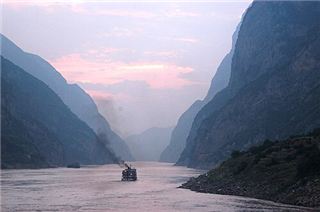
The Liangzhu culture, or Liangzhu civilisation, flourished in the Yangtze River Delta of eastern China between about 3300 and 2300 BCE. It was the last of the Neolithic jade cultures of the delta. Like other archaeological cultures it takes its name from a place: Liangzhu in Yuhang County, Zhejiang, where the type site was found and first excavated by Shi Xingeng in 1936. The name is an archaeologists’ label for the people who left these remains.
On 29 November 2007 the Zhejiang provincial government announced the discovery of the base of an ancient city wall, and it was concluded that the site had been the centre of the whole culture. The city seems to have been settled and developed with a specific purpose in mind, since the area has very few remains from earlier periods. Its palace complex, its flood defences and the sharp differences between rich and poor graves have led researchers to see Liangzhu as perhaps one of the oldest Neolithic sites in East Asia that could be called a state society.
Some Liangzhu techniques recall older ones of the region: well technology at the Miaoqian site resembles that of the earlier Hemudu period. Tools found at Liangzhu sites, among them adze handles shaped like a bent knee, stone adzes, spindle whorls of baked clay, harvesting knives and spear points, are also common in later Neolithic Southeast Asia, and the technical and economic toolkits of those societies possibly developed in the Neolithic Yangtze River area. Ancient DNA adds another line of evidence, linking the people buried at the Liangzhu sites of Maqiao and Xindili to populations of coastal eastern China.
Society

Liangzhu society was highly stratified. Jade, silk, ivory and lacquer objects have been found only in elite burials, while poorer graves held mostly pottery. This division in the burials is the main reason the culture is described as an early state. Elite groups at the Liangzhu site presided over local centres, though lesser centres also produced elite crafts and many had their own jade, so researchers do not see the culture as a simple pyramid of status.
Liangzhu Ancient City lay in wetland on a plain of rivers between Daxiong Mountain and Dazhe Mountain in the Tianmu range, and is said to have been the largest city of its time. Its clay walls enclosed 290 hectares and had six gates, two each in the north, east and south walls. At its centre stood the 30-hectare Mojiaoshan palace complex. Waterways led in and out of the city, linking it to the river network, and inside were artificial earth mounds and natural hills. Beyond the walls remains cover another 700 hectares, with houses laid out to a plan, and about 8 km to the north lay dam-like works thought to be a flood-protection system. A granary may have held up to 15,000 kg of rice. Excavations have revealed city walls, foundations of large buildings, tombs, altars, houses, docks and workshops.
The economy rested on advanced agriculture, with irrigation, paddy rice and aquaculture. More than 300 Liangzhu communities have been found, most of them near rivers. Houses were often raised on stilts over rivers or shorelines as protection against floods, while on higher ground people lived in semi-subterranean houses with thatched roofs. Boats, oars, a wooden pier and a flood embankment show how much daily life depended on water.
Beliefs & Worldview
Religion appears to have been of considerable importance. At Yaoshan in Zhejiang archaeologists excavated an elaborate altar built of carefully positioned piles of stones and rock walls. It has three levels, the highest a platform of rammed earth, with three further platforms paved with cobblestones and the remains of a stone wall. On the altar lie twelve graves in two rows.
The finest pieces are large ritual jades: cong, the tube-shaped cylinders, the largest weighing 3.5 kg; bi discs; and yue ceremonial axes. They were often incised with the motif known as the taotie and were placed in elite graves, and utensils for ritual purposes have been found both inside and outside the city.
Some scholars claim that the ritual sacrifice of slaves was part of Liangzhu tradition. The influence of Liangzhu ritual objects lasted well beyond the culture itself: its jade work is said to have had a lasting influence on ritual objects in later periods of Chinese culture.
Arts & Knowledge
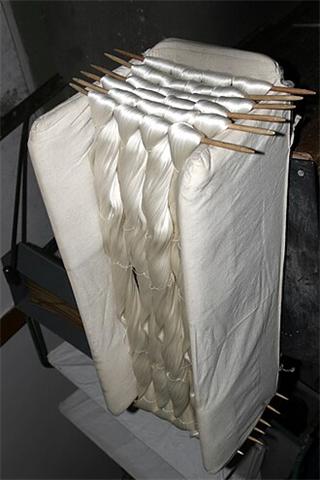
Jade is the culture’s best-known craft. Its makers worked large ritual pieces, cong cylinders, bi discs and yue axes, as well as pendants engraved with small birds, turtles and fish. Many pieces have a milky white, bone-like look, the result of their tremolite stone and of water-based fluids at the burial sites, although jade of actinolite and serpentine was also common. Most cultures of the time had some jade, but 90 per cent of all the cong and bi jades recovered, and by far the best in quality, come from Liangzhu sites.
The Liangzhu also worked harder stone. Researchers have found that some axes were made with diamond tools, which the craftsmen used to work corundum into ceremonial axes “polished to a mirrorlike luster”, with results said to be hard to match even with modern technology. This is the earliest known use of diamond tools in the world, thousands of years before the gem is known to have been used elsewhere, and Liangzhu is the only prehistoric culture known to have worked sapphire.
Liangzhu pottery was mostly soft-fired and grey with a black or red slip, and its art favoured spirals and circles; potters also used cord-marking and pedestals with cut-out decoration. Some of it recalls the black “eggshell” ware of the Shandong Longshan culture: tremolite particles were used in some of the black pieces, and their colour came from similar advances in carburisation and firing. The people also made spindle whorls of baked clay, worked silk, ivory and lacquer, built boats and dug wells.
Contact & Exchange
Liangzhu was extremely influential: its sphere of influence reached as far north as Shanxi and as far south as Guangdong. The elites of the ancient city exchanged goods with elites elsewhere in the Liangzhu world and in other regions of Longshan-era China, and they set the standard for what jade should look like. The Liangzhu do not seem to have imported jade, though they exported it widely. Cong tubes, bi discs and other jades like those of Liangzhu have been found in the Longshan culture of Shandong, at Taosi in Shanxi, in the Qijia culture and at many sites in northern Shaanxi.
Pottery shows other contacts. The way pottery was made at Liangchengzhen, the largest site of the Dawenkou culture, is similar enough to Liangzhu practice that researchers believe the two cultures were in touch, and the Guangfulin site combines influence from more northern cultures with typical Liangzhu potting. Liangzhu is said to have been more socially developed and complex than its northern contemporaries in the Han Valley.
Genetic studies trace the people further. A 2007 analysis found high frequencies of the Y-DNA haplogroup O1-M119 at the Liangzhu sites of Maqiao and Xindili, linking them with modern eastern or coastal Han Chinese and with the Austronesian and Kra–Dai peoples; the haplogroup was absent at inland Liangzhu sites, which the authors suggest may reflect two routes, one coastal and one inland, in the peopling of East Asia. A 2025 autosomal DNA study found the ancient Liangzhu samples intermediate between today’s Han Chinese of Jiangsu and Zhejiang, Kra–Dai speakers and Austronesian speakers of Taiwan and the Philippines, and closer to Neolithic samples from Fujian than to modern Austronesian speakers.
Legacy
Liangzhu flourished around 2500 BCE but disappeared from the Taihu Lake area after about 2300 BCE, and almost no traces of it follow there. Research shows that rising waters interrupted settlement in the area several times: the culture’s layers are often broken by muddy, marshy and sandy-gravelly deposits with buried ancient trees, which has led researchers to blame extreme environmental changes such as floods. A 2021 study linked the collapse to a decades-long period of very heavy rain about 4,345 to 4,324 years ago, probably caused by more frequent El Niño conditions; flooding and poor drainage in the low-lying land may have forced the people to abandon their capital and the Taihu Plain. This may have happened during, or in the century before, the global drought credited with bringing down early civilisations such as the Indus Valley Civilisation, Old Kingdom Egypt and the Akkadian Empire.
Its jade outlived it. Cong and bi like those of Liangzhu appear in later Neolithic cultures across northern China, and Liangzhu jade work is said to have influenced ritual objects in later Chinese culture. The geneticist Sun Jin counts the haplogroup O1-M119, frequent at coastal Liangzhu sites, among the founding paternal lineages of the Han people.
The site is now protected and on display. A new Liangzhu Culture Museum was completed in 2008 and opened late that year, and on 6 July 2019 the archaeological ruins of Liangzhu City were inscribed as a UNESCO World Heritage Site.
In the Research Series
The Liangzhu culture was the last Neolithic jade culture of the Yangtze River Delta, from about 3300 to 2300 BCE. Its rice farmers built a walled city near present-day Hangzhou with a palace complex and flood defences, and its sharply ranked burials mark it as an early state. Its jade cong and bi influenced ritual objects across China, floods probably brought it to an end, and its city is a UNESCO World Heritage Site.
Test yourself
5 questions on this page, from its key events and facts.
The questions open here once the page has loaded.
References
- Allan, Sarah (ed.) The Formation of Chinese Civilization: An Archaeological Perspective. ISBN 0-300-09382-9.
- Zhou Ying (2007) The Dawn of the Oriental Civilization: Liangzhu Site and Liangzhu Culture. Beijing: China Intercontinental Press.