Americas
El Perú-Waka'
At a glance
- The first recorded meeting between Teotihuacan and the Maya took place at Waka' in January 378, when the war leader Siyaj K'ahk' passed through roughly eight to ten days before taking over Tikal: the moment archaeologists call La Entrada.
- Waka' abandoned its early alliance with Tikal for Calakmul, sealed by the marriage of K'inich Balam to a princess of the Kan dynasty who bore the high title ix kaloomté; Lady K'abel governed the Wak kingdom for the Snake dynasty between 672 and 692.
- Tikal's ruler Yik'in Chan K'awiil defeated Waka' in 743, made it a vassal and carried off an image of a celestial serpent, possibly its patron deity; a decade later the city was destroyed and K'inich Balam's successor captured and sacrificed.
Rise & Fall
- 378The Teotihuacan war leader Siyaj K'ahk' arrives at Waka' in January, ten days before reaching Tikal: La Entrada, the first recorded meeting of Teotihuacan and the Maya.
- c. 400Waka' reaches its political peak with a population of tens of thousands, drawn by its location and trade.
- 416Stela 15, a text-only monument, is erected naming the kings back to the mid fourth century and recording Siyaj K'ahk's coming.
- 672–692Lady K'abel, daughter of Calakmul's king Yuknoom Yich'aak K'ak' and wife of K'inich B'ahlam II, governs the Wak kingdom as a lady warlord for the Kan dynasty.
- 692Stela 34 portrays Lady K'abel; her tomb, found in the main pyramid temple in 2012, held an alabaster jar naming Lady Water Lily Hand and Lady Snake Lord.
- 732Calakmul's ruler Yuknoom Took' K'awiil, likely the brother of Lady T'abi, is defeated, captured and sacrificed in Tikal's central plaza.
- 743Yik'in Chan K'awiil of Tikal defeats Waka', makes it a vassal and takes the image of its celestial serpent to Tikal, recorded on Temple IV.
- c. 753About a decade after its defeat Waka' is destroyed and K'inich Balam's successor is captured and sacrificed.
Foundation
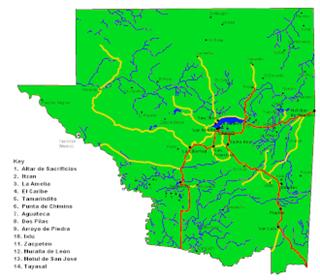
El Perú, known to its own people as Waka', stands on an escarpment six kilometres north of the San Pedro River in the Department of Petén, northern Guatemala, 60 km west of Tikal. The site was occupied from the Preclassic into the Classic period, roughly 500 BCE to 800 CE, and was the capital of a Maya city-state. The name El Perú was given on its rediscovery in the twentieth century; deciphered glyphs show the ancient name was Waka', read by Simon Martin as Wak Ajaw, which Stanley Paul Guenter interprets as "Wak-water" or "Wak-place", wak meaning perhaps the number six or a place on an escarpment.
Stela 15, dated by Guenter to 416, names rulers back to the mid fourth century. An elite tomb of between about 200 and 400 inside an 18-metre pyramid in the central core, with jade, shell, twelve ballplayer figurines, jaguar paws and stones from the Eastern Highlands and Pacific Lowlands, shows the city's early regional importance in the southern lowlands. In January 378 the foreign war leader Siyaj K'ahk' came to Waka', by David Stuart's reading roughly eight days before he took over Tikal's government: the first recorded meeting between Teotihuacan and the Maya, known as La Entrada. Stela 16 shows a man in Teotihuacan royal dress holding a bird-headed staff that David Freidel reads as the sign of Spearthrower Owl, the Teotihuacan king and father of Siyaj K'ahk'. In the early phases of the Early Classic Waka' was allied with Tikal.
Socioeconomy
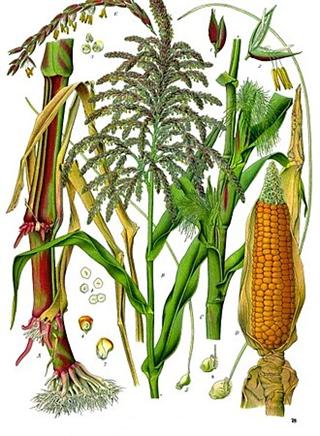
Waka' was a trading power. It lay close to the San Pedro River, which flowed westward from the Petén, and commanded a north–south overland route linking southern Campeche with the Petén; its position between the dominant capitals Calakmul and Tikal added to its commercial weight. Its market dealt in maize, beans, chili peppers, avocados, chicle and latex, and the city obtained jade and quetzal feathers for costume. Around 400 it had a population of tens of thousands, which Chris Hardman counts its political peak, drawn by its ideal location and trade. The city held hundreds of buildings, four plazas, a ballcourt and ceremonial centres.
Wealth was displayed in burial and in feasting. In the Tolok group, under the staircase of the residential compound N14-2, a deposit held a middle-aged man with a tabular-modified skull and a two-year-old child, each laid between two rocks on broken ceramics, with many bowls, plates and vases, animal bones, figurines and musical instruments. Keith Eppich reads it as a ritual feast at the dedication called Och-Otot, "enters house", in which the two, possibly sacrifices, became the soul of the building, and such feasts as a means of establishing social position. Research at Zapote Bobal suggests a strong connection with El Perú, which may have influenced the dynasty there.
Military

War shaped the kingdom's fortunes from the entrada of 378, when Siyaj K'ahk' passed through on his way to Tikal and, by Guenter's reading of Stela 16, "planted [his] banner stone" at Waka'. Allied with Tikal in the Early Classic, Waka' later betrayed it and forged a political alliance with Calakmul. K'inich Balam ("Sun Faced Jaguar"), who ruled from the late seventh to the early eighth century, married Lady T'abi, a princess of the Kan dynasty's capital; the union bound El Perú to Calakmul and its leader Yuknom Cheen in a military alliance. Lady T'abi later bore the title ix kaloomté, "empress" or "warlord". Stela 34 of 692 shows Lady K'abel, wife of K'inich B'ahlam II and daughter of Calakmul's Yuknoom Yich'aak K'ak', as a lady warlord, and her tomb held a huunal jewel of the kind set on the ko'haw helmets of war leaders, though archaeologists think her more likely a guardian of the things of battle than a commander in the field.
The alliance brought ruin. When Tikal re-emerged from its hiatus in the Late Classic, Calakmul fell to its military might: its ruler Yuknoom Took' K'awiil, likely Lady T'abi's brother, was defeated, captured and sacrificed in Tikal's central plaza in 732. Tikal's Yik'in Chan K'awiil defeated Waka' in 743, reduced it to a vassal and took an image of a celestial serpent, possibly its patron deity, to Tikal, where Temple IV records the act. A decade later Waka' was destroyed, and K'inich Balam's successor captured and sacrificed.
Governance & Law
Waka' was ruled by kings bearing the title Ajaw. Their Late Classic emblem glyph spelled the name in syllables: a first glyph with the K'uh prefix, meaning divine, over a head with a spotted cheek that Guenter takes for the maize god, and a second reading Wak Ajaw. Late Classic kings also attached a second part recognising new rulers and the alliance with Calakmul. Stela 30 records King Mah-Kina-Balam and his wife attending the accession of Jaguar-Paw of Calakmul and displaying the God K sceptre to him. The sequence of rulers includes Muwaan Bahlam, an unnamed king of the early seventh century buried in Burial 39, and K'inich Bahlam II.
Royal women held real power. Lady K'abel governed the Wak kingdom for her family, the Kan or Snake dynasty of Calakmul, between 672 and 692, and the alabaster jar in her tomb names Lady Water Lily Hand and Lady Snake Lord. Kingship was bound to the Maize God's rebirth: the 23 figurines of Burial 39 show a kneeling king with the Maize God's hair, healed by a deer spirit, and beside them the successor, the Scribe King with his monkey headdress, and his queen; an altar's quatrefoil is described in its text as tu yol ahk, "at the heart of the turtle", the portal of the Maize God's rebirth. Succession could be violent: Michelle Rich believes the two women buried back to back in the Tomb of Two Women, one pregnant, were sacrificed by a new ruler eliminating the family in power.
Global & Regional Impact
Waka' mattered beyond its size as the junction where two Mesoamerican worlds met. Its stelae are the key evidence that Teotihuacan's entry into the Maya lowlands came by way of the San Pedro, Siyaj K'ahk' passing through in January 378 days before he took Tikal, and Stela 16 shows a lord in Teotihuacan dress generations later. In the Late Classic the city was a pillar of Calakmul's hegemony: its royal marriage, its queen governing for the Snake dynasty, and its kings' attendance at Jaguar-Paw's accession show how the Kan rulers bound the western kingdoms to them.
The site has also changed what is known of the Maya. An Olmec-style figurine in Burial 39, laid north of the ruler's head in two lip-to-lip vessels coated with cinnabar, with a trefoil maize sprout on its crown, is evidence that the ancient Maya knew the Olmec maize god. The court figurines of the same tomb are a rare picture of a royal ceremony, and Karl Taube and Marc Zender take its two helmeted dwarfs as a sign that boxing was a Mesoamerican sport. The tombs of royal women, Lady K'abel's above all, found in 2012 in the main pyramid temple with ceramic vessels, jade jewellery and stone figurines, have shown the power women could hold in the Maya world. Debate over the emblem glyph, once wrongly identified with the Snake Head emblem from two looted stelae, has refined the reading of Maya political geography.
Decline & Fall
Waka's downfall was likely set in motion by its alliance with Calakmul. When Tikal re-emerged from its hiatus in the Late Classic, Calakmul fell to its military might, and in 732 Yuknoom Took' K'awiil, likely the brother of Lady T'abi, was defeated, captured and sacrificed in Tikal's central plaza. Eleven years later Yik'in Chan K'awiil defeated Waka' itself and converted it into a vassal state, carrying the image of its celestial serpent, possibly its patron deity, to Tikal and recording the triumph on Temple IV; Naranjo fell to him within the year. About a decade after that Waka' was destroyed, an event that included the capture and sacrifice of K'inich Balam's successor. The site's occupation ends around 800, and no later dynasty is recorded.
The ruins lay in the forest of the Laguna del Tigre until oil prospectors found them in the 1960s; looters took Stela 34 and other monuments in that decade, and Ian Graham of Harvard documented what remained in the 1970s. In 2003 David Freidel of Southern Methodist University and Héctor Escobedo of the University of San Carlos began excavations that uncovered the Queen's Tomb, Burial 39 in 2006, the Tomb of Two Women in 2005, the tomb attributed to Lady K'abel found by José Ambrosio Díaz in 2004 and the burial in the main pyramid temple identified as hers in 2012. Waka' is open to the public but hard to reach, inside the Laguna del Tigre National Park of the Maya Biosphere Reserve, by an arduous route from Flores.
El Perú-Waka', a Maya kingdom on the San Pedro River west of Tikal, received Teotihuacan's war leader Siyaj K'ahk' in 378, peaked around 400 with tens of thousands of people, and in the Late Classic bound itself to Calakmul through royal marriage and the rule of Lady K'abel; Tikal defeated it in 743 and destroyed it a decade later.
Test yourself
5 questions on this page, from its key events and facts.
The questions open here once the page has loaded.
References
- Robert J. Sharer with Loa P. Traxler, The Ancient Maya (Stanford University Press, 2006)
- Linda Schele and David Freidel, A Forest of Kings: The Untold Story of the Ancient Maya (William Morrow, 1990)
- Stanley Paul Guenter, "On the Emblem Glyph of El Peru", The PARI Journal 7(2) (2007)
- Keith Eppich, "Feast and Sacrifice at El Perú-Waka': The N14-2 Deposit as Dedication", The PARI Journal 10(2) (2009)
- David Freidel, Michelle Rich and F. Kent Reilly III, "Resurrecting the Maize King", Archaeology 63(5) (2010)
Connections
Open the full connections map →