Social ladder · 1181–1297 (from Jayavarman VII to Zhou Daguan's stay at Angkor)
Social Hierarchy of the Khmer Empire
From God-King to Slave
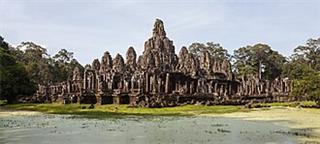
Khmer society was arranged in a hierarchy that reflected the Hindu caste system. At its head stood a king whom the cult of the devaraja, the “god-king”, identified with Shiva or Vishnu, or under Jayavarman VII (r. 1181–1219) with the bodhisattva Avalokiteshvara, and whose temples, Angkor Wat and the Bayon, celebrated his divine rule on earth. Below him the kshatriyas, royalty, nobles and warriors, formed the governing elite, and Brahmins served as priests and often as high officials. Traders and artisans worked in and for the cities, but rice farmers and fishermen made up the large majority, and their harvests, watered by a vast network of canals and reservoirs, fed a capital region of some 700,000 to 900,000 people in the 13th century. Slaves stood at the bottom. No written records of the period survive other than stone inscriptions, so much of what is known of ordinary lives comes from the reliefs of the Bayon and from Zhou Daguan, a Chinese envoy who lived at Angkor from August 1296 to July 1297.
Period 1181–1297 (from Jayavarman VII to Zhou Daguan's stay at Angkor)People c. 2–4 million (est.)Ranks 8Profile Khmer Empire
The ladder
By rank, the ladder is drawn as a pyramid. To scale, each bar is as wide as that rank’s share of the people. Shares marked est. are estimates where no count survives; their boxes and bars are dashed.
Ruler · One ruler
Devaraja (The king)
chakravartin, kamraten jagad ta raja
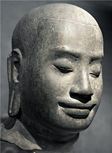
The kings of Angkor were seen as gods on earth, and they built huge stone temples such as Angkor Wat and the Bayon.
Since Jayavarman II proclaimed himself chakravartin, “universal ruler”, and devaraja, “god-king”, in 802, Khmer kings were held to have the divine quality of living gods, incarnations of Shiva or Vishnu. At the heart of a royal city stood a temple-mountain whose central lingam bore the king’s own name. Jayavarman VII, a Mahayana Buddhist, represented himself instead as the bodhisattva Avalokiteshvara in the face towers of the Bayon. The king and his officials ran the canals and reservoirs on which the harvests depended, and kings led large armies against Champa and Dai Viet. Zhou Daguan saw the king ride out standing on an elephant whose tusks were encased in gold, holding his sacred sword.
Moving in or out. No settled rule governed the succession: of the 27 rulers of Kambuja, eleven lacked a legitimate claim to power. Suryavarman I took the throne by seizing Angkor, Jayavarman VII by retaking it from the Cham, and in 1295 Jayavarman VIII was deposed by his son-in-law Srindravarman.
How many? One king, with the wives and concubines who rode behind him in procession under more than a hundred gold-flecked parasols.
Nobility and officials · c. 0.5–2% (est.)
Kshatriya (Royalty, ministers and nobles)
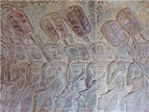
Princes and ministers rode on elephants under red umbrellas, and the higher a man’s rank, the bigger his house.
The kshatriyas, royalty, nobles, warlords, soldiers and warriors, formed the governing elite. The king was surrounded by ministers, state officials, nobles and royal kin, and in his procession Zhou Daguan saw the ministers and princes mounted on elephants under innumerable red umbrellas. Rank was written into their homes: the dwellings of the princes and principal officials were much larger than those of the people and laid out differently, their size set by each person’s official rank, and only the family temple and the main apartment could be roofed with tiles. Officials managed the waterworks and collected a rent for each trader’s place in the market.
Moving in or out. Royal and noble birth gave entry to the rank, but its members fought over it: Khmer kings and royal families were often caught up in power struggles over the succession or rivalries over principalities, and the relationship between the rulers and their elites was unstable. A prince could rise as a soldier, as Jayavarman VII did, leading armies under earlier kings before he took the throne.
How many? Estimate: no count survives; the royal family, the ministers, officials and nobles and their households, a governing elite among 2–4 million people.
Picture: The procession of Suryavarman II, a relief at Angkor Wat · Photo Dharma from Penang, Malaysia · CC BY 2.0 · Wikimedia Commons
Religious and learned · c. 0.1–0.5% (est.)
Brahmins
brahmin
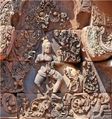
Brahmins were Hindu priests who led the ceremonies of the king and the nobles.
Hinduism was the state religion for most of the empire’s history, and its ceremonies and rituals were performed by Brahmins, usually only among the king’s family, the nobles and the ruling class. The rite by which Jayavarman II made himself god-king in 802 was taken from the Hindu tradition, and the royal cult was housed in temples to Shiva and Vishnu, from Pre Rup to Angkor Wat. Zhou Daguan had little to say about the Brahmans, except that they were often employed as high officials. Beside them he saw a third group, whom he called by a Chinese name and who appear to have been Shaivites: the only image they revered, he wrote, was a block of stone.
Moving in or out. The priests’ fortunes followed the king’s faith. Jayavarman VII made Mahayana Buddhism the state religion and had Hindu temples altered to show the Buddha; from about 1243 Jayavarman VIII restored Hinduism, made the Bayon a temple to Shiva and replaced Buddha images with lingams. From the 14th century Theravada Buddhism prevailed, and the last Sanskrit inscription dates from 1327.
How many? Estimate: no count survives; a priestly class whose Hindu rites were held mostly among the king’s family, the nobles and the ruling class, small beside the farming majority.
Picture: Shiva dancing, a relief of the 10th century at Banteay Srei · Pierre André Leclercq · CC BY-SA 4.0 · Wikimedia Commons
Religious and learned · c. 0.5–2% (est.)
Buddhist monks
-
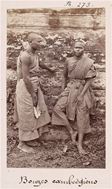
Buddhist monks at Angkor shaved their heads and wore yellow robes.
For most of the Angkor period Buddhism came after Hinduism in popularity, though kings built Buddhist temples and monasteries beside their Hindu shrines, and Jayavarman VII founded Ta Prohm for his mother and Preah Khan for his father. During the 13th century Theravada Buddhism, which had come from Sri Lanka by way of the kingdoms of Dvaravati and Haripunchai, spread even among the lower classes. When Zhou Daguan arrived in 1296 it was the dominant religion: its monks had shaven heads and wore yellow robes, and its temples impressed him with their simplicity, their Buddha images made of gilded plaster. Srindravarman, who took the throne in 1295, was a follower of Theravada Buddhism.
Moving in or out. The surviving sources say little of how men entered or left the monkhood. The faith’s spread mattered to the whole order: George Coedès argued that Theravada’s denial of the ultimate reality of the individual sapped the royal cult that had raised the great temples.
How many? Estimate: no count survives; by 1296 Theravada Buddhism was the dominant religion and its monks a common sight, but how many there were is not known.
Picture: Cambodian Buddhist monks, 1860s · Emile Gsell · Public domain · Wikimedia Commons
Soldiers, merchants and craftsmen · c. 3–8% (est.)
Traders and artisans
-
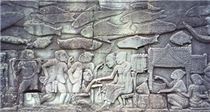
At Angkor’s market most of the traders were women, who sat on straw mats on the ground to sell their goods.
Among the other classes were traders and artisans: carpenters and stonemasons, potters, metalworkers, goldsmiths and textile weavers. Bronze was the preferred material for statues of the gods. The market of Angkor had no permanent buildings: it was an open square where traders sat on woven straw mats on the ground, some under a thatched parasol, and officials levied a rent for each space. Until the 13th century barter was the main way of exchange; Zhou Daguan recorded rice, grain and Chinese coins for small purchases, cloth as another medium, and gold and silver for the largest. Trade was mainly in women’s hands. No local people produced silk, Zhou wrote, and they wove cotton from kapok by hand, without a loom.
Moving in or out. Newcomers brought crafts of their own: settlers from Siam grew mulberry trees, raised silkworms and wove silk, and the local people asked Siamese women to mend their clothes. A Chinese man arriving at Angkor, Zhou wrote, first took in a local woman, partly to profit from her skill in trade.
How many? Estimate: no count survives; the farmers were the large majority, and a capital region of 700,000–900,000 people needed its carpenters, stonemasons, potters, metalworkers, goldsmiths, weavers and market traders.
Picture: A market scene in the reliefs of the Bayon · Unknown author · CC BY-SA 3.0 · Wikimedia Commons
Free commoners · About 80% (the rest, est.)
Rice farmers and fishermen
-
Most Khmer people were rice farmers and fishermen who lived in bamboo houses on stilts, safe from floods.
Rice farmers and fishermen formed the large majority. They planted rice by the banks of the lake and rivers, in the irrigated plains around their villages, or in the hills when the lowlands flooded, and canals and great reservoirs, the barays, watered their fields. Orchards gave palm sugar, coconuts, fruit and vegetables. Fish was the main source of protein, often made into prahok, a fish paste; pigs, cattle and poultry were kept beneath houses of woven bamboo raised on stilts against the floods. Zhou Daguan saw peasant men and women go barefoot with bare chests, wearing only a cloth around the waist. The reliefs of the Bayon show them fishing, butchering, playing a chess-like game and gambling on cockfights.
Moving in or out. War reached them all: when the Siamese attacked, Zhou wrote, ordinary people were ordered to face them without strategy or preparation, and soldiers fought naked and barefoot with lance and shield. When droughts and floods damaged the waterworks in the 14th and 15th centuries, many may have left the great cities and moved south.
How many? Everyone not counted in the other ranks: the large majority of the people. The empire’s population and several other ranks are estimates, so this share is one too.
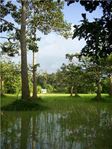
Picture: Rice fields around Angkor Thom · diego_cue · CC BY-SA 3.0 · Wikimedia Commons
Serfs and dependants · c. 1–3% (est.)
Temple servants
-
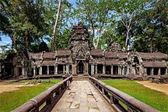
Giant temples like Ta Prohm needed thousands of people to look after them.
Only the gods had a right to houses of stone, so the temples were the empire’s great buildings, and they needed a great workforce. A stone carving at Ta Prohm, the monastery Jayavarman VII founded for his mother, states that 12,640 people serviced that single temple complex, and one estimate puts at some 300,000 the agricultural workers needed to feed the temples’ servants. Most surviving stone inscriptions record the religious foundations of kings and other potentates, so the temples’ people are known mostly as numbers. In the reign of Jayavarman VII alone Ta Prohm, Preah Khan, Banteay Kdei and Neak Pean were built, beside the Bayon at the centre of Angkor Thom.
Moving in or out. The surviving sources used here do not say how people came to serve a temple, or whether they could leave. George Coedès argued that the spread of Theravada Buddhism wore away the royal cult that had raised the temples, and the workforce that served them may have shrunk with it.
How many? Estimate: an inscription at Ta Prohm counts 12,640 people serving that one temple, and the Angkor area holds over a thousand temples; how many served temples full time across the empire is not known.


Enslaved · c. 5–15% (est.)
Slaves
-
At the bottom of Khmer society were slaves, people who belonged to others and were not free.
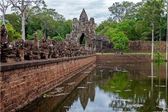
Slaves stood on the lowest social level of Khmer society, beneath the farmers and fishermen. Zhou Daguan’s account of Angkor, some forty pages long, treats slavery among its subjects beside religion, justice, kingship, agriculture and commerce, and with the inscriptions and the reliefs of the Bayon and Angkor Wat it is an important source on everyday life in the city. What he wrote of slaves, how many there were and what work they did, however, the accounts of his book used here do not record. Zhou did note that the gates of Angkor Thom, open by day and closed at night, were barred to dogs and to convicts.
Moving in or out. How people became slaves at Angkor, and whether they could go free, is not recorded in the sources used here.
How many? Estimate: no count survives; slaves stood on the lowest level of society, and the share given here is a wide guess for want of any figure.
Born into history
Where would you have stood? Chance places you on the ladder, as birth placed most people: weighted by how many each rank held.
Moving up and down
Birth set most people’s place, and the sources record movement chiefly at the top. The throne itself changed hands by force again and again: eleven of the 27 rulers of Kambuja lacked a legitimate claim, and kings such as Suryavarman I and Jayavarman VII won it by taking the capital. Faith could lift or lower whole groups: the Brahmins’ rites and the Buddhist monasteries rose and fell with the religion of each king, until Theravada Buddhism spread in the 13th century even among the lower classes. Foreigners found places of their own: Siamese settlers wove silk, and Chinese men took local women and shared in their trade. When Angkor declined its people moved too: the court left for the Phnom Penh area in 1431, and in Ayutthaya, which took over Angkor’s social stratification, the scribes, court Brahmans, jurists, chamberlains, accountants, physicians and astrologers of the early kingdom usually came from Khmer-speaking elites.
Women on the ladder
Women ran most of Angkor’s trade. “The local people who know how to trade are all women,” Zhou Daguan wrote, and the role suggests that they enjoyed significant rights and freedom. They married and bore children young, which may have added to the kingdom’s large population, and Zhou, judging by Chinese eyes, thought women of twenty or thirty looked like Chinese women of forty or fifty. Beautiful women were sent to court to serve the king or his family at his whim: in the royal procession three to five hundred palace women with flowers in their hair carried candles, others the royal regalia of gold and silver, and others lances and shields, ahead of the king’s guards, while his wives and concubines followed in palanquins and carriages and on horses and elephants. Common women wore a strip of cloth across the chest, noblewomen a longer one over the shoulder, and common women wore hair ornaments and gold rings or bracelets. In a farmer’s house the daughters had a room of their own, while the sons slept wherever they found space. Royal women were honoured in stone: Jayavarman VII built Ta Prohm for his mother.
Compare with another society
Test yourself
4 questions on the ladder of the Khmer Empire.
The questions open here once the page has loaded.
Sources and further reading
- Cœdès, G. (1966) The making of South East Asia. University of California Press.
- Higham, C. (2001) The Civilization of Angkor. Phoenix.
- Freeman, M. and Jacques, C. (2006) Ancient Angkor. River Books.
- Dagens, B. (1995) Angkor: Heart of an Asian Empire. Translated by Ruth Sharman. London: Thames & Hudson.
- Snellgrove, D. L. (2004) Angkor, Before and After: A Cultural History of the Khmers. Orchid Press.
- Zhou Daguan (2007) The Customs of Cambodia. The Siam Society.
The shares are of the whole population, children included. Where a scholar has counted or estimated a rank, its share follows that work, named on the rank; where no count survives, the share is an estimate, marked est. and drawn dashed, made from what the rank was and did, from related figures and from the same rank in comparable societies, and its note says what it rests on. Population: Estimate: the Greater Angkor Region alone held some 700,000–900,000 people at its peak in the 13th century, and the empire ruled or held as vassals most of mainland Southeast Asia beyond it; no figure for the whole empire rests on a count.
Cite this page
- APA
- The Epoch Institute. (2026). Social Hierarchy of the Khmer Empire. In Social Ladders. https://the-epoch-institute.org/societies/khmer-empire
- MLA
- “Social Hierarchy of the Khmer Empire.” Social Ladders, The Epoch Institute, 2026, https://the-epoch-institute.org/societies/khmer-empire. Accessed .
- Chicago
- The Epoch Institute. “Social Hierarchy of the Khmer Empire.” Social Ladders. 2026. https://the-epoch-institute.org/societies/khmer-empire.
- Harvard
- The Epoch Institute (2026) ‘Social Hierarchy of the Khmer Empire’, Social Ladders. Available at: https://the-epoch-institute.org/societies/khmer-empire (Accessed: ).