Social ladder · 1293–1389 (from Raden Wijaya to the death of Hayam Wuruk)
Social Hierarchy of Majapahit
From God-King to Palace Servant
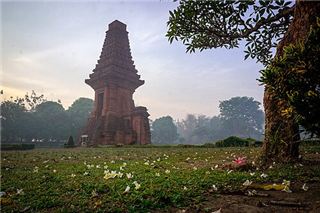
Majapahit, the Hindu-Buddhist kingdom founded in east Java in 1293, ranked people from a king held to be a living god down to the peasants of its villages. Under the king stood his close relatives, the Bhre, who ruled its provinces, a board of ministers headed by the patih, the prime minister, and the officials of the two faiths, Shaivism and Buddhism; the warrior and noble castes led the army’s levies, and religious learning passed through the households of kshatriya nobles and brahmana priests. Most people grew rice in the fertile northeast lowlands of Java, but inscriptions name a growing number of crafts and trades, and merchants from China, India and the Muslim lands settled in the ports. Under Queen Tribhuwana (r. 1328–1350) and her son Hayam Wuruk (r. 1350–1389), with the prime minister Gajah Mada, the kingdom claimed tribute from 98 lands from Sumatra to New Guinea, though its direct rule did not extend beyond east Java and Bali. Much of what is known comes from the court poem Nagarakretagama (1365), from inscriptions, and from foreign visitors: Odoric of Pordenone, Ibn Battuta and, in 1413, Ma Huan.
Period 1293–1389 (from Raden Wijaya to the death of Hayam Wuruk)People c. 3–6 million (est.)Ranks 9Profile Majapahit Empire
The ladder
By rank, the ladder is drawn as a pyramid. To scale, each bar is as wide as that rank’s share of the people. Shares marked est. are estimates where no count survives; their boxes and bars are dashed.
Ruler · One ruler
The king
chakravartin
The king of Majapahit was seen as a living god, and once a year people from many islands came to bring him tribute.
The king was the paramount ruler: as chakravartin he was considered the universal ruler and believed to be a living god on earth, regarded as the incarnation of Shiva, Vishnu and the Buddha at once, and held the highest political authority. Poets composed kakawin to worship the king of the gods whose incarnation the king represented, and Prapanca’s Nagarakretagama praises Hayam Wuruk. Every year, on the first day of Caitra, representatives of all the lands paying tax or tribute came to the capital to pay court. Kings were deified after death: the first king, Kertarajasa, was portrayed as Harihara in his mortuary temple. Ma Huan saw a king crowned with gold leaves, bare-chested, a dagger in his belt.
Moving in or out. The throne passed within the house of Raden Wijaya, and a woman could hold it: when Jayanegara was murdered in 1328, childless, the Queen Grandmother Gayatri Rajapatni, who had become a Buddhist nun, set her daughter Tribhuwana on it. After Hayam Wuruk died in 1389, his son-in-law and his son by a concubine fought over it in the Regreg War of 1405–1406.
How many? One king or reigning queen, with the queens and concubines of the court.
Nobility and officials · Fewer than 1 in 1,000 (est.)
Bhre (Royal kin and provincial lords)
Paduka Bhattara, Bhattara Saptaprabhu
The king’s close relatives ruled the provinces of Java and helped him make big decisions.
The title Bhre, “duke or duchess”, marked the highest position below the monarch. The provinces of east and central Java were ruled by provincial kings, the Paduka Bhattara, usually the king’s close relatives: under Hayam Wuruk there were twelve. They administered their provinces, collected taxes, sent yearly tribute to the capital and managed the defence of their borders. Seven influential elders, mostly close kin of the king, the Bhattara Saptaprabhu, formed a council that advised the king and sat in judgement on important cases: it suspended Gajah Mada over the disaster at Bubat. The highest offices of the court, the Rakryan Mahamantri Katrini, were usually reserved for the king’s heir.
Moving in or out. Royal birth or marriage brought the rank, and its members fought for more. Bhre Wirabhumi, Hayam Wuruk’s son by a concubine, claimed the throne against Vikramavardhana and was caught and beheaded in the Regreg War; the council then sentenced to death the man who had beheaded him.
How many? Estimate: twelve provinces were held by the king’s close relatives under Hayam Wuruk, and with the royal family around them the rank held some hundreds to a few thousand people among 3–6 million.
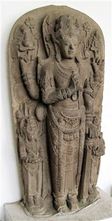
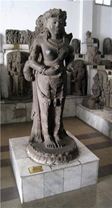
Picture: The portrait statue of Queen Suhita of Majapahit (r. 1429–1447) · Gunawan Kartapranata · CC BY-SA 3.0 · Wikimedia Commons

Nobility and officials · c. 0.5–2% (est.)
Mantri (Ministers, officials and nobles)
Rakryan Mantri ri Pakira-kiran, Rakryan Mapatih, Patih Hamangkubhumi, akuwu
Ministers helped the king run Majapahit, and the greatest of them, Gajah Mada, swore to unite the islands.
Royal edicts passed from the king to the high officials and on to their subordinates. A board of ministers, the Rakryan Mantri ri Pakira-kiran, ran the daily administration; its head, the Rakryan Mapatih or Patih Hamangkubhumi, was something like a prime minister and decided war and peace with the king. Below the provinces, regencies were run by a wiyasa and districts by an akuwu. Nobles lived in compounds outside the palace, Gajah Mada’s separated from it by open fields. Tomé Pires, in 1513, found the lords of Java “revered like gods”: great hunters and horsemen, their krises and lances inlaid with gold, keeping many concubines. In war the warrior and noble castes led the levies.
Moving in or out. Service could raise a man far. Gajah Mada, who saved Jayanegara with his Bhayangkara guard during the Kuti rebellion of 1319, was promoted to high office and in 1336 became mahapatih; Adityawarman, Jayanegara’s cousin, rose to be a senior minister. Office could also end in death: Halayudha, who had plotted against his rivals at court, was sentenced to death, and the minister Demung Sora was sentenced to death for killing Mahisa Anabrang.
How many? Estimate: no count survives; the ministers, the officials of the regencies and districts and the noble families with their households, among 3–6 million people.

Religious and learned · c. 0.5–2% (est.)
Priests and religious teachers
brahmana, dharmmadhyaksa, mahāresi, dewaguru
Priests of Shiva and of the Buddha led the kingdom’s ceremonies, and students learned from teachers in schools high in the hills.
Religion had officials of its own. The Dharmmadhyaksa oversaw the laws of the state and of religion: above all stood the Dharmmadhyaksa ring Kasewan, the highest Shaivite priest, and the Dharmmadhyaksa ring Kasogatan, the highest Buddhist one, each the authority on the religious law of his faith, while the Dharmma-upapatti dealt with religious affairs. Shaivism, Vaishnavism and Buddhism were all practised, and the state religion was possibly the Siwa Buddha, a joining of Shaivism and Buddhism. Shiva priests and Buddhists had quarters outside the palace walls. Priests led the court’s rites, such as the seven-day sraddha for the soul of the Queen Grandmother, and the Buddhist cleric Prapanca wrote the Nagarakretagama.
Moving in or out. Learning passed through the households of brahmana families and the Kadewaguruan, schools set in quiet forests or on hills and mountains far from habitation, each led by a mahāresi, a high priest also called dewaguru. Royalty too could enter religious life, as Gayatri Rajapatni did when she became a Buddhist nun.
How many? Estimate: no count survives; the Shaivite and Buddhist clergy of the court and the temples, the priestly households and the teachers of the Kadewaguruan.
Soldiers, merchants and craftsmen · c. 1–3% (est.)
Prajurit (Professional soldiers)
Bhayangkara, wwang jaladhi
Majapahit had a paid army of 30,000 soldiers and great ships called jongs that carried them across the sea.
The army had two kinds of men: prajurit, professional soldiers, and levies taken from the peasants. Majapahit kept some 30,000 full-time troops, soldiers and commanders paid in gold, a standing army only a handful of Southeast Asian empires could hope to maintain. The regular infantry wore scale armour, the richer soldiers of higher rank an armour called kawaca, and war elephants carried nobles and soldiers of higher rank. The Bhayangkara, an elite guard, protected the king and the nobility. The navy, the wwang jaladhi, was a corps of its own with better facilities, sailing the great jong; under Gajah Mada the fleet used gunpowder weapons learned from the Yuan. Troops from subordinate lands fought beside the Javanese.
Moving in or out. A soldier could rise far: Gajah Mada led the Bhayangkara guard that saved Jayanegara in 1319 and became prime minister. Many died far from home in the kingdom’s wars: in southern Borneo the dead were burned at Tambak Wasi in 1358, and surviving soldiers, sailors and metalsmiths settled in Amuntai, Alabio and Nagara.
How many? Estimate: some 30,000 full-time troops, with their families perhaps three or four times as many, among 3–6 million people.
Soldiers, merchants and craftsmen · c. 0.2–1% (est.)
Foreign merchants
-
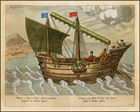
Traders from China, India, Arabia and nearby islands came to Majapahit’s ports to buy and sell spices.
The fame of the king, the Nagarakretagama says, drew foreign merchants from far and wide: Indians, Khmers, Siamese and Chinese among them. Muslim traders lived in the capital itself by the mid-14th century, for two Muslim tombstones near the palace date from 1368 and 1376, and there were Muslim courtiers. Later Ma Huan found large numbers of Chinese and Muslim merchants, from Arabia, India and above all Sumatra and the Malay Peninsula, settled in Tuban, Gresik and Hujung Galuh. A special tax was levied on some foreigners, possibly those who stayed on in Java and ran some business other than foreign trade. The spices of Maluku passed through the north coast ports, a chief source of the kingdom’s income.
Moving in or out. Foreigners rose by trade and by the king’s favour: Ma Huan counted seven or eight leaders among the foreign families of the capital who served the king. In the 15th century King Kertabhumi gave Muslim merchants trading rights on the north coast in return for their loyalty, and the coastal power of Demak that grew from them overthrew the kingdom in 1527.
How many? Estimate: Ma Huan found some 200 or 300 foreign families at the capital in 1413, and large numbers of Chinese and Muslim merchants settled in the north coast ports; no count survives.
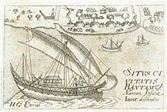
Picture: A Chinese or Javanese ship, an engraving of 1596 · Jan Huyghen van Linschoten · Public domain · Wikimedia Commons
Soldiers, merchants and craftsmen · c. 5–10% (est.)
Artisans and traders
-
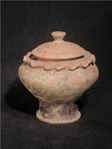
Craftspeople in Majapahit made gold jewellery, clay pots and money boxes shaped like wild boars.
Inscriptions of the period mention a large number of occupations, from gold and silversmiths to drink vendors and butchers, and the share of people earning an income from work other than farming seems to have grown. The Canggu inscription of 1358 lists 78 ferry crossings in Java. Around 1300 the old gold and silver coins gave way to imported Chinese copper coins, small enough for everyday buying and selling; taxes and fines were paid in cash, and savers kept coins in clay money boxes, often shaped like a wild boar. Potters made terracotta figurines, jars, roof tiles and ornaments, builders worked in red brick, and smiths forged steel daggers with handles of gold, rhinoceros horn or ivory.
Moving in or out. Court artisans worked for the royal house, preparing the great ceremonies of the court. Others were carried far by the kingdom’s wars, as the metalsmiths who settled in Borneo after the campaign of 1358; and when Majapahit fell, many artisans, with courtiers and priests, fled east to Bali.
How many? Estimate: no count survives; inscriptions name many occupations, from gold and silversmiths to drink vendors and butchers, and the share of people earning an income outside farming seems to have grown in this period.
Picture: A Majapahit terracotta vessel · C Hazzard · CC BY-SA 3.0 · Wikimedia Commons
Free commoners · About 85% (the rest, est.)
Rice farmers
-
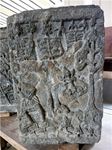
Most people in Majapahit were rice farmers, and their rich fields gave two harvests a year.
Most people farmed. The northeast lowlands of Java suited rice, and in Majapahit’s prime many irrigation projects were undertaken, some with the government’s help; Ma Huan wrote that rice was harvested twice a year, with white sesame and lentils but no wheat, and a Chinese writer of about 1339 called Java’s fields rich and well watered, its grain twice as plentiful as elsewhere. Villages, wanua, were administered by a thani. Commoners’ houses were thatched with palm leaves, and each family kept its goods in a brick storage shed and lived on top of it. When war came, peasants were conscripted as levies, bare-chested in a sarong, with spear, short sword or bow.
Moving in or out. Levies were led by the warrior and noble castes and fought far from home, and some never came back: Javanese soldiers who survived the Borneo war settled where they had fought. The sources used here give no other path out of the village.
How many? Everyone not counted in the other ranks: the great majority of the people. The kingdom’s population and several other ranks are estimates, so this share is one too.
Picture: Fields and mountains, a Majapahit relief (Museum Mojopahit, Trowulan) · Anandajoti Bhikkhu from Sadao, Thailand · CC BY 2.0 · Wikimedia Commons


Serfs and dependants · c. 1–3% (est.)
Servants of the palace and great households
-
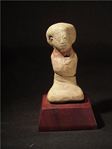
Servants lived in rows of houses inside the palace walls and worked for the royal family.
The royal compound at Trowulan, walled in red brick, held more than the king and his court: at the south end of its first courtyard a gate led to rows of houses set on terraces, where the palace servants lived. Great households had servants too. Tomé Pires described the lords of Java going out with large retinues and keeping apartments for their women, and Ma Huan recorded that among the upper class widowed wives, concubines or female servants performed sati, throwing themselves into the flames of the cremation fire. The law book of the period, the Kutaramanawa Dharmashastra, had rules on debts and pawnbroking, but the sources used here do not say whether debt bound anyone to service.
Moving in or out. How people entered service, and whether they could leave it, is not recorded in the sources used here.
How many? Estimate: no count survives; palace servants lived in rows of houses within the royal compound, and noble households kept female servants and large retinues.
Picture: A Majapahit terracotta figurine of a woman · C Hazzard · CC BY-SA 3.0 · Wikimedia Commons

Born into history
Where would you have stood? Chance places you on the ladder, as birth placed most people: weighted by how many each rank held.
Moving up and down
Birth set most ranks, but service to the king could lift a man a long way. Gajah Mada, a guard of the palace, became prime minister and made his Palapa oath to unite the archipelago; Adityawarman, raised in the palace, rose to be a senior minister and went on to found his own dynasty in the Minangkabau highlands. Conquest made lords of commanders: after Bali fell in 1343 its government was shared among the brothers of the general Arya Damar, and Arya Kenceng became the forebear of the royal houses of Tabanan and Badung. The same court was dangerous: Raden Wijaya’s most trusted men and former companions in arms, Ranggalawe, Sora and Nambi among them, rose against him and his son, and ministers and princes were put to death. Merchants rose with the ports: Muslim traders, present at court in the 14th century, dominated the north coast through Demak by the end of the 15th. When Majapahit fell to Demak in 1527, many courtiers, artisans, priests and members of the royal family fled east to Bali.
Women on the ladder
Two queens reigned in their own right, Tribhuwana (1328–1350) and Suhita (1429–1447), the title Bhre was held by duchesses as well as dukes, and the Queen Grandmother Gayatri Rajapatni, a Buddhist nun, was revered as the “protector of the world” and deified after her death. Ibn Battuta wrote that the women of Java rode horses, understood archery and fought like men. Royal marriages served alliance, and could end in bloodshed: when Hayam Wuruk sought the Sundanese princess Dyah Pitaloka as a consort in 1357, Gajah Mada turned the wedding into a demand for Sunda’s submission, and almost the whole Sundanese party was killed at Bubat. Tradition remembers Jayanegara for abusing women, the wives of his own officials among them, and the council of royal elders spoke strongly against his wish to marry his half-sisters. In marriage, Ma Huan wrote, the groom went to the bride’s family home and three days later brought her back to his own with drums, gongs and fireworks. Among the upper class, widows, concubines and female servants performed sati in the cremation fire.
Compare with another society
Test yourself
4 questions on the ladder of Majapahit.
The questions open here once the page has loaded.
Sources and further reading
- Hall, D. G. E. (1981) A History of South-East Asia (4th ed.). London: The Macmillan Press Ltd.
- Pigeaud, T. G. T. (1960) Java in the 14th Century: A Study in Cultural History, Volume III: Translations (3rd revised ed.). The Hague: Martinus Nijhoff.
- Muljana, S. (2005) Menuju Puncak Kemegahan: Sejarah Kerajaan Majapahit. Yogyakarta: LKiS Pelangi Aksara.
- Nugroho, I. D. (2011) Majapahit Peradaban Maritim. Suluh Nuswantara Bakti.
- Prapanca, Mpu (2018) Kakawin Nagarakertagama: Teks Asli dan Terjemahan (2nd ed.). Yogyakarta: Narasi.
The shares are of the whole population, children included. Where a scholar has counted or estimated a rank, its share follows that work, named on the rank; where no count survives, the share is an estimate, marked est. and drawn dashed, made from what the rank was and did, from related figures and from the same rank in comparable societies, and its note says what it rests on. Population: Estimate: no count survives (Raden Wijaya gave a census record to the Yuan in 1293, but no figure from it is known); Java was "populous exceedingly" to Odoric of Pordenone and "vast and densely populated" to Chinese writers, and a standing army of 30,000, with levies besides, suggests a realm of some millions in eastern Java, Madura and Bali, without the overseas tributaries.
Cite this page
- APA
- The Epoch Institute. (2026). Social Hierarchy of Majapahit. In Social Ladders. https://the-epoch-institute.org/societies/majapahit
- MLA
- “Social Hierarchy of Majapahit.” Social Ladders, The Epoch Institute, 2026, https://the-epoch-institute.org/societies/majapahit. Accessed .
- Chicago
- The Epoch Institute. “Social Hierarchy of Majapahit.” Social Ladders. 2026. https://the-epoch-institute.org/societies/majapahit.
- Harvard
- The Epoch Institute (2026) ‘Social Hierarchy of Majapahit’, Social Ladders. Available at: https://the-epoch-institute.org/societies/majapahit (Accessed: ).