Social ladder · 1320–1413 (the Tughluq sultans)
Social Hierarchy of the Delhi Sultanate
From Sultan to Enslaved

Under the Tughluq sultans (1320–1413) the Delhi Sultanate reached its greatest extent and then broke apart. People were ranked by their place in the sultan’s service, by their faith and by whether they were free. At the top stood the sultan and a military nobility of khans, maliks and amirs, many of them immigrants from Iran and Central Asia, who drew the land revenue of districts assigned to them. In the eyes of the sultanate’s chroniclers the Muslims were the people of the state, although most of them were Indians who had converted. Non-Muslims were classed as dhimmis and owed the jizya, yet the sultans relied on Hindu chiefs and village officials to collect the revenue. Slavery reached far up the ladder as well as down it: Firuz Shah Tughluq is said to have owned 180,000 slaves, who served him as guards, officials and craftsmen, while war and unpaid taxes drove many more into bondage.
Period 1320–1413 (the Tughluq sultans)People c. 50–90 million (est.)Ranks 10Profile Delhi Sultanate
The ladder
By rank, the ladder is drawn as a pyramid. To scale, each bar is as wide as that rank’s share of the people. Shares marked est. are estimates where no count survives; their boxes and bars are dashed.

Ruler · One ruler
Sultān
The sultan of Delhi ruled much of India. One sultan even made his whole court move to a new capital far to the south.
The sultan granted and confirmed the iqtas that paid his nobles, and for many Muslim observers his rule was justified by the protection and advancement of the faith. Ghiyath al-Din Tughluq, a frontier commander, took the throne in 1320 by defeating and killing Khusrau Khan. His son Muhammad bin Tughluq (1325–1351) ruled the widest realm any sultan held, but his schemes cost him dearly: a forced move of the Muslim elite to Daulatabad, coins of base metal that people forged at home, and revolts from 1327 on. Firuz Shah Tughluq (1351–1388) ruled for 37 years; in his memoir he wrote that he had banned torture such as amputation and the tearing out of eyes.
Moving in or out. No fixed rule decided the succession. Ghiyath al-Din seized the throne in 1320, and some historians, among them Vincent Smith, hold that his son killed him in 1325; after Firuz Shah’s death the nobles and his slave guard made and unmade sultans.
How many? One man, with the royal family.
Nobility and officials · c. 0.1–0.3% (est.)
Amīr (Nobles and revenue holders)
khān, malik, muqtiʿ, iqtadār
Nobles called khans and maliks collected the taxes of lands the sultan gave them and used the money to pay soldiers.
The great men of the sultanate bore the titles khan and malik, and the elite of its early years were overwhelmingly immigrants from Iran and Central Asia: Persians, Turks, Ghuris and Khalaj. Most were paid with an iqta, an assignment of the land revenue of a territory. Its holder, the muqti, collected the revenue, paid his troops from it, sent the surplus to the treasury and, in theory, had no further claim on the peasants. Muhammad bin Tughluq set a separate officer over the administration and paid soldiers from the treasury, and he cruelly punished nobles who would not move to Daulatabad, earning a hatred they long remembered. Firuz Shah made the iqtas hereditary to please the nobles.
Moving in or out. Office and revenue came from the sultan, and in theory an iqta was not inherited until Firuz Shah made it so. Birth still counted: when the frontier commanders Jalaluddin Khalji and Ghiyath al-Din Tughluq reached for the throne, they found little support because of their un-noble origins.
How many? Estimate: the khans, maliks and amirs who held high office and iqta assignments, with their families and households: a small military elite of a few thousand families among tens of millions.
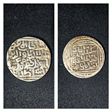
Picture: A silver tanka of Alauddin Khalji, 1296–1312 · SpeakingArch · CC BY-SA 4.0 · Wikimedia Commons

Soldiers, merchants and craftsmen · c. 0.2–0.4% (est.)
Ghulām (The sultan's slaves)
Some enslaved boys were trained to be soldiers and officials for the sultan, and his slave guard became very powerful.
Slaves in the sultan’s service could stand above most free people. The sultanate’s army had begun as the Turkic slave soldiers of Muhammad of Ghor, its nucleus were household cavalry archers of slave origin, and the sultans bought Turks to build a corps of mounted archers whose loyalty was to their master, not to any people. Firuz Shah Tughluq vastly increased the slaves in his own service and in that of the Muslim nobles. They were converted to Islam, taught to read and memorise the Quran and employed in many offices, above all in the army, and about 12,000 of them were skilled artisans. Known as the Ghulaman-i-Firuz Shahi, they formed an elite guard that became influential in the state.
Moving in or out. Men entered the corps by capture or purchase. Their service could carry them far: after Firuz Shah’s death his old slaves turned against Sultan Abu Bakr Shah and had Nasir ud-Din Muhammad Shah placed on the throne, and under the Khaljis the slave general Malik Kafur, born to a Hindu family, had held power himself in 1316.
How many? Estimate: Firuz Shah Tughluq is said to have owned 180,000 slaves, roughly 12,000 of them skilled artisans; among some 50–90 million people, roughly 0.2–0.4 per cent.
Picture: Firoz Shah Kotla, the citadel of Firuz Shah Tughluq in Delhi · Zebraisnotblack&white · CC BY-SA 4.0 · Wikimedia Commons

Religious and learned · c. 0.5–1% (est.)
ʿUlamāʾ (Muslim scholars, judges and Sufis)
qāzī, sayyid, shaikh
Muslim scholars and judges taught and used Islamic law, and Sufi holy men were honoured with great tombs.
The sultanate followed the Hanafi school of Islamic law, and its judges and learned men wore ample gowns and an Arabic robe, the durra, unlike the soldiers and clerks, who wore the qaba coat. Muhammad bin Tughluq ordered the sayyids, shaikhs and ulama, with the nobles, to move to Daulatabad, seeing them as propagandists of his empire and hoping the Sufis would win converts in the Deccan. Sufi saints were honoured with great tombs: the first major monument of the Tughluq age, built in Multan between 1320 and 1324, was the tomb of the saint Shah Rukn-e-Alam. Strict chroniclers such as Ziauddin Barani urged harsher treatment of non-Muslims, and Firuz Shah acted against Shi’a and other sects he judged heretical.
Moving in or out. Learning and descent made a scholar: sayyids claimed descent from the Prophet Muhammad. The sultan’s favour decided the rest, and Firuz Shah would not tolerate preachers of sects he held to be deviant.
How many? Estimate: the scholars, judges, sayyids and Sufi shaikhs with their families, a small learned class, as in the neighbouring Islamic states.
Nobility and officials · c. 1–3% (est.)
Rāwat (Hindu chiefs and village officials)
patwārī
Hindu chiefs and village officials collected taxes for the sultan, but some chiefs rebelled and made their own kingdoms.
The sultanate claimed to be the paramount power rather than the only one, as earlier Hindu kingdoms had done. It left some conquered Hindu rulers their autonomy and their armies, and took Hindu vassals and officials freely into its service. In the countryside it relied on Hindu subordinate elites, such as the rawats and the patwaris, to collect the land revenue, and the Tughluqs employed many Hindus in their corps of architects and builders. The chiefs’ loyalty was never assured. By 1339 Hindu kings in the south had revolted and declared their independence, the Vijayanagara Empire arose in answer to the sultanate’s attacks, and the Kangra State defeated the army Muhammad bin Tughluq sent over the Himalayas.
Moving in or out. A chief kept his rank by submitting and paying, and lost it by defeat; a rising, as in the south in the 1330s, could make him independent again.
How many? Estimate: the Hindu vassal rulers and chiefs, and the rawats, patwaris and other local men who collected the revenue, with their families.
Religious and learned · c. 3–6% (est.)
Brāhmaṇa (Brahmins and temple priests)
Brahmins were Hindu priests. When soldiers attacked one great temple, its priests hid its holy books and carried its statue away.
The Brahmins held a standing that even the sultans recognised: Firuz Shah Tughluq’s predecessor had exempted all Brahmins from the jizya, and Firuz Shah extended the tax to them only at a reduced rate. By the account of a Sri Vaishnava temple chronicle, when Ulugh Khan, the future Muhammad bin Tughluq, sacked the temple of Srirangam in 1323, some 12,000 scholars and temple functionaries were killed; the teacher Pillai Lokacharya carried the processional image south, and Vedanta Desika hid the sacred manuscripts. Yet the same sultan, a Sanskrit inscription records, repaired a temple of Shiva and Parvati at Bidar after his conquest of the Deccan.
Moving in or out. Brahmin rank came by birth. A Brahmin who became a Muslim was freed of the jizya and, under Firuz Shah, given presents and honours.
How many? Estimate: the Brahmin families, of whom the priests and temple servants were a part; the same rank in classical India is put at 4–8 per cent.
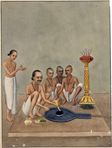
Picture: Priests at worship in the Baijnath temple, Deoghar, a watercolour by Shiva Lal, about 1870 · Shiva Lal · Public domain · Wikimedia Commons
Soldiers, merchants and craftsmen · c. 2–4% (est.)
Soldiers of the standing army
-
The sultan’s army had hundreds of thousands of horsemen and fought off invaders from Central Asia.
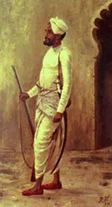
The sultans kept a large standing army. Historians put that of the Khaljis at 300,000 to 400,000 horsemen and 2,500 to 3,000 war elephants, and the Tughluqs at 500,000 horsemen. It fought off the Mongol invasions from the Chagatai Khanate and carried the sultanate’s conquests deep into southern India. Soldiers dressed like the officers above them, in the qaba coat in the style of Khwarezm, tucked in at the waist, a turban wrapped round a cap, and red boots. Muhammad bin Tughluq paid his soldiers from the central treasury to check corruption, while Firuz Shah went back to assigning villages to soldiers instead of a salary and made the assignments hereditary.
Moving in or out. Horsemen were recruited and bought: the core of the cavalry came from slave backgrounds. Under Firuz Shah a soldier’s village assignment passed to his heirs.
How many? Estimate: historians put the Tughluq standing army at 500,000 horsemen; with their families, among some 50–90 million people.
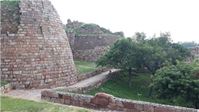
Picture: Tughlaqabad, the fortress of the Tughluq sultans in Delhi · Pinakpani · CC BY-SA 4.0 · Wikimedia Commons
Free commoners · c. 8–12% (est.)
Townspeople
-
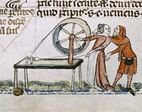
In the towns, craftsmen and traders made and sold goods, and the spinning wheel came into use in India.
The towns held the sultanate’s merchants, craftsmen and labourers. Their trade lived under close control: Alauddin Khalji had replaced the private markets with four state markets, fixed the price of everything and required merchants to register, and Barani wrote that even after the controls were lifted on his death in 1316 people feared his spies and avoided trading in costly goods. Muhammad bin Tughluq’s coins of base metal (1329–1332) failed because people minted their own at home. New machines came in from the Islamic world, such as geared water-wheels, and the earliest clear reference to a spinning wheel in India dates from 1350. Hindustani, or Hindavi, took shape as the common speech of the period.
Moving in or out. Migrants fleeing the Mongol raids on Central and West Asia brought traders, artists and artisans into the towns. War could also carry artisans away: in 1398 Timur’s army massacred the people of Delhi and took skilled craftsmen to Samarkand as slaves.
How many? Estimate: the merchants, shopkeepers, artisans and labourers of Delhi, Daulatabad, Multan and the other towns, by comparison with the 9–15 per cent of the Mughal ladder three centuries later.
Free commoners · About 77% (the rest, est.)
Peasants
-
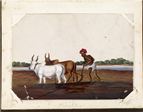
Most people were farmers who paid heavy taxes on their harvests to the sultan and his nobles.
The peasants paid for the sultanate. Alauddin Khalji had raised the tax on harvests from a fifth to half and limited the grain cultivators could keep for themselves. Their revenue went to the iqta holders, who in theory could claim nothing more from them once it was paid, and it was collected through local Hindu officials. Non-Muslim men owed the jizya too, from which Hanafi jurists exempted women, children, the old and the poor. After Muhammad bin Tughluq’s failed coinage, famine, poverty and rebellion spread across the kingdom. Firuz Shah dug a canal from the Yamuna to steady the food supply, offered converts freedom from taxes and the jizya, and raised the jizya on those who stayed Hindu.
Moving in or out. Conversion lightened the tax under Firuz Shah, while a village that resisted or failed to pay could be enslaved: Balban had ordered it in Awadh, and Alauddin Khalji made it lawful for revenue defaulters.
How many? Everyone not counted in the other tiers: chiefly the peasants of the villages, most of them Hindus who owed the land revenue and the jizya. Several of the other ranks are estimates, so this share is one too.
Picture: Ploughing, from an album of Indian village life, about 1870 (Walters Art Museum) · Unknown author · Public domain · Wikimedia Commons


Enslaved · c. 1–3% (est.)
Banda (Enslaved people)
ghulām
Many people were captured in wars or for unpaid taxes and forced to work as slaves, and some were sold far away in Central Asia.
Slavery became the predominant system of North India in the 13th century, André Wink writes, and kept considerable importance in the 14th. People were enslaved in war and through the revenue system: the sultans and their officers had their armies seize the people of villages that resisted or did not pay, and Alauddin Khalji made it lawful to enslave those who defaulted on the jizya and land tax. His officials sold them in the growing towns, where slave labour was in demand, and so many Hindus were sold to the markets of Central Asia that Indian slaves became cheap. Many were forced to convert to Islam, and children born to enslaved women of Muslim masters were raised as Muslims.
Moving in or out. Some enslaved men rose high in the sultans’ service, as Qutb ud-Din Aibak, a former slave, rose to be the first sultan of Delhi in 1206. Others were carried far from home: in 1398 Timur took men, women and children from Delhi to Samarkand as slaves.
How many? Estimate: besides the sultan’s own slaves, counted above, slaves served the nobles, soldiers and townspeople; Barani credited Alauddin Khalji with 50,000 slave boys and 70,000 building slaves.
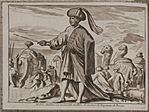
Picture: Malik Ambar, who rose from slavery to rule in the Deccan, in a European engraving · Pieter Boudewyn Van Der Aa · Public domain · Wikimedia Commons

Born into history
Where would you have stood? Chance places you on the ladder, as birth placed most people: weighted by how many each rank held.
Moving up and down
The sultanate’s ladder was open at the top to soldiers and slaves. Its first rulers were slave generals: Qutb ud-Din Aibak, a former slave of Muhammad of Ghor, became the first sultan in 1206. Under the Khaljis Malik Kafur, born to a Hindu family, and Khusrau Khan, another slave general of Indian origin, held power, and Ghiyath al-Din Tughluq rose from frontier commander to sultan in 1320. Firuz Shah’s slave guard ended by choosing sultans. Conversion was the other road: most Muslims in India were Indians who had converted, Firuz Shah rewarded converts with freedom from taxes and the jizya and with presents and honours, and his grand vizier, Khan-i-Jahan Maqbul, was a Telugu Muslim. Migration kept the elite changing, as Mongol raids on Central and West Asia drove soldiers, scholars, mystics, traders and artisans into India. Downward the roads were short and steep: a village that failed to pay could be enslaved, and nobles who refused Muhammad bin Tughluq’s order to move to Daulatabad were cruelly punished.
Women on the ladder
Women’s lives followed their family’s rank and faith. In the century before the Tughluqs a woman had ruled: Razia Sultana reigned from 1236 to 1240, one of the few women to rule in the Islamic world, though nobles and clergy resented a female monarch, and in 1236 Shah Turkan had run the government for her son Rukn ud-Din Firuz. Alauddin Khalji forbade marriages between noble families, to keep the nobility from combining against him. Under Hanafi law women were exempt from the jizya. Enslaved women bore children to Muslim masters, and those children were raised as Muslims, and non-Muslim women whom Muslim soldiers and nobles had taken converted to Islam to escape rejection by their own communities. In 1398 Timur’s army carried women and children off from Delhi into slavery.
Compare with another society
Test yourself
4 questions on the ladder of the Delhi Sultanate.
The questions open here once the page has loaded.
Sources and further reading
- Cahen, C. (1971) 'Iḳṭāʿ', in Lewis, B., Ménage, V. L., Pellat, Ch. and Schacht, J. (eds) The Encyclopaedia of Islam, Second Edition. Volume III: H–Iram. Leiden: E. J. Brill.
- Elliot, H. M. and Dowson, J. (1867) The History of India, as Told by Its Historians. The Muhammadan Period, Vol. 3. London: Trübner & Co.
- Hambly, G. R. G. and Asher, C. B. (1994) 'Delhi Sultanate', in Yarshater, E. (ed.) Encyclopædia Iranica, Vol. VII/3. London and New York: Routledge & Kegan Paul.
- Kumar, S. (2007) The Emergence of the Delhi Sultanate, 1192–1286. Permanent Black.
- Levi, S. C. (2002) 'Hindus Beyond the Hindu Kush: Indians in the Central Asian Slave Trade', Journal of the Royal Asiatic Society.
- Saksena, B. P. (1992) 'The Khaljis: Alauddin Khalji', in Habib, M. and Nizami, K. A. (eds) A Comprehensive History of India, Vol. 5: The Delhi Sultanat (A.D. 1206–1526). 2nd edn. The Indian History Congress / People's Publishing House.
- Wink, A. (1991) Al-Hind: the Making of the Indo-Islamic World. Leiden: Brill Academic.
The shares are of the whole population, children included. Where a scholar has counted or estimated a rank, its share follows that work, named on the rank; where no count survives, the share is an estimate, marked est. and drawn dashed, made from what the rank was and did, from related figures and from the same rank in comparable societies, and its note says what it rests on. Population: Estimate: Angus Maddison puts all of India at 85 million in 1200 and 101 million in 1500; the sultanate held most of the subcontinent at its height under Muhammad bin Tughluq and lost the east and the south from 1339.
Cite this page
- APA
- The Epoch Institute. (2026). Social Hierarchy of the Delhi Sultanate. In Social Ladders. https://the-epoch-institute.org/societies/delhi-sultanate
- MLA
- “Social Hierarchy of the Delhi Sultanate.” Social Ladders, The Epoch Institute, 2026, https://the-epoch-institute.org/societies/delhi-sultanate. Accessed .
- Chicago
- The Epoch Institute. “Social Hierarchy of the Delhi Sultanate.” Social Ladders. 2026. https://the-epoch-institute.org/societies/delhi-sultanate.
- Harvard
- The Epoch Institute (2026) ‘Social Hierarchy of the Delhi Sultanate’, Social Ladders. Available at: https://the-epoch-institute.org/societies/delhi-sultanate (Accessed: ).