Social ladder · 1605–1703 (Ekathotsarot to Phetracha)
Social Hierarchy of the Ayutthaya Kingdom
From King to Slave

Ayutthaya ranked every person by law. Under the sakdina system, which King Borommatrailokkanat fixed in 1454 and the Three Seals Law records, each rank carried a number, in name the rai of land its holder was entitled to: 5 for a slave, 20 for a commoner, 600 for a learned monk, 10,000 for a chief minister and 100,000 for the uparaja, the king’s chosen successor. What the numbers measured in practice was manpower. Every free man was registered as a phrai under a lord, who called him up for labour and war, and an official’s standing rested on how many phrai he commanded. A service nobility of a few thousand ran the kingdom for a king revered as semi-divine. Outside the scale, to some extent, stood the Buddhist monks and the Chinese, who owed no labour service. In the 17th century, an age of peace and trade, foreigners rose high at court, and almost every succession to the throne was fought out in the capital.
Period 1605–1703 (Ekathotsarot to Phetracha)People c. 1.5–3 million (est.)Ranks 7Profile Ayutthaya Kingdom
The ladder
By rank, the ladder is drawn as a pyramid. To scale, each bar is as wide as that rank’s share of the people. Shares marked est. are estimates where no count survives; their boxes and bars are dashed.
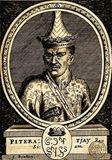
Ruler · One ruler
Phra Chao Phaendin (The king)
chakkraphat
The king of Ayutthaya was called Lord of the Land, and people spoke to him in a special royal language.
From the 17th century the king of Ayutthaya was an absolute monarch with a semi-religious standing. Hindu tradition cast him as an incarnation of Vishnu, Indra or Shiva; Buddhist thought made him a righteous ruler and a bodhisattva, whose duty was to build temples and Buddha images. His subjects called him Phra Chao Phaendin, “Lord of the Land”, and court etiquette required a royal language, Rachasap, for speaking to him or of him. In theory he commanded all manpower and so owned all land; since Naresuan every phrai was bound to him directly. He appointed ministers and governors, sat at times as the highest judge over traitors and rebels, and held a virtual monopoly of the kingdom’s income. François-Timoléon de Choisy wrote in 1685 that “the king has absolute power”.
Moving in or out. No settled law fixed the succession. The king often named a preferred successor as uparaja, but any man of the royal clan could claim the throne by defeating his rivals: in the 17th century, as one study puts it, “the method of royal succession at Ayutthaya … was battle”. Officials took it too: the Kalahom Prasat Thong in 1629, and Phetracha, Narai’s elephant commander, in 1688.
How many? One king, with his wives, who usually numbered in the dozens, and their children.
Nobility and officials · Fewer than 1 in 1,000 (est.)
Princes of the royal clan
uparaja, Maha Uparat
The king’s sons and brothers lived at court, and one of them was chosen to be the next king.
The king’s kin stood above every official. The highest of them was the uparaja, an office created by Borommatrailokkanat and usually held by the king’s senior son or full brother; the Three Seals Law gave the Maha Uparat a sakdina of 100,000, ten times a chief minister’s. Meant to settle the succession in a polygamous dynasty, the office bred rivalry between king and heir. The chronicles distinguish legitimate sons from the sons of concubines: Songtham, a son by a first-class concubine, became king only after both legitimate sons of Ekathotsarot had died. After Naresuan no princes governed provinces. They were kept in the capital, and their struggles for power went on there, under the king’s eye.
Moving in or out. Princes were born to the rank. Thai tradition favoured brothers over sons, but nearly every succession was contested, and the losers often died: Prince Sisin, the late king’s brother, was captured and executed in 1628, and King Chai was deposed and executed by his uncle in 1656.
How many? Estimate: the king’s sons and brothers and their households, some hundreds to a few thousand people, kept in the capital since Naresuan’s reign.
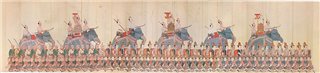
Picture: A royal procession in the reign of King Narai (1656–1688), from a 1918 copy of an older original · Unknown author · Public domain · Wikimedia Commons
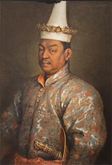
Nobility and officials · c. 0.3–1% (est.)
Mun nai (Officials and lords)
amat, nai, chao nai
Each noble in Ayutthaya had a number that showed his rank, and he led the men who worked and fought for the king.
A service nobility of a few thousand men governed the kingdom. Each held a title and a sakdina, up to 10,000 for a chief minister, and his allotment answered to the number of phrai he commanded. Two prime ministers headed the court: the Samuha Nayok for civil affairs, over the four ministries, and the Samuha Kalahom over the armed forces. The king appointed the governors of the cities, each watched by an inspector, the yokkrabat. Officials were rewarded with rice fields, not salaries. As mun nai, lords, they raised their own phrai for war and royal works, which made them powerful in politics. Ministries and governorships, with their sakdina, usually passed within a few families, often tied to the king by marriage.
Moving in or out. Offices were mostly inherited, but the king could raise new men, and foreigners often rose high: the Greek adventurer Constantine Phaulkon became Narai’s prime minister. A fall could be fatal. Purges of officials followed conflicts with the king, and Phaulkon was executed in 1688.
How many? Estimate: a service nobility of a few thousand men, with their families, among 1.5–3 million people.
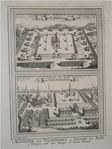
Religious and learned · c. 1–2% (est.)
Sangha (Monks and court Brahmins)
Buddhist monks lived in temples, and any man, rich or poor, could become a monk.
Theravada Buddhism was the kingdom’s main religion, and its monastic community, the sangha, stood partly outside the sakdina order, for men of every class could join it. The Three Seals Law gave a learned monk a sakdina of 600, thirty times a commoner’s. Building temples was one of a king’s chief duties: Songtham raised a great temple at Wat Phra Phutthabat, and Borommakot, celebrated as a pious king, sent two Siamese monks to reform Buddhism in Sri Lanka in 1753. The court Brahmins conducted the coronation and the rites of divine kingship, for many elements of the political order came from Hindu scripture. The Buddhist clergy resented the favour Narai showed to French interests and the Catholic missionaries.
Moving in or out. Any man could enter the sangha, and many phrai did so to escape their lords’ control. A monk could also leave it: in 1760 the people of the capital urged Uthumphon, a former king living as a monk, to lead its defence against the Burmese.
How many? Estimate: no count survives; the sangha was open to men of every class, and phrai entered it to escape labour service; monks are counted without families, and the court Brahmins were a small group.
Picture: Siamese monks (talapoins), from Prévost's Histoire générale des voyages, 1746–1759 · Jacques-Nicolas Bellin · Public domain · Wikimedia Commons
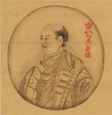
Soldiers, merchants and craftsmen · c. 0.5–2% (est.)
Chinese and foreign communities
-
Traders from China, Japan, Persia and Europe lived in Ayutthaya, and some of them served as the king’s guards.
Ayutthaya was a great port, and its foreign communities had a place of their own. The Chinese were not obliged to register for labour service and could move about the kingdom and trade at will; by the 16th century they controlled its internal trade and held important posts in civil and military service. The Japanese quarter, Ban Yipun, under a chief the Thai authorities appointed, held traders, Christians fleeing persecution and former samurai. Persian, Malay, Cham, Makassar, Dutch and Portuguese communities lived and traded there too. The kings hired foreign mercenaries, and foreigners, lacking ties within the kingdom, often rose high at court: Yamada Nagamasa’s Japanese served as King Songtham’s royal guard.
Moving in or out. Foreigners rose with a king’s favour and fell with it: Prasat Thong had Yamada Nagamasa assassinated in 1630 and banished the Japanese, and a Makassar revolt failed in 1686. The Chinese grew with the rice trade to China in the late 17th and 18th centuries.
How many? Estimate: the Chinese of the capital possibly tripled from 1680 to 1767, when they reached 30,000; the Japanese quarter held about 1,500 people (some estimates say 7,000); Persians, Malays, Chams, Dutch and Portuguese lived there too.
Free commoners · About 79% (the rest, est.)
Phrai (Commoners)
phrai luang, phrai som, phrai suay
Most people in Ayutthaya were rice farmers, and every man had to work for the king or a lord for part of each year.
Every free man was registered as a phrai under a lord, a system Ramathibodi II (r. 1491–1529) made general. A phrai owed labour for half the months of the year, on public works such as canals and on the lands of his official, and in war the men were conscripted; the phrai suay paid in taxes instead. Phrai luang served the king, worked crown lands and fought in his army, phrai som the officials. Most lived in villages of extended families, often along the canals near the cities, where the headman held the land for the community and families kept its use as long as they farmed it. They grew rice to eat and to pay taxes, and made textiles for sale abroad. Their sakdina was 20.
Moving in or out. A phrai could become a monk, or sell himself as a slave to another lord, who compensated his old one. Many simply escaped: they fled into the forests or bribed conscription officers, and as trade grew more of them slipped away to farm on their own.
How many? Everyone not counted in the other ranks: the great majority of the people. The kingdom’s population and several other ranks are estimates, so this share is one too.
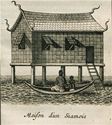
Picture: A Siamese house, drawn for Simon de La Loubère's account of his embassy, 1687–1688 · Simon de la Loubère · Public domain · Wikimedia Commons



Enslaved · c. 10–25% (est.)
That (Enslaved people)
Some people in Ayutthaya were slaves who belonged to a master, often because they were captured in war or owed money.
Slaves, that (from the Pali dasa), formed the lowest rank, with a sakdina of 5. By law a master “had absolute power over their slaves other than the right to take their lives”. People became slaves as war captives, through debt or by birth to slave parents, and a phrai could sell himself to a lord. Ayutthaya’s victorious campaigns brought conquered people into the kingdom, where they were put into its labour force. Masters set their slaves to work on their lands and gardens and in their households, or let them earn their own living in return for a yearly payment: Simon de la Loubère, who visited in 1687, put it at four to eight ticals.
Moving in or out. Slavery came by capture, debt, sale or birth. It was abolished in stages from 1874 to 1905, under King Chulalongkorn, and legally ended only in 1915.
How many? Estimate: no count survives for the 17th century; people were enslaved as war captives, through debt and by birth, and phrai sold themselves into slavery, so their number was large but is not known.
Picture: Slaves in Bangkok, photographed in 1895 · Unknown author · Public domain · Wikimedia Commons

Born into history
Where would you have stood? Chance places you on the ladder, as birth placed most people: weighted by how many each rank held.
Moving up and down
Rank in Ayutthaya was fixed by law but not sealed by birth. Commoners moved by choice as well as misfortune: a phrai could join the sangha, sell himself into slavery or flee to the forest, and the laws tightening control of labour were issued again and again, a sign of how hard the elite found it to hold its people. Foreigners climbed furthest: Constantine Phaulkon became Narai’s prime minister, and Yamada Nagamasa became ruler of Nakhon Si Thammarat. Officials could reach the throne itself, as Prasat Thong did in 1629 and Phetracha in 1688. In the kingdom’s last 150 years, trade made some commoners rich: late records name a new category, the phrai mangmi, rich “serfs”, and nobles took titles and privileges once kept for royalty. The same weakening of labour control left the kingdom short of soldiers when the Burmese invaded in 1759–1760 and 1765–1767.
Women on the ladder
The sources say little of women outside the court. Kings married to bind powerful families to the throne, and their wives usually numbered in the dozens; the queen wore a chada headdress and the sabai, a breast cloth over one shoulder, while concubines wore their hair long. The chronicles set legitimate sons apart from the sons of concubines, and royal consorts could be drawn into deadly politics: in the 18th century the uparaja Thammathibet was executed for an affair with two of his father’s consorts. Only men were conscripted, and the sangha was a community of men. Village women wore the sabai and pha nung, as noblewomen did. In Lavo, before the kingdom was founded, a Chinese account noted that women held considerable authority over economic and travel decisions, and the rabam that La Loubère saw in 1687 was danced by men and women together.
Compare with another society
Test yourself
5 questions on the ladder of the Ayutthaya Kingdom.
The questions open here once the page has loaded.
Sources and further reading
- Baker, C. and Phongpaichit, P. (2017) A History of Ayutthaya: Siam in the Early Modern World. Cambridge: Cambridge University Press.
- Lieberman, V. (2003) Strange Parallels: Southeast Asia in Global Context, c. 800–1830. Volume 1: Integration on the Mainland. Cambridge: Cambridge University Press.
- Wyatt, D. K. (2003) Thailand: A Short History. New Haven: Yale University Press.
- Wood, W. A. R. (1924) A History of Siam. London: Fisher Unwin.
- Marcinkowski, M. I. (2005) From Isfahan to Ayutthaya: Contacts between Iran and Siam in the 17th Century. Singapore: Pustaka Nasional.
The shares are of the whole population, children included. Where a scholar has counted or estimated a rank, its share follows that work, named on the rank; where no count survives, the share is an estimate, marked est. and drawn dashed, made from what the rank was and did, from related figures and from the same rank in comparable societies, and its note says what it rests on. Population: Estimate: no count for the 17th century survives in the sources used; the Burmese war of 1765–1767 killed some 200,000 people and carried 30,000–100,000 off to Burma, losses that left Siam depopulated for much of the following century.
Cite this page
- APA
- The Epoch Institute. (2026). Social Hierarchy of the Ayutthaya Kingdom. In Social Ladders. https://the-epoch-institute.org/societies/ayutthaya
- MLA
- “Social Hierarchy of the Ayutthaya Kingdom.” Social Ladders, The Epoch Institute, 2026, https://the-epoch-institute.org/societies/ayutthaya. Accessed .
- Chicago
- The Epoch Institute. “Social Hierarchy of the Ayutthaya Kingdom.” Social Ladders. 2026. https://the-epoch-institute.org/societies/ayutthaya.
- Harvard
- The Epoch Institute (2026) ‘Social Hierarchy of the Ayutthaya Kingdom’, Social Ladders. Available at: https://the-epoch-institute.org/societies/ayutthaya (Accessed: ).