Social ladder · 1556–1707 (Akbar to Aurangzeb)
Social Hierarchy of the Mughal Empire
From Emperor to Enslaved
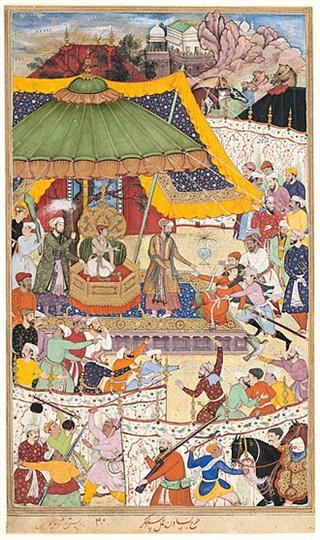
Mughal India ranked people by their place in the emperor’s service, by their rights over land and by birth. The emperor granted every rank in an imperial service that was army, nobility and government at once: the mansabdars, a deliberately mixed elite of Central Asians, Iranians, Afghans, Indian Muslims and Rajputs, paid with assignments of land revenue that he moved at will. Below them the zamindars held hereditary rights over the revenue of the countryside, from Rajput kings to village landholders, and religion gave its own honour to Muslim scholars, Sufi shaikhs and Brahmin priests. The great majority were peasants, who owed a third or more of their harvest to the state, and society was divided into many castes, the lowest held to be untouchable. The ladder was steep: around 1650 the 445 highest-ranked nobles drew 61 per cent of the empire’s revenue.
Period 1556–1707 (Akbar to Aurangzeb)People 116–150 millionRanks 9Profile Mughal Empire
The ladder
By rank, the ladder is drawn as a pyramid. To scale, each bar is as wide as that rank’s share of the people. Shares marked est. are estimates where no count survives; their boxes and bars are dashed.
Ruler · One ruler
Pādshāh (The emperor)
The Mughal emperor gave every noble his rank, and when he died his sons often fought each other for the throne.
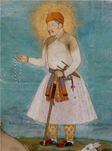
The emperor, the pādshāh, was the source of every rank. He granted, raised and cut the mansabs of the nobility and assigned and withdrew the revenue that paid them, and when a noble died his estate came under the emperor’s control, the heirs receiving what he chose to give them. Akbar divided the power of a single chief minister among four, for finance, the army, the household and religious grants, so that none could dominate. In law the emperor was the final judge: Jahangir hung a “chain of justice” in the Agra Fort that any wronged subject could shake. The revenue of the crown lands, the khalisa, which was never assigned to nobles, kept his household and paid his own troops. No rule fixed the succession. Princes held ranks and armies of their own and fought for the throne: Aurangzeb defeated his brother Dara Shikoh in 1659 and kept their father Shah Jahan a prisoner until his death in 1666.
Moving in or out. Only a prince of the dynasty, descended from Timur, could reign, and the throne went to the son who won the struggle that followed an emperor’s illness or death. Akbar came to it in 1556, aged thirteen, under the regent Bairam Khan.
How many? One man, with the imperial family and the women of the imperial household.

Nobility and officials · Fewer than 1 in 1,000
Mansabdār (Ranked nobles and officers)
umarā
Mughal nobles held numbered ranks that showed how many horsemen they had to keep ready for the emperor.
Under the mansabdari system every officer of the empire above the lowest levels, judges apart, held a mansab, a numbered rank in one service that was army, nobility and civil government at once. From about 1595 each rank had two numbers: the zat fixed a man’s pay and precedence, the sawar the horsemen he had to keep. Ranks ran from 10 up to 5,000, later 7,000, for anyone but a prince, and only holders of 500, later 1,000, and above counted as nobles (umara). Lesser officers were often paid in cash; most of the rest held a jagir, the right to collect the land revenue of named villages, which gave no ownership of the land and was moved every three or four years. The mansabdars numbered 1,823 in 1595 and some 8,000 by 1650, when the 445 highest drew 61 per cent of the empire’s revenue. The emperors mixed them on purpose: Turanis from Central Asia, Iranis, Afghans, Indian Muslims, Rajputs and, under Aurangzeb, Deccanis and Marathas.
Moving in or out. A newcomer needed a patron to present him to the paymaster general and money for horses and men; promotions came at festivals, on campaigns or for a handsome present. No rank or title was inherited, but sons of the service, the khanazads, held nearly half the high ranks under Aurangzeb.
How many? About 8,000 mansabdars around 1650 (Stephen Blake’s count); with their families, roughly 0.02–0.06 per cent of the population.

Nobility and officials · c. 1–2% (est.)
Zamīndār (Landholders and chiefs)
Zamindars were local landholders and chiefs who collected taxes from farmers and kept part for themselves.
The zamindars held hereditary rights over the revenue of the land, and the word covered men of very different weight. Mughal chroniclers used it for the rajas who ruled their own territories from forts, two to three hundred of them under Akbar by one contemporary count, for intermediaries over whole districts, and for landholders with rights in a single village. They collected the land revenue from the peasants for the state and kept a customary share, and were expected to advance loans and tools in hard times. Many commanded armed kinsmen: the Ain-i-Akbari puts the zamindars’ forces at 384,558 horsemen and over four million foot, a local militia rather than an army. Most great zamindars were Hindus of high castes, among them Rajputs, Brahmins and Kayasthas, but there were Jat and Muslim zamindars too, and Rajput kings who entered the imperial service kept their ancestral lands as hereditary jagirs. Under too heavy a demand, zamindars took up arms.
Moving in or out. Zamindari rights passed by inheritance, though the choice of heir depended in part on the emperor’s pleasure. A chief who submitted might be given a mansab; in eastern Bengal Isa Khan accepted only a nominal Mughal overlordship and kept his autonomy.
How many? Estimate: the zamindars, great and small, with their families; Arif Qandhari counted two to three hundred autonomous chiefs under Akbar alone.
Picture: A Rajput nobleman on horseback, painting from Rajasthan, early 18th century (Metropolitan Museum of Art) · Unknown author · Public domain · Wikimedia Commons

Religious and learned · c. 1–2% (est.)
Ulamā (Religious scholars and holy men)
qāzī, shaikh, brāhmaṇ
Muslim scholars and judges, Sufi holy men and Hindu priests called Brahmins were honoured for their learning.
Learning and holiness formed a rank of their own in both great faiths. The ulama, scholars of Islamic law, sat as qazis, from the district judge to the chief qazi who travelled with the imperial camp, and Sufi shaikhs kept shrines that emperors themselves visited: Akbar prayed at the tomb of Moinuddin Chishti at Ajmer and built Fatehpur Sikri beside the shrine of Salim Chishti. Brahmin priests and scholars performed the rites of temple and household and kept Sanskrit learning alive; the Brahmin poet Tulsidas retold the Ramayana in Awadhi. A minister, the sadr, managed the madad-i-ma’ash, tax-free grants of land revenue to the learned and the pious, and Jahangir gave many more than Akbar. Favour followed policy: Akbar’s House of Worship, built in 1575, came to host debates among men of every faith, while Aurangzeb had 500 jurists compile the Fatawa-i-Alamgiri and in 1672–73 ordered the grants held by Hindus taken back.
Moving in or out. Muslim scholars rose by learning and patronage, and a trained jurist could be appointed qazi by the emperor or the sadr. Brahmin rank came by birth, and some Brahmins lived as landholders, officials or farmers instead.
How many? Estimate: the Muslim scholars and judges, the Sufi shaikhs and the Brahmin priests, with their families.

Soldiers, merchants and craftsmen · c. 2–4% (est.)
Sarrāf (Merchants and bankers)
Mughal merchants and bankers grew rich from trade and sent money between distant cities using written bills.
The great merchants and bankers were rich, and the empire’s silver economy ran through their hands. Long-distance trade lay largely with communities such as the Banias, Marwaris and Khatris, the Muslim Bohras, the Armenians and the Parsis. Sarrafs, money-changers and bankers, issued hundis, bills of exchange that could be cashed in distant cities. At Surat, the empire’s great port, Virji Vora traded in pepper, bullion, coral and opium through agents from Agra to Calicut, lent to the English and Dutch companies, and was said by the English to be worth 8 million rupees. Wealth brought no rank in the imperial order, however. In 1638 the governor of Surat jailed Virji Vora until Shah Jahan summoned him to court; Aurangzeb taxed Hindu merchants at 5 per cent against 2.5 for Muslims; and Shivaji’s raid on Surat in 1664 plundered Virji Vora’s house and warehouses.
Moving in or out. Trade and banking ran in families and communities. A few merchants crossed into the imperial service, as the Persian diamond trader Mir Jumla II did, rising to be a Mughal general and governor of Bengal; extortion by officials or a raid could ruin a house.
How many? Estimate: the merchant and banking families, among them the Bania castes, the Bohras and the Khatris.
Picture: Anoopchund, a shroff (banker) of Gujarat, by Robert Melville Grindlay, 1809 · Robert Melville Grindlay · Public domain · Wikimedia Commons

Free commoners · c. 10–15% (est.)
Artisans and townspeople
Mughal weavers made fine cotton cloth, such as muslin, that people bought all over Asia and Europe.
Mughal India had many large towns: under Akbar, Nizamuddin Ahmad counted 120 great cities and 3,200 townships, and Agra, Lahore and Delhi may each have held several hundred thousand people. Their artisans, shopkeepers, moneylenders and labourers lived by the court and the market. Weaving was the greatest industry: the cottons, calicoes and muslins of Bengal and other provinces sold across Asia and Europe, and in the early 18th century India held a quarter of the world’s trade in textiles. In the emperor’s karkhanas, or workshops, craftsmen made arms, clothes, jewellery, carpets and tents for the court. Most crafts belonged to particular jatis, hereditary groups that married among themselves. Wages for manual labour were low, and a town’s fortunes rose and fell with the court: Shah Jahan’s new capital at Delhi, Shahjahanabad, completed in 1648, drew people to it.
Moving in or out. Most artisans followed the craft of their family and jati. The most skilled could find work in the imperial workshops, and people moved to wherever the court and its demand went.
How many? Estimate: estimates of the share of people living in towns around 1600 run from under 9 per cent (Tim Dyson) to about 15 per cent (Irfan Habib, Shireen Moosvi), and many artisans lived in villages.
Picture: Masons and labourers build Fatehpur Sikri under Akbar's eye: painting by Balchand for the Akbarnama, 1603–05 (Chester Beatty) · Balchand · Public domain · Wikimedia Commons
Free commoners · About 69% (the rest, est.)
Raiyat (Peasants)
khud-kāsht, pāhī-kāsht
Most people in Mughal India were farmers who grew wheat, rice and cotton and paid heavy taxes on their harvests.
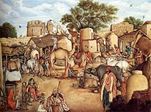
The peasants, the raiyat, were the great majority and paid for the empire. Under the zabt system worked out by Todar Mal from 1580, fields in the core provinces were measured and the state’s demand fixed in cash at a third of the average crop of the previous ten years; elsewhere the crop was shared or assessed village by village. In practice, Irfan Habib argued, added cesses and assignees who held their villages for only a few years had pushed the demand to half the crop or more in many places by Aurangzeb’s reign. Resident cultivators, the khud-kasht, had a hereditary right to till their fields as long as they paid; the pahi-kasht farmed in other villages at lower rates. Peasants grew wheat, rice and barley to eat and cotton, indigo, sugar cane and opium for sale, and took up maize and tobacco from the Americas between 1600 and 1650. When the burden grew too heavy they fled or rose, as the Jats around Mathura did in 1669.
Moving in or out. Clearing new land earned a peasant tax-free years; a heavy demand could drive a family from its fields, and revenue officers could even enslave peasants who failed to pay.
How many? Everyone not counted in the other tiers: the great majority (Shireen Moosvi reckons 82 per cent of the late-16th-century labour force rural). Several of the other ranks are estimates, so this share is one too.
Picture: A village in the Punjab, painting by Ghulam Ali Khan, a Delhi artist of the late Mughal period, early 19th century · Ghulam Ali Khan · Public domain · Wikimedia Commons
Outcast groups · c. 8–14% (est.)
The lowest castes
People of the lowest castes were kept apart by higher castes and did work such as tanning leather and sweeping.
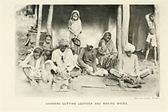
Below the peasants stood the castes that Brahmin texts placed outside the four varnas altogether and that higher castes treated as untouchable, because their hereditary work, such as tanning hides and sweeping, was counted as polluting. The four varnas were a scheme of the texts; lived society was made of many jatis, groups born to an occupation that married among themselves, and historians debate how rigid the order was before British rule, whose censuses and laws hardened it. Irfan Habib argued that custom kept the lowest castes from holding land, so that they worked other men’s fields and served as village menials. They were not voiceless. Ravidas, a poet-saint born to a leather-working family, preached against caste, and his verses entered the Sikh scripture, the Adi Granth. In 1672 the Satnamis of Narnaul, a sect that rejected caste and drew many followers from low-caste leatherworkers, rose against Mughal officials; the court chronicler sneered at them as goldsmiths, carpenters, sweepers and tanners.
Moving in or out. Caste came by birth. Devotional movements that rejected caste, like those of Ravidas and the Satnamis, offered dignity and community, though not a higher rank.
How many? Estimate: the castes then called “depressed” were about 14 per cent of the people of British India in the census of 1931; the share in the 17th century was probably of the same order.
Picture: Chamars, a caste of leather-workers, cutting leather and making shoes: photograph, late 19th or early 20th century · Unknown author · Public domain · Wikimedia Commons


Enslaved · c. 0.5–2% (est.)
Ghulām (Enslaved people)
Enslaved people were owned by others and made to work without pay, mostly as servants in rich households.
Slavery in Mughal India was mostly domestic. Enslaved men and women served in the households of the emperor and the nobles as servants, concubines and eunuchs, and were given as gifts and dowries: when Prince Salim married the daughter of the Rajput raja Bhagwant Das, her dowry included male and female slaves of Abyssinian, Caucasian and Indian origin. People were enslaved in war, when the women and children of defeated rebels were taken and shared among officers, and through the revenue system: a missionary in Bengal in 1629–30 reported that revenue officers could enslave peasants who failed to pay. Others were bought, among them Ethiopians, called Habshis, prized as soldiers and servants, while Indian captives were sold north to Central Asia. The Fatawa-i-Alamgiri, Aurangzeb’s code of Islamic law, denied slaves inheritance and the right to testify and required their owner’s leave to marry, but it also set out how they could be freed.
Moving in or out. Freedom came by manumission, in whole or in part, under rules the jurists set out. Slave soldiers could rise far: in the neighbouring Ahmadnagar Sultanate the Ethiopian Malik Ambar, brought to India as a slave, became regent and led the Deccan’s resistance to the Mughals.
How many? Estimate: slavery was mostly domestic, in the households of nobles and the well-off; famines and wars also drove people into bondage.
Picture: An African man with a long staff, Indian painting, 17th century: Habshis, Ethiopians bought as slaves, were prized as soldiers and servants · Unknown author · Public domain · Wikimedia Commons

Born into history
Where would you have stood? Chance places you on the ladder, as birth placed most people: weighted by how many each rank held.
Moving up and down
Mughal society was steep, but its summit was open to talent, fortune and the emperor’s favour. No rank in the imperial service was hereditary, and emperors kept recruiting new men from Iran, Central Asia and the Deccan. Todar Mal began as a clerk and rose to be Akbar’s finance minister with a rank of 4,000. Mirza Ghiyas Beg reached India from Iran impoverished and held only a modest post until his daughter married Jahangir in 1611 as Nur Jahan; he then became chief minister. The Persian diamond merchant Mir Jumla II became a Mughal general and governor of Bengal. Rajput chiefs entered the nobility by alliance, the Kachhwahas of Amber from 1562, and Aurangzeb won over Deccani nobles and Maratha chiefs with high ranks. Yet sons of the service held nearly half the high ranks under Aurangzeb, and below the elite change was slow: castes kept their crafts, peasants could win tax-free years by clearing new land, and a heavy revenue demand drove families to flight or revolt.
Women on the ladder
Women’s lives followed the rank of their families. Some women of the imperial household held great power and wealth. Akbar’s wife Mariam-uz-Zamani owned trading ships; Nur Jahan, Jahangir’s empress from 1611, held the imperial seal, had coins struck in her name, traded in indigo and cloth, and built caravanserais and her father’s tomb at Agra; Shah Jahan’s daughter Jahanara held the revenues of the port of Surat, owned ships and laid out Chandni Chowk in Shahjahanabad. Islamic law gave a Muslim daughter half the inheritance of a son and let women own property in their own right. Among Hindus, sati, a widow’s burning on her husband’s pyre, was practised in some families, and Aurangzeb ordered it banned in 1663. Peasant and artisan women worked alongside their families, and enslaved women were at the disposal of their owners.
Compare with another society
Test yourself
4 questions on the ladder of the Mughal Empire.
The questions open here once the page has loaded.
Sources and further reading
- Athar Ali, M. (1966) The Mughal Nobility under Aurangzeb. Bombay: Asia Publishing House.
- Bayly, S. (1999) Caste, Society and Politics in India from the Eighteenth Century to the Modern Age. Cambridge: Cambridge University Press.
- Dyson, T. (2018) A Population History of India: From the First Modern People to the Present Day. Oxford: Oxford University Press.
- Habib, I. (1999) The Agrarian System of Mughal India, 1556–1707. 2nd edn. New Delhi: Oxford University Press.
- Raychaudhuri, T. and Habib, I. (eds) (1982) The Cambridge Economic History of India, Volume 1: c. 1200–c. 1750. Cambridge: Cambridge University Press.
- Richards, J. F. (1993) The Mughal Empire. Cambridge: Cambridge University Press.
The shares are of the whole population, children included. Where a scholar has counted or estimated a rank, its share follows that work, named on the rank; where no count survives, the share is an estimate, marked est. and drawn dashed, made from what the rank was and did, from related figures and from the same rank in comparable societies, and its note says what it rests on. Population: modern estimates for India around 1600: Tim Dyson puts the serious assessments for about 1595 at 116–145 million, and some run to 150 million.
Cite this page
- APA
- The Epoch Institute. (2026). Social Hierarchy of the Mughal Empire. In Social Ladders. https://the-epoch-institute.org/societies/mughal-empire
- MLA
- “Social Hierarchy of the Mughal Empire.” Social Ladders, The Epoch Institute, 2026, https://the-epoch-institute.org/societies/mughal-empire. Accessed .
- Chicago
- The Epoch Institute. “Social Hierarchy of the Mughal Empire.” Social Ladders. 2026. https://the-epoch-institute.org/societies/mughal-empire.
- Harvard
- The Epoch Institute (2026) ‘Social Hierarchy of the Mughal Empire’, Social Ladders. Available at: https://the-epoch-institute.org/societies/mughal-empire (Accessed: ).