Oceania
Rapa Nui
At a glance
- A Polynesian society on remote Easter Island, settled around 1200 and organised in kin groups under a sacred paramount chief of the Miru clan.
- Its people carved some 887 moai, mostly from Rano Raraku tuff, and devised rongorongo, the only possible script known from Polynesia.
- Slave raids and epidemics in the 1860s reduced the islanders to 111 by 1877, and Chile annexed the island in 1888.
Rise & Fall
- c. 1200Polynesian voyagers settle Rapa Nui; tradition names Hotu Matuʻa as the founder
- c. 1250–1430Contact with Native Americans leaves lasting traces in the Rapanui genome
- 1722Jacob Roggeveen reaches the island on Easter Sunday, 5 April
- 1774James Cook finds that some moai have already been toppled
- 1862–1863Peruvian slave raiders carry off or kill about 1,500 islanders
- 1864The missionary Eugène Eyraud arrives and later first reports the rongorongo tablets
- 1877The island’s population falls to 111
- 1888Atamu Tekena and eleven chiefs sign an agreement with Chile’s Policarpo Toro
Foundation

Rapa Nui, the island that Europeans named Easter Island, is a small triangle of volcanic land some 3,700 kilometres off the coast of Chile and about 2,600 kilometres from Mangareva in eastern Polynesia, one of the most remote inhabited places on Earth. Polynesian voyagers reached it, probably from Mangareva or the Marquesas. Estimates of the date of settlement once ranged from 400 to 1300 CE, but current estimates place the first arrival around 1200. Island tradition names the founding chief as Hotu Matuʻa, who sailed from a homeland called Hiva after seven scouts had found the island, landed at Anakena Bay on the north coast and divided the land among his sons, the ancestors of the island’s clans. Some historians suspect that parts of this story took their present form only in the nineteenth century, and it cannot be read as a record of events. The settlers brought chickens and the Polynesian rat, with crops such as bananas, sugar cane and taro, and they also grew the sweet potato, a plant of South American origin. Genomic studies of ancient and living Rapanui show Polynesian ancestry with about ten per cent Native American ancestry, from contact dated to about 1250–1430. Over the following centuries the population grew to several thousand.
Socioeconomy
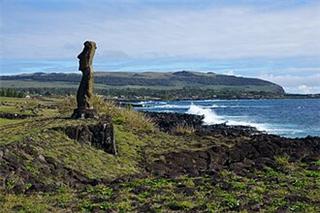
Rapa Nui society was organised in kin groups, mata, each holding territory that ran inland from a stretch of coast, and by the fifteenth century these lineages had formed two confederations. The island had no permanent streams, and farming depended on careful technique: islanders spread broken stone over their fields to keep in moisture and improve fertility, and grew sweet potatoes above all, with bananas, sugar cane and taro, while chickens, fish and seabirds supplied protein. In 1786 a gardener with the expedition of Jean-François de La Pérouse reportedly judged that three days’ work a year would feed the population, though the islanders’ labour went into far more than subsistence. Before human arrival the island was wooded, with several kinds of tree growing 15 metres tall or more; over the centuries some 21 tree species and all native land birds disappeared, through forest clearance, introduced rats and perhaps drought, the balance of causes being disputed. Sediment cores record a long drought from about 1550. The older idea that deforestation brought a population collapse before European contact, popularised by Jared Diamond, has been challenged: recent studies find no conclusive evidence of such a collapse, and genomic research finds no sign of a severe population crash in the seventeenth century. At European contact the islanders numbered some 3,000–4,000.
Military
Rapa Nui had no state army, and fighting, where it occurred, was between kin groups and their leaders. Oral traditions recorded after European contact describe rivalry and wars between clans and between the two confederations, and some writers have linked the toppling of the moai to such conflicts: when James Cook visited in 1774 some statues had already fallen, and by the middle of the nineteenth century almost all the statues on the platforms had been pulled down. Archaeology gives a more cautious picture. The commonest obsidian implements, the stemmed blades called mataʻa, made from volcanic glass quarried at Maunga Orito, were long described as spearheads, but a 2016 study of their shapes concluded that they were not designed for killing and probably served as general-purpose tools. A study of skulls found fractures suffered during life in only about 2.5 per cent of them, and the evidence for large-scale warfare before contact remains slight. The gravest violence in the island’s history came from outside. In 1862–1863 Peruvian slave raiders seized or killed about 1,500 Rapanui, of whom 1,408 were set to work as indentured labourers in Peru, and the islanders had no means of resisting armed ships. Chile’s annexation in 1888 was carried out by a naval officer, Captain Policarpo Toro, without fighting.
Governance & Law

Rapa Nui was a chiefdom rather than a state with formal institutions. Highest in rank stood the ariki mau, the paramount chief, drawn from the Miru clan, which was traditionally associated with the kingship and claimed descent from Hotu Matuʻa. His authority was above all sacred: he embodied the mana of the founding line and presided over ritual, while the chiefs of each mata organised land, labour and feasting within their territories. Missionaries in the 1860s recorded that the ariki had held great power over nine other clans and their chiefs. Priests and specialists kept genealogies, chants and the knowledge of rongorongo. In the later period another institution gained importance: the birdman rite at Orongo, on the south-western tip of the island, dedicated to the god Makemake. Each year men of rank chose men of lower status, hopu, to swim to the islet of Motu Nui and wait for the first egg of the sooty tern; the sponsor whose hopu brought it back became tangata manu, the birdman, for a year, received tribute and lived in seclusion, while his clan gained rights over the season’s eggs and fledglings on the islet. The rite lasted into the 1860s, and the names of 86 birdmen were later recorded. After the old order collapsed, missionaries had Atamu Tekena of the Miru appointed king in 1883.
Global & Regional Impact
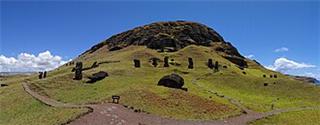
The moai are the island’s most famous legacy. Some 887 statues have been recorded, about 95 per cent of them carved from the volcanic tuff of the Rano Raraku crater; nearly half remained in the quarry, and only about a quarter were set up on ahu, the stone platforms, of which 313 are known and 125 carried statues. Most moai stood with their backs to the sea, facing the land of the kin group that raised them, and they are generally understood as images of deified ancestors. The largest ever erected, known as Paro, is about 9.9 metres long and weighs some 82 tonnes, and Ahu Tongariki in the east carried fifteen statues. How the moai were moved is still debated; island tradition says that they walked. The rongorongo script, carved on wooden tablets and first reported by the missionary Eugène Eyraud in 1864, is the only possible writing system known from Polynesia; about two dozen texts survive, none of them on the island, and none has been deciphered. Rapa Nui has also been central to modern debates about environmental collapse, which recent research has turned towards a story of adaptation. Rapa Nui National Park, covering about 40 per cent of the island, became a UNESCO World Heritage Site in 1995, and in 2017 some 3,500 of the island’s 7,750 residents identified as Rapa Nui.
Decline & Fall
Recorded contact with Europeans began on Easter Sunday, 5 April 1722, when the Dutch navigator Jacob Roggeveen reached the island and gave it its European name. The catastrophe came in 1862–1863, when Peruvian slave raiders carried off or killed about 1,500 islanders; survivors who were later returned brought smallpox. The first Catholic missionary, Eugène Eyraud, arrived in January 1864, and within a few years the survivors had become Christian and the old rites were abandoned. In 1867 an epidemic killed a quarter of the remaining 1,200 people, and Kerekorio Manu Rangi, the last generally recognised ariki mau, died. A dispute between the mission and the French adventurer Jean-Baptiste Dutrou-Bornier, who wanted the island for sheep farming, led in 1871 to the removal of most islanders to the Gambier Islands; by 1877 only 111 people lived on Rapa Nui. On 9 September 1888 Atamu Tekena and eleven chiefs signed an agreement with Captain Policarpo Toro. In the Spanish text the island’s sovereignty passed to Chile in perpetuity, while the Rapa Nui text made Chile only a protector, and Atamu gave Toro a handful of grass while keeping a handful of earth, a gesture that the historian Lorenz Gonschor reads as granting Chile only the use of the land. Chile never ratified the agreement but has governed the island ever since.
Rapa Nui shows how Polynesian settlers on one of the most remote islands on Earth built a society able to carve and raise giant moai and to devise the rongorongo script, before slave raids, epidemics and ranching in the nineteenth century reduced its people to 111 and opened the way to annexation by Chile.
Test yourself
5 questions on this page, from its key events and facts.
The questions open here once the page has loaded.
References
- Fischer, S.R. (2005) Island at the End of the World: The Turbulent History of Easter Island. London: Reaktion Books.
- Kirch, P.V. (2000) On the Road of the Winds: An Archaeological History of the Pacific Islands before European Contact. Berkeley: University of California Press.
- McCall, G. (1994) Rapanui: Tradition and Survival on Easter Island. 2nd edn. Honolulu: University of Hawaii Press.
- Métraux, A. (1940) Ethnology of Easter Island. Honolulu: Bernice P. Bishop Museum.
- Van Tilburg, J.A. (1994) Easter Island: Archaeology, Ecology and Culture. London: British Museum Press.
Connections
Open the full connections map →