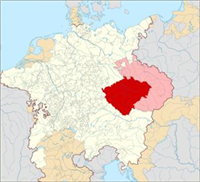
Europe
Kingdom of Bohemia
At a glance
- The only kingdom within the Holy Roman Empire, ruled from Prague, whose king was one of the electors of the King of the Romans.
- Under Charles IV Prague became an imperial capital with Central Europe’s first university, founded in 1348.
- Its Hussite reformation predated Luther by a century, and the Defenestration of Prague in 1618 began the Thirty Years War.
Rise & Fall
- 1212The Golden Bull of Sicily makes the Bohemian royal title hereditary
- 1278Ottokar II is defeated and killed at the Battle on the Marchfeld
- 1348Charles IV founds the university of Prague and the New Town
- 1415Jan Hus is burned at the Council of Constance, sparking the Hussite revolution
- 1434Moderate forces defeat the radical Hussites at the Battle of Lipany
- 1526The estates elect Ferdinand I, beginning Habsburg rule
- 1620The Protestant estates are crushed at the Battle of White Mountain
- 1918Czechoslovakia is proclaimed in Prague, with Bohemia at its core
Foundation
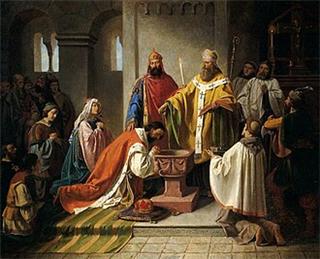
The Kingdom of Bohemia grew out of the Duchy of Bohemia, which the Přemyslid dynasty had ruled from Prague since the late ninth century, when Duke Bořivoj I accepted Christianity. Two earlier dukes had received a personal royal title from the emperor, Vratislaus II in 1085 and Vladislaus II in 1158, but neither could pass it on. The decisive step came during the contest for the German throne that followed the death of Emperor Henry VI: in 1198 Duke Ottokar I backed Philip of Swabia, who recognised him as king. In 1212 the young Frederick II, seeking allies against his rival Otto IV, issued the Golden Bull of Sicily, which made the royal title hereditary, recognised the right of the Bohemians to choose their own king, whom the emperor would then confirm, and limited the king’s obligations to the empire. Bohemia thus became the only kingdom within the Holy Roman Empire, and its ruler one of the princes who elected the King of the Romans, a right later fixed in the Golden Bull of 1356. The kingdom was closely bound to the Margraviate of Moravia, held by Přemyslid princes, and during the thirteenth century its kings encouraged German settlement, founded chartered towns and opened silver mines, laying the economic foundations of the medieval kingdom.
Socioeconomy
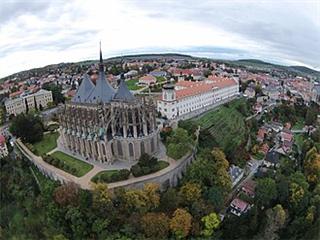
Bohemia’s wealth rested on agriculture in the fertile basins of the Elbe and Vltava and, from the late thirteenth century, on silver. The strikes at Kutná Hora made Bohemia one of the largest producers of silver in Europe, and around 1300 Wenceslaus II introduced the Prague groschen, a heavy silver coin minted at Kutná Hora that circulated across Central Europe, and issued a mining code, the Ius regale montanorum. German-speaking colonists invited by the Přemyslids settled in the towns and in the forested border regions, so that Czech and German speakers lived side by side. Prague, with its Old Town, Lesser Town and the New Town founded by Charles IV in 1348, became one of the largest cities north of the Alps. Religion shaped society deeply: the Hussite revolution transferred much church land to nobles and towns, and for two centuries Utraquists, who gave communion in both kinds, coexisted with Catholics, later joined by the Unity of the Brethren and Lutherans. After 1620 the Counter-Reformation restored a Catholic monopoly, and a new, partly foreign nobility built baroque estates worked by serfs, whose labour obligations remained heavy until Joseph II abolished personal serfdom in 1781. In the nineteenth century Bohemia became the industrial heart of the Habsburg monarchy, producing coal, textiles, glass, sugar and machinery, notably at the Škoda Works in Plzeň.
Military

The Přemyslid kings fielded armoured knights drawn from the nobility, and under Ottokar II (r. 1253–1278) Bohemia was briefly the strongest power in the empire. Ottokar defeated Béla IV of Hungary at the Battle of Kressenbrunn in 1260, securing Styria, and joined the crusades of the Teutonic Knights against the pagan Prussians. His refusal to recognise Rudolf of Habsburg as King of the Romans cost him Austria in 1276 and ended in his defeat and death at the Battle on the Marchfeld in 1278. Bohemia’s most original military achievement came in the Hussite Wars of 1419–1434. Under Jan Žižka and later Prokop the Great, armies of townsmen and peasants used wagon forts of chained war wagons, defended with handguns and light artillery, to defeat the crusades launched by Emperor Sigismund and the papacy, notably at Vítkov Hill in 1420 and Domažlice in 1431, and raided Saxony, Silesia and Hungary. Their defeat came from within, when an alliance of moderate Utraquists and Catholics destroyed the radical field armies at the Battle of Lipany in 1434. In 1620 the army of the rebel Bohemian estates was routed at the Battle of White Mountain outside Prague. Thereafter Bohemian recruits and taxes served Habsburg armies, while the kingdom became a battlefield in the Thirty Years War, the Silesian Wars and the Austro-Prussian War of 1866, decided at the Battle of Königgrätz.
Governance & Law
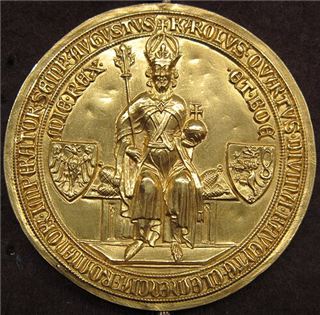
The king of Bohemia governed through great officers of the realm, such as the supreme burgrave of Prague, and through the land court, while the nobility, organised as estates, met in a diet that steadily gained power. The kingdom stood at the centre of the Lands of the Bohemian Crown, a union that Charles IV formalised in 1348 and which included Moravia, the Silesian duchies, most of them made Bohemian fiefs by King John of Luxembourg between 1327 and 1335, and Upper and Lower Lusatia; each land kept its own diet and law. Charles IV (r. 1346–1378), crowned emperor in 1355, made Prague the residence of the empire, obtained an archbishopric for Prague in 1344 and in the Golden Bull of 1356 confirmed the king of Bohemia as the first among the secular electors. In the fifteenth century weak or absent kings let the estates dominate, and the Land Ordinance of Vladislaus II of 1500 confirmed the privileges of the lords. After 1526 the elected Habsburg kings gradually strengthened royal power, and Rudolf II, who made Prague his residence from 1583, granted religious freedom in the Letter of Majesty of 1609. The Renewed Land Ordinance of 1627 made the crown hereditary in the Habsburg line, permitted only Catholicism and gave German equal standing with Czech, and in 1749 Maria Theresa merged the Bohemian and Austrian chancelleries.
Global & Regional Impact

Under Charles IV Prague became a European capital. The university he founded in 1348, today Charles University, was the oldest in Central Europe, and the Gothic architecture of Peter Parler at St Vitus Cathedral and on the Charles Bridge, together with the castle of Karlštejn, shaped the art of the whole region. The kingdom’s most far-reaching contribution was religious. Jan Hus, a Prague preacher influenced by the writings of John Wycliffe, attacked church abuses and was burned at the Council of Constance in 1415. The movement that followed created, a century before Martin Luther, a church that rejected papal authority in practice and won legal recognition through the Compacts of Basel in 1436. The Unity of the Brethren, which grew out of it, produced the Bible of Kralice and the educator John Amos Comenius, and its exiles later revived as the Moravian Church. Under Rudolf II, Prague drew artists, alchemists and the astronomers Tycho Brahe and Johannes Kepler, and the Defenestration of Prague of 1618 set off the Thirty Years War, which reshaped Europe. In the nineteenth century the historic rights of the Bohemian Crown became the basis of Czech national claims, articulated by the historian František Palacký and the Czech National Revival, and the historic frontiers of Bohemia, Moravia and Czech Silesia still largely form the borders of the Czech Republic.
Decline & Fall

The kingdom lost its independence gradually rather than at a single blow. When King Louis II died at the Battle of Mohács in 1526, the Bohemian estates elected Ferdinand I of Habsburg, beginning nearly four centuries of Habsburg rule. Religious tensions grew as royal officials restricted the Protestant rights guaranteed in the Letter of Majesty, and on 23 May 1618 Protestant nobles threw two royal governors and a secretary from a window of Prague Castle. The estates deposed Ferdinand II and elected Frederick V of the Palatinate, but their defeat at the Battle of White Mountain in 1620 was followed by the execution of 27 leaders in Prague’s Old Town Square in 1621, the confiscation of rebel estates and the emigration of much of the Protestant nobility and townspeople. Bohemia remained a separate kingdom with its own diet and coronation, but real power passed to Vienna. In 1635 the Lusatias went to Saxony, and in 1742 Prussia took most of Silesia. The centralism of Joseph II and the spread of German in administration helped provoke the Czech National Revival, and neither the revolution of 1848 nor the Austro-Hungarian Compromise of 1867 satisfied Czech demands for recognition of Bohemian state rights. On 28 October 1918, as Austria-Hungary collapsed, the Czechoslovak state was proclaimed in Prague, and the kingdom became the core of the new republic.
The Kingdom of Bohemia, the only kingdom within the Holy Roman Empire, made Prague an imperial capital under Charles IV, gave rise to the Hussite reformation a century before Luther and, with the Defenestration of Prague in 1618, set off the Thirty Years War; its historic lands still define the Czech Republic.
Test yourself
5 questions on this page, from its key events and facts.
The questions open here once the page has loaded.
References
- Agnew, H. (2004) The Czechs and the Lands of the Bohemian Crown. Stanford: Hoover Institution Press.
- Teich, M. (ed.) (1998) Bohemia in History. Cambridge: Cambridge University Press.
- Kaminsky, H. (1967) A History of the Hussite Revolution. Berkeley: University of California Press.
- Evans, R.J.W. (1973) Rudolf II and His World: A Study in Intellectual History, 1576–1612. Oxford: Clarendon Press.
- Pánek, J. and Tůma, O. (eds) (2009) A History of the Czech Lands. Prague: Karolinum Press.
Connections
Open the full connections map →