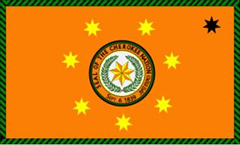
Americas
Cherokee Nation
At a glance
- A Native American republic that wrote down its laws from 1808 and adopted a constitution with three branches in 1827.
- Sequoyah’s syllabary spread literacy in Cherokee, and the Cherokee Phoenix of 1828 printed English and Cherokee side by side.
- Forced west on the Trail of Tears in 1838–1839, the Nation rebuilt at Tahlequah but lost its self-government when Oklahoma became a state in 1907.
Rise & Fall
- 1794The Chickamauga Cherokee make peace with the United States at Tellico Blockhouse
- 1808The first written Cherokee law creates the Lighthorse Guard
- 1827The Cherokee Nation adopts a written constitution
- 1828The Cherokee Phoenix appears at New Echota; John Ross is elected principal chief
- 1832Worcester v. Georgia rules that Georgia’s laws have no force in the Cherokee Nation
- 1838Forced removal on the Trail of Tears begins
- 1839An Act of Union reunites the Cherokee, with Tahlequah as capital
- 1907Oklahoma statehood ends the Nation’s self-government
Foundation

The Cherokee, in their own language Tsalagi, lived in towns across the southern Appalachians, in parts of present-day Georgia, Tennessee, North Carolina, South Carolina and Alabama. In the eighteenth century these towns were bound together by clans, language and ceremony rather than by a central government, and decades of war with colonists and then with the United States cost them much of their land. The Chickamauga towns, led until his death in 1792 by Dragging Canoe, fought on after other Cherokees had made peace, until a Tennessee militia expedition destroyed Nickajack and Running Water and the Chickamauga made peace in the Treaty of Tellico Blockhouse in November 1794. In the following years leaders such as the principal chiefs Little Turkey, Black Fox and Pathkiller, the last two former warriors of Dragging Canoe, set out to build a national government strong enough to stop town chiefs from selling land piecemeal. A council in 1809 reunited the former Chickamauga towns with the rest of the Nation, and national institutions grew quickly, encouraged by the United States’ “civilisation” policy and by missionaries such as the Moravians at Spring Place. By the late 1820s the result was a republic with written laws, a capital at New Echota and a constitution, a deliberate answer to the pressure on Cherokee land.
Socioeconomy

Cherokee society changed rapidly between 1794 and 1838. Hunting for the deerskin trade gave way to farming and herding, with maize, cotton, cattle, hogs and orchards, while spinning wheels and looms supplied by United States agents made cloth at home. A wealthy minority, among them Joseph Vann, Major Ridge and John Ross, built plantations worked by enslaved African Americans; a census of 1835 counted 1,592 enslaved people in the Nation. Clans and matrilineal kinship remained strong in most families, although the new laws protected children’s inheritance from their fathers, and while individuals owned their houses, fields and improvements, the land itself stayed the common property of the Nation. Moravian, Baptist, Methodist and Presbyterian missions opened schools. Around 1821 Sequoyah, who could not read English, completed a syllabary of 86 characters for writing Cherokee; it spread so fast that within a few years many Cherokees could read and write their own language. The Cherokee Phoenix, first printed at New Echota on 21 February 1828 under the editor Elias Boudinot, was the first Native American newspaper in the United States, with columns in English and Cherokee. In Indian Territory the Nation opened a public school system in 1841, launched the Cherokee Advocate in 1844 and opened its Male and Female Seminaries in 1851.
Military
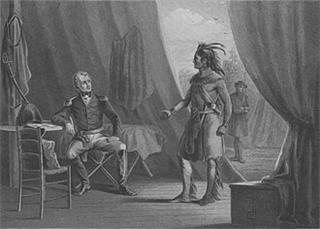
The Cherokee Nation was born from war: from 1776 to 1794 Cherokee towns, above all the Chickamauga, fought colonists and then the United States in the Cherokee–American wars. After the peace the Nation kept no standing army. Its first written law, in 1808, created the Lighthorse Guard, mounted companies that suppressed horse theft and enforced the council’s laws. In the Creek War some 500 Cherokees fought beside Andrew Jackson against the Red Stick Creeks at the Battle of Horseshoe Bend in March 1814, John Ross among them, a service that brought them no protection when Jackson later pressed for removal. Against removal the Nation chose petitions and lawsuits rather than arms, and in 1838 about 7,000 soldiers and militia under General Winfield Scott rounded Cherokee families into camps. Removal left a bitter feud: on 22 June 1839 Major Ridge, John Ridge and Elias Boudinot were killed for signing away the homeland, and killings between the factions went on until 1846. In the American Civil War the Nation signed a treaty with the Confederacy on 7 October 1861. Stand Watie’s 1st Cherokee Mounted Rifles fought at Pea Ridge in March 1862 and, with Richard Gano’s brigade, captured a Union supply train worth about $1 million at Cabin Creek in September 1864; on 23 June 1865 Watie became the last Confederate general in the field to surrender.
Governance & Law
The Cherokee built their state step by step. After the Lighthorse law of 1808, the seven clans agreed in 1810 to give up blood vengeance, handing the duty of punishing killings to the national government. A smaller National Committee came to share power with the National Council, a Supreme Court was set up in 1822, and on 12 November 1825 the council made New Echota, in present-day Gordon County, Georgia, the capital. In 1827 the Nation adopted a written constitution modelled on that of the United States, with a principal chief elected by the legislature, a two-house General Council and courts, and declared Cherokee land the common property of the Nation. Pathkiller had been principal chief from 1811 to 1827, with Charles R. Hicks as second chief and, from 1813, the leader in practice; John Ross, elected in October 1828, held the office until his death in 1866, longer than anyone else. A law made the sale of Cherokee land without the Nation’s consent a capital crime, the law later invoked against the signers of the removal treaty. In the West an Act of Union of 12 July 1839 joined the newcomers with the Western Cherokee, or Old Settlers, under a new constitution adopted at Tahlequah, the new capital, where the Cherokee National Capitol was completed in 1869.
Global & Regional Impact
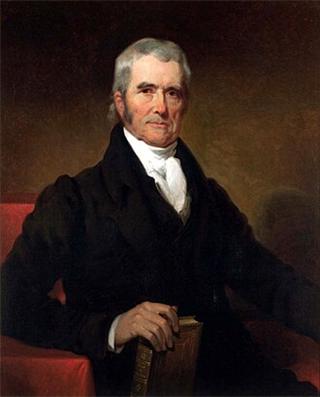
The Cherokee Nation showed that a Native American people could adopt a written constitution, courts, schools and a printing press while insisting on its sovereignty, and its fate became a test of American law and conscience. In Cherokee Nation v. Georgia in 1831 Chief Justice John Marshall described Native nations as “domestic dependent nations”, and in Worcester v. Georgia, decided on 3 March 1832, the Supreme Court held that Georgia’s laws had no force in Cherokee territory. The ruling did not stop removal, but its principle of tribal sovereignty became a foundation of federal Indian law. Sequoyah’s syllabary, one of the few scripts devised by a single person, is still taught and used. The Trail of Tears became a lasting symbol of the injustice of Indian removal, commemorated since 1987 by the Trail of Tears National Historic Trail. The Nation’s history also includes slavery: the Cherokee Freedmen were promised the rights of native Cherokees by the treaty of 1866, a right confirmed by a federal court in 2017. Three federally recognised tribes carry on the Cherokee story: the Cherokee Nation and the United Keetoowah Band, both based in Tahlequah, and the Eastern Band of Cherokee Indians in North Carolina, descended largely from Cherokees who avoided removal.
Decline & Fall
The Nation’s achievements could not protect it from American demand for its land. Georgia extended its laws over Cherokee territory between 1827 and 1831, gold was found there in 1829, and in 1832 the state gave Cherokee land away by lottery, forcing the government to hold its councils at Red Clay in Tennessee. On 29 December 1835 a minority Treaty Party led by Major Ridge, John Ridge and Elias Boudinot signed the Treaty of New Echota, ceding the eastern homeland for land in Indian Territory and $5 million. Nearly 16,000 Cherokees signed Ross’s petition against it, but the Senate ratified it by one vote in 1836. From May 1838 about 16,000 people were driven into camps and then west in detachments, most under Cherokee management; an estimated 4,000 or more died on the Trail of Tears. Rebuilt around Tahlequah, the Nation prospered until the Civil War divided and impoverished it. In 1893 it sold the Cherokee Outlet for about $8.6 million. The Curtis Act of 1898 abolished the tribal courts, an agreement of 1902 divided the land into individual allotments, and the Five Civilized Tribes Act of 1906 left the government little more than a shell before Oklahoma became a state on 16 November 1907. The federal government later appointed chiefs; the Nation adopted a new constitution in 1975–1976 and governs itself from Tahlequah once more.
The Cherokee Nation turned a network of mountain towns into a constitutional republic with its own script, newspaper and courts, won recognition of its sovereignty from the Supreme Court in 1832, endured removal on the Trail of Tears and rebuilt in Indian Territory before its government was dismantled ahead of Oklahoma statehood.
References
- McLoughlin, W.G. (1986) Cherokee Renascence in the New Republic. Princeton, NJ: Princeton University Press.
- McLoughlin, W.G. (1993) After the Trail of Tears: The Cherokees’ Struggle for Sovereignty, 1839–1880. Chapel Hill: University of North Carolina Press.
- Moulton, G.E. (1978) John Ross, Cherokee Chief. Athens: University of Georgia Press.
- Perdue, T. (1979) Slavery and the Evolution of Cherokee Society, 1540–1866. Knoxville: University of Tennessee Press.
- Perdue, T. and Green, M.D. (2007) The Cherokee Nation and the Trail of Tears. New York: Viking.
Connections
Open the full connections map →