
Movement · Islamic Caliphates & Middle East
Zionism
At a glance
- Zionism arose in the late 19th century among the Jews of Central and Eastern Europe, in reaction to new waves of antisemitism and to the Jewish Enlightenment, holding that Jews are a nation with a right to self-determination.
- Through settlement, land purchase, the Balfour Declaration of 1917 and the British Mandate, the movement built the institutions of a Jewish quasi-state in Palestine, and David Ben-Gurion declared the State of Israel in 1948.
- Its advocates see a national liberation movement returning an indigenous people to its ancestral homeland; Palestinians and other opponents see a colonial or settler-colonial movement, pointing to the expulsion and flight of Palestinians in 1948, which Palestinians call the Nakba.
Timeline
- 1882The Bilu group, one of the Lovers of Zion, establishes its first settlement in Palestine, the first of several aliyahs
- 1896Theodor Herzl publishes Der Judenstaat (“The Jewish State”), calling for the creation of a Jewish state
- 1897The First Zionist Congress at Basel founds the Zionist Organization and adopts the Basel Program
- 1917In the Balfour Declaration Britain supports “the establishment in Palestine of a national home for the Jewish people”
- 1922The British Mandate for Palestine, based on the Balfour Declaration, makes the Jewish Agency a partner of the mandatory government
- 1937During the Arab Revolt of 1936–1939, the Peel Commission proposes partition and a transfer of Palestinian Arabs
- 1947The United Nations General Assembly votes to partition Palestine into separate Jewish and Arab states
- 1948Ben-Gurion declares the State of Israel; in the war of 1948–1949 an estimated 710,000 Palestinians are driven out
Background

In 1880 there were 8 million Jews in the world, 90% of them in Europe, and most of those in Eastern Europe lived under Tsarist rule, confined to the Pale of Settlement and exposed to poverty, antisemitism and waves of pogroms. By the 1870s Jews had won almost complete civic emancipation in western and central Europe, yet many secularized Jews there felt excluded from the national movements around them, in a century that saw Greek, Serbian, Polish, Italian, Hungarian and German movements found nation states.
Jewish tradition revered the Land of Israel, and prayers at the end of Passover and Yom Kippur close with “next year in Jerusalem”, but the return to Zion was held to depend on Divine Providence in a messianic age. Forerunners gave the hope an active form: the rabbis Judah Alkalai and Zvi Hirsch Kalischer, whose Seeking Zion of 1862 was the first written work to demand mass Jewish migration to Palestine, and Moses Hess, regarded as the first modern Jewish nationalist. Christian restorationist ideas also favoured the migration of Jews to Palestine.
After a new wave of Russian pogroms, Leon Pinsker, once an assimilationist, concluded in Auto-Emancipation that Jews needed a homeland of their own. Groups in the Pale and Poland began to support emigration to Palestine, and the Lovers of Zion met at the Katowice Conference of 1884. A key event that set the modern movement in motion was the Dreyfus affair, which erupted in France in 1894 and was witnessed by Theodor Herzl.
Aims
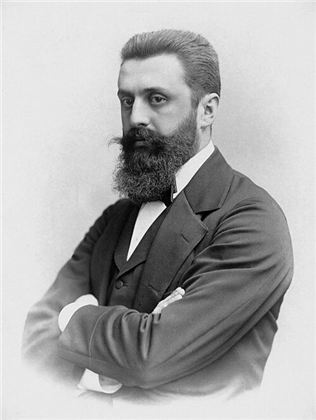
Fundamental to Zionism is the belief that Jews constitute a nation with a moral and historic right and need for self-determination. Herzl’s Der Judenstaat of 1896 called for a Jewish state, an idea he claimed was “an ancient one”, and the Basel Program of 1897 set the goal of a legally recognized home for the Jewish people in Palestine. Early Zionism was ambiguous about the form: according to Shlomo Avineri, only in the 1930s did a sovereign state become the fully articulated goal, and the Biltmore Program of 1942 openly declared for a Jewish state in all of Palestine.
Early Zionists saw assimilation as unrealistic or undesirable and sought to renew Jewish life where Jews were a majority: the “New Jew” of Max Nordau’s Muscular Judaism, Hebrew revived as a spoken language, and the “conquest of labor”, the belief that exclusively Jewish labour was the pre-condition for an independent Jewish society. Advocates have seen the movement as national liberation, the repatriation of an indigenous people to the homeland of their ancestors, and Zionists widely asserted that their historical right to Palestine outweighed that of its Arab population.
Mainstream Zionism held that Jews should be a majority in Palestine, chiefly through immigration. Historians such as Benny Morris argue that “transfer”, a euphemism for removing the Arab population, was present in Zionist thought from the start; some leaders saw it as an ideal solution, but it remained controversial.
Course of Events

The Bilu group of the Lovers of Zion founded its first settlement in 1882, the first of several aliyahs, or waves of settlement. Herzl’s efforts led to the First Zionist Congress at Basel in 1897. Other territories were considered, among them “Uganda” in British East Africa, but in 1905 the Congress voted against settling in East Africa. The Jewish National Fund, founded in 1901, bought land, mostly from absentee landlords, after which tenant farmers were often expelled. The Second Aliyah, from 1904, founded the first kibbutzim, the first political parties and Ha-Shomer, forerunner of the Haganah.
Chaim Weizmann won British support: the Balfour Declaration of 1917 backed “a national home for the Jewish people”, and the Mandate of 1922 made the Jewish Agency a partner of the government. Immigration rose after 1933, with 61,854 arrivals in 1935. Anger at land purchases and British rule grew into the Arab Revolt of 1936–1939; the Peel Commission proposed partition in 1937, and the White Paper of 1939 limited Jewish immigration.
After the war, under the pressure of American opinion and of attacks on the British by the Irgun, Lehi and later the Haganah, Britain referred Palestine to the United Nations, which voted for partition on 29 November 1947. Civil war followed, and from April 1948 Zionist forces carried out Plan Dalet, destroying Arab towns and villages and expelling civilians. On 14 May 1948 Ben-Gurion declared the State of Israel, and neighbouring Arab states joined the war.
People
Theodor Herzl, the paramount Zionist leader, wrote Der Judenstaat and convened the First Zionist Congress; with Max Nordau he led political Zionism, which sought sovereignty first. Leon Pinsker and Moshe Leib Lilienblum led practical Zionism, which favoured gradual settlement. Ahad Ha’am (Asher Ginsberg) founded cultural Zionism, seeking a spiritual centre in Palestine and opposing political solutions that victimised non-Jews, and Eliezer Ben-Yehuda is most closely associated with the creation of Modern Hebrew.
Chaim Weizmann, head of the World Zionist Organization, pursued a state step by step through settlement and land acquisition. David Ben-Gurion, secretary general of the Histadrut and leader of the Zionist labour movement, declared the State of Israel; Labor Zionism was also shaped by Nachman Syrkin, Berl Katznelson, Ber Borochov and A. D. Gordon. Ze’ev Jabotinsky founded the Revisionist Party in 1925, seeking a state on both banks of the Jordan and an “iron wall” of Jewish military force against Arab resistance. Religious Zionism was first led by Yitzchak Yaacov Reines and Abraham Isaac Kook.
Dissenters within the movement included Brit Shalom, founded in 1925 by Martin Buber, Gershom Scholem and others to promote Arab-Jewish cooperation, and Judah Magnes, who supported a binational state. Christian support has been important from the start: Christians United for Israel, led by John Hagee, is today the largest Zionist organisation.
Outcomes
The movement achieved its central aim. By the end of the 1948 war the State of Israel controlled over 78% of Mandatory Palestine, instead of the 55% of the UN partition plan. Its Declaration of Independence described a democracy with equal social and political rights for all citizens and offered peace to its neighbours. Afterwards the World Zionist Organization worked mainly to help Jews migrate to Israel, aided Soviet Jews in winning the right to leave the USSR, and supported the exodus of 850,000 Jews from the Arab world, mostly to Israel.
For the Palestinians the war brought the 1948 Palestinian expulsion and flight. The United Nations Conciliation Commission for Palestine estimated that 710,000 Palestinians were driven out and 40,000 more internally displaced, primarily by expulsions and massacres; Benny Morris counts 24 massacres by Zionist forces, the most notorious at Deir Yassin, and historians such as Ilan Pappé describe Plan Dalet as ethnic cleansing. Of 870,000 Palestinians in the territory an estimated 160,000 remained, a Palestinian minority in Israel.
Laws of the first Israeli government prevented the displaced from returning or reclaiming their property, and many of them and their descendants remain refugees supported by UNRWA. A JNF Naming Committee replaced Arab place names with Hebrew ones, and the Jewish Agency for Palestine became the Jewish Agency for Israel.
Legacy
Zionism remains Israel’s dominant ideology, in many strands. Labor Zionism led the Yishuv and Israel until the election of 1977; the Likud, developed by followers of Revisionist Zionism, has dominated most governments since. After the Six-Day War of 1967 religious Zionists came to see settling the West Bank as a commandment of God, and religious Zionist ideology motivated the assassination of Yitzhak Rabin in 1995. Liberal Zionists today criticize the occupation since 1967 while holding a Jewish state to be a necessity.
Opposition has been wide. Before the Second World War many Jews rejected Zionism, Orthodox Jews as preempting the Messiah and the Bund in favour of socialism in the diaspora; groups such as the Satmar Hasidim still do. Among the non-Jewish communities of Palestine opposition was overwhelmingly common from the 1880s. In 1975 the UN General Assembly declared that “Zionism is a form of racism and racial discrimination”, a resolution repealed in 1991.
Scholars such as Joseph Massad, Edward Said and Nur Masalha describe Zionism as colonial or settler colonial, and Palestinians such as Noura Erakat and Mohammed El-Kurd see it as inseparable from the Nakba. Most Zionists and Israeli Jews reject that portrayal, viewing Jewish migration as repatriation; Alan Dowty and Efraim Karsh conclude it was not colonialism, there being no mother country.
Zionism is the nationalist movement that arose among European Jews in the late 19th century to establish a Jewish homeland in Palestine, and it was the main force behind the creation of the State of Israel in 1948. Its supporters see it as the national liberation of a people returning to its ancestral land; Palestinians and other critics see it as colonialism, pointing to the expulsion and flight of Palestinians in 1948, the Nakba.
Test yourself
5 questions on this page, from its key events and facts.
The questions open here once the page has loaded.
References
- Michael Brenner, Zionism: A Brief History (Eurospan Group, 2003)
- Howard M. Sachar, A History of Israel: From the Rise of Zionism to Our Time (Knopf Doubleday, 2007)
- Melvin I. Urofsky, American Zionism from Herzl to the Holocaust (1995)
- David Hazony, Yoram Hazony and Michael B. Oren (eds), New Essays on Zionism (Shalem Press, 2007)
- Judith Butler, Parting Ways: Jewishness and the Critique of Zionism (Columbia University Press, 2013)
- Geoffrey Wigoder (ed.), New Encyclopedia of Zionism and Israel, second edition (1994)