Social ladder · c. 320–360 CE (the reign of Ezana)
Social Hierarchy of the Kingdom of Aksum
From King of Kings to Slave

Aksum, in what is now northern Ethiopia and Eritrea, was by the end of the 3rd century CE one of the four great powers of the world in the eyes of the prophet Mani, beside Rome, Persia and China. Its wealth came from the Red Sea trade between the Roman world and India, which passed through its port of Adulis, and from a productive farming country in the highlands. At the top stood the king, who called himself king of kings and claimed peoples on both sides of the Red Sea; below him were his kin, the nobles and the lesser kings who owed him allegiance. Merchants, many of them Greek-speaking, worked the trade, and farmers and herders fed the kingdom. Slaves were among the goods it sold. Under Ezana (320s – c. 360) the court turned from the old gods to Christianity, and a Syrian Christian who had been the king’s slave and tutor became its first bishop. The sources, mostly inscriptions, coins and foreign writers, say much about the king and little about everyone else.
Period c. 320–360 CE (the reign of Ezana)People c. 300,000–2,000,000 (est.)Ranks 6Profile Aksumite Empire
The ladder
By rank, the ladder is drawn as a pyramid. To scale, each bar is as wide as that rank’s share of the people. Shares marked est. are estimates where no count survives; their boxes and bars are dashed.
Ruler · One ruler
Nəguś (The king of kings)
nagasi, basileus
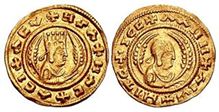
King Ezana of Aksum put his picture on gold coins and became one of the first kings anywhere to take up Christianity.
The ruler of Aksum called himself king of kings, a title often found in inscriptions, and in a Greek inscription Ezana named himself king of the Aksumites, the Himyarites, Reeidan, the Ethiopians, the Sabaites and other peoples. He struck coins in gold, silver and bronze bearing his image, crowned or in a royal headcloth, and his clan name, bisi Alene, “man of Halen”; some bore the motto “May this please the country”. His inscriptions record four campaigns, against the Bega, the Agwezat, a people called the Afan, and the Noba and Kasu. The state closely controlled the supply of gold. Around 340 Ezana’s coins changed the disc and crescent of the old gods for the cross.
Moving in or out. Tradition holds that Ezana succeeded his father Ella Amida (Ousanas) as a child, with his mother Sofya as regent. Stuart Munro-Hay thought that in the early kingdom a new king of kings may have been chosen from among all the kings of a confederacy rather than by birth order.
How many? One king, with his family; in Ezana’s later years he shared the throne with his brother Sazanas.
Nobility and officials · c. 0.5–1.5% (est.)
Royal kin, nobles and lesser kings
-
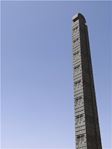
Aksum’s nobles were buried under tall carved stones that showed how important they were.
Below the king stood a small elite whose ranks the sources glimpse mainly through their buildings and graves. The early kingdom, Stuart Munro-Hay concluded, was probably a confederacy whose king of kings commanded the allegiance of petty kings. Aksum, Adulis and Matara had great elite houses, built of dressed granite and stone with timber beams whose ends, the “monkey heads”, stood out from the walls. The tall stelae marked the tombs of kings and nobles and could be carved with a mark of the dead person’s rank; high-ranking people were buried in stone coffins with their jewellery and personal belongings. The king’s own kin held command: Ezana’s brother Sazanas was one of the commanders against the Bega.
Moving in or out. Rank came with kinship to the king and with his favour: Sazanas, an army commander, was raised in Ezana’s later years to share his throne, and a Roman emperor’s letter of 356/57 was addressed to both brothers.
How many? Estimate: the king’s kin, the nobles and the lesser kings with their households, the people of the large residences and stone tombs, a small group.
Picture: A stela in the main stelae field at Aksum · Adam Jones from Kelowna, BC, Canada · CC BY-SA 2.0 · Wikimedia Commons
Religious and learned · c. 0.2–0.5% (est.)
Priests and the first clergy
-
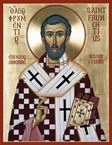
Aksum’s first bishop, Frumentius, had once been a slave. He taught the young king and helped him become a Christian.
Before Ezana’s conversion the Aksumites worshipped gods related to those of southern Arabia, among them Astar, Mahrem, Beher and Medr, under the sign of the disc and crescent; great stone monuments honoured kings and priests, and granite thrones probably carried metal statues dedicated to the gods. The Christian clergy began with Frumentius, a Syrian Christian who had taught the young Ezana and converted him. In contact with the Church of Alexandria, he was appointed Bishop of Ethiopia around 330. Alexandria never closely ran the Aksumite church, which grew its own form of Christianity. In 356/57 the emperor Constantius II asked for Frumentius to be sent to Alexandria for examination and replaced, but the request came to nothing.
Moving in or out. A bishop was appointed in contact with the Church of Alexandria, as Frumentius was. He had once been a slave, so the new church’s first leader rose from the bottom of the ladder.
How many? Estimate: the priests of the old gods and, from about 330, a small Christian clergy, with their families.
Soldiers, merchants and craftsmen · c. 1–3% (est.)
Merchants and foreign traders
-
Merchants at Aksum’s port of Adulis traded ivory and gold for silk and spices from faraway lands.
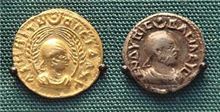
Aksum’s merchants worked the trade between the Mediterranean and India. Through the port of Adulis went ivory, tortoiseshell, rhinoceros horn, gold, emeralds, incense, slaves and exotic animals, and in came silk, spices and metals; the Periplus of the Erythraean Sea notes that Aksum imported a little money for the foreigners who lived there. Greek was the language of administration, diplomacy and trade, and sizeable Greek communities lived in Adulis and Ptolemais Theron. Aksum dealt with Roman, Egyptian and Persian traders, and salt was traded often. Its gold coins, with Greek legends, served mainly the trade abroad, while silver and copper circulated at home; Ezana’s coins have been found in India.
Moving in or out. Trade and coined money belonged to the towns: most Aksumite coins are found in the large trading centres and very few in remote villages, where people traded by barter.
How many? Estimate: the merchants of Aksum, Adulis and the towns on the road between them, with the Greek communities of Adulis and Ptolemais Theron and the foreign traders who lived there.
Free commoners · About 95% (the rest, est.)
Farmers and herders
-
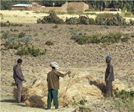
Most people in Aksum were farmers who grew a grain called teff and kept cattle, sheep and goats.
Most Aksumites lived by farming and herding in the highlands, where settlement was dense in northeastern Tigray and central Eritrea. They worked a complex system of irrigation, dams, terraces and the plough, and grew teff, finger millet, sorghum, wheat, barley and oats, with linseed, cotton, grapes, lentils, chickpeas and peas. They herded cattle, sheep and goats. A shift in the climate around the first century lengthened the rainy season and doubled the growing season. Clay models from Hawelti show round huts with conical thatched roofs and square houses. Ears of barley or wheat circled the king’s image on the coins, but few coins reached the villages, where trade was by barter.
Moving in or out. Little is recorded of how farmers rose or fell. Ordinary people were buried without coffins, with a few grave goods: pottery, glassware and iron tools.
How many? Everyone not counted in the other tiers: the farmers and herders of the highlands of Tigray and Eritrea. The other ranks are estimates, so this share is one too.
Picture: Threshing season at Aksum today · A. Davey from Where I Live Now: Pacific Northwest · CC BY 2.0 · Wikimedia Commons


Enslaved · c. 1–3% (est.)
Enslaved people
-
Some people in Aksum were enslaved and sold to traders from far away across the sea.
Slaves appear in the record of Aksum mostly as goods for sale. Pliny the Elder listed them with hippopotamus hide and monkeys among Aksum’s exports, and Adulis shipped slaves abroad with ivory, incense, gold and exotic animals; to supply such goods the kings built up a trading network reaching inland. Some slaves lived at the heart of the kingdom. Frumentius, a Syrian Christian, was a slave when he taught the young Ezana, and he was the one who converted the king to Christianity. Of the lives of most enslaved people in Aksum, the inscriptions and the foreign writers say nothing.
Moving in or out. Frumentius rose from slave and royal tutor to Bishop of Ethiopia around 330. For the slaves sold abroad through Adulis, no way back is recorded.
How many? Estimate: slaves were sold abroad through Adulis and some served at court; no one counted them.
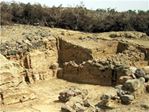
Picture: Excavations at Adulis, Aksum's port on the Red Sea · David Stanley from Nanaimo, Canada · CC BY 2.0 · Wikimedia Commons

Born into history
Where would you have stood? Chance places you on the ladder, as birth placed most people: weighted by how many each rank held.
Moving up and down
Little is recorded of how people moved between ranks in Aksum, for the sources are mostly the kings’ own inscriptions and coins and the reports of foreign travellers. At the top, rank followed the royal family: Ezana is said to have come to the throne as a child under his mother’s regency, and he later raised his brother Sazanas to share it. Stuart Munro-Hay thought that in the early kingdom a king of kings may even have been chosen from among the lesser kings rather than by birth. The most striking rise known is that of Frumentius, a Syrian Christian who had been a slave, taught the young king and became Bishop of Ethiopia around 330. Trade drew foreigners into the kingdom, and Greek communities lived in its ports.
Women on the ladder
The sources say very little about women in Aksum. By tradition Ezana’s mother, Sofya, ruled as regent for her son until he came of age, so a queen mother could hold the kingdom’s highest power for a time. Later centuries remembered women rulers too: Ibn Hawqal, writing around 980, recorded a queen of Abyssinia who had ruled for thirty years, whom later tradition calls Gudit. Of the lives of ordinary women in Ezana’s time, farming, trading or enslaved, the inscriptions and coins say nothing.
Compare with another society
Test yourself
3 questions on the ladder of the Kingdom of Aksum.
The questions open here once the page has loaded.
Sources and further reading
- Kobishchanov, Y. M. (1979) Axum, ed. J. W. Michels, trans. L. T. Kapitanoff. University Park, Pennsylvania: University of Pennsylvania.
- Munro-Hay, S. (1988) 'The Dating of Ezana and Frumentius', Rassegna di Studi Etiopici, 32, pp. 111–127.
- Phillipson, D. W. (1998) Ancient Ethiopia. Aksum: Its Antecedents and Successors. The British Museum Press.
- Phillipson, D. W. (2012) Foundations of an African civilization: Aksum & the Northern Horn, 1000 BC – AD 1300. Woodbridge, Suffolk: James Currey.
- Sergew Hable Sellassie (1972) Ancient and Medieval Ethiopian History to 1270. Addis Ababa: United Printers.
The shares are of the whole population, children included. Where a scholar has counted or estimated a rank, its share follows that work, named on the rank; where no count survives, the share is an estimate, marked est. and drawn dashed, made from what the rank was and did, from related figures and from the same rank in comparable societies, and its note says what it rests on. Population: Estimate, kept wide: no count survives; the estimate rests on the dense settlement of the highlands of northeastern Tigray and central Eritrea that the Aksumite sites show, and the towns of Aksum, Adulis, Matara and Qohaito.
Cite this page
- APA
- The Epoch Institute. (2026). Social Hierarchy of the Kingdom of Aksum. In Social Ladders. https://the-epoch-institute.org/societies/aksum
- MLA
- “Social Hierarchy of the Kingdom of Aksum.” Social Ladders, The Epoch Institute, 2026, https://the-epoch-institute.org/societies/aksum. Accessed .
- Chicago
- The Epoch Institute. “Social Hierarchy of the Kingdom of Aksum.” Social Ladders. 2026. https://the-epoch-institute.org/societies/aksum.
- Harvard
- The Epoch Institute (2026) ‘Social Hierarchy of the Kingdom of Aksum’, Social Ladders. Available at: https://the-epoch-institute.org/societies/aksum (Accessed: ).