Sub-Saharan Africa
Kingdom of Ndongo
At a glance
- An Mbundu kingdom in the highlands of northern Angola whose rulers’ title, ngola, gave the country of Angola its name.
- From 1579 it fought Portuguese Angola, winning at Lukala in 1590 but seeing its capital, Kabasa, sacked after 1617.
- Queen Njinga resisted from 1624 to 1656, allied with Matamba, the Imbangala and the Dutch; Pungo Andongo fell in 1671.
Rise & Fall
- 1518The ngola sends envoys to Portugal asking for missionaries
- 1560A Portuguese embassy under Paulo Dias de Novais arrives in Ndongo
- 1579Ngola Kilombo kia Kasenda has the Portuguese at Kabasa killed, starting a long war
- 1590Ndongo and Matamba rout a Portuguese army at the Battle of Lukala
- 1622Njinga Mbande negotiates peace in Luanda and is baptised as Ana de Sousa
- 1626Portugal makes war on Njinga and sets up rival kings at Pungo Andongo
- 1647Njinga and her Dutch allies defeat the Portuguese at the Battle of Kombi
- 1671The Portuguese take Pungo Andongo, ending the Kingdom of Ndongo
Foundation

The Kingdom of Ndongo took shape among the Mbundu, Kimbundu-speaking farmers of the highlands between the Lukala and Kwanza rivers in what is now northern Angola. Its rulers bore the title ngola a kiluanje; the word ngola, which also named iron symbols of authority among the Mbundu, later gave Angola its name. The kingdom’s beginnings are known only from traditions written down by outsiders. Those collected by the Jesuit Baltasar Barreira in the late sixteenth century named the founder as Ngola Kiluanje, also called Ngola Inene, a migrant from Kongo, while another tradition told of an ironworker, Musuri, who rose to be king. In the early sixteenth century Ndongo was the strongest of the states under the overlordship of the Kingdom of Kongo, whose king listed ‘Angola’ among his titles in 1535. In 1518 the ngola sent envoys to Portugal asking for missionaries, but the mission that came in 1520 achieved little, and Afonso I of Kongo took its priests to his own court. Around 1556 Ndongo sent a second embassy to Lisbon. Older histories describe a war that year in which Ndongo defeated Kongo and won independence; recent research suggests this rests on a misreading of the sources, but Ndongo was now acting on its own account, and in 1560 a Portuguese embassy led by Paulo Dias de Novais came to its court at Kabasa.
Socioeconomy
Most of Ndongo’s people were free commoners, the ana murinda or ‘children of the murinda’, living in villages grouped into districts under local lords. Beneath them were two unfree groups: the ijiko (singular kijiko), war captives and their descendants attached permanently to royal or noble lands, who could not be sold, and the abika, captives who could be bought, sold or inherited. Many kin groups were matrilineal. Women did much of the hoe farming of millet and sorghum, to which the American crops maize and cassava were later added, while men cleared land, built houses and fences, worked iron and traded over long distances; specialist groups included smiths, potters, cloth-makers and salt-makers. Religion centred on the ancestors and local spirits, served by priests and diviners who also advised the king; Njinga kept her brother’s remains in a reliquary for consultation. Portuguese traders sought ivory, copper, hides and salt, and rumours of silver mines at Cambambe drew them inland, but the trade that came to dominate was in people. From the mid-sixteenth century captives from Ndongo’s wars and markets were sold to Portuguese merchants, and after 1575 the wars with Portuguese Angola turned the trade against Ndongo itself, as large numbers of its people were shipped from Luanda to Brazil and Spanish America.
Military
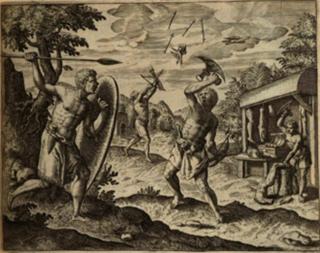
Ndongo fought on foot. The tsetse fly ruled out cavalry, and soldiers relied on bows, spears and battle-axes. A Jesuit observer of the 1570s described a style of fighting called sanguar, in which warriors leapt and twisted to dodge arrows and spears instead of carrying shields. Armies were raised from the followers of the provincial lords around a core of professional troops and royal guards, formed up in a centre and two wings, and built wooden field forts to cover a retreat. War with Portugal began in 1579, when King Ngola Kilombo kia Kasenda had the Portuguese at Kabasa killed. A Kongo invasion was narrowly beaten off in 1580, but Portuguese forces pushed up the Kwanza, founded the fort of Massangano in 1582 and won over many coastal lords. In 1590 Ndongo and its new ally Matamba crushed a Portuguese army marching on Kabasa at the Battle of Lukala. The balance shifted again when the Portuguese enlisted Imbangala war bands from 1615, and from 1617 Governor Luís Mendes de Vasconcelos invaded Ndongo and sacked Kabasa. Under Njinga, Ndongo’s forces adopted Imbangala methods and fought from mobile war camps; allied with the Dutch, they routed the Portuguese at the Battle of Kombi in 1647, though without artillery they could not take Massangano.
Governance & Law
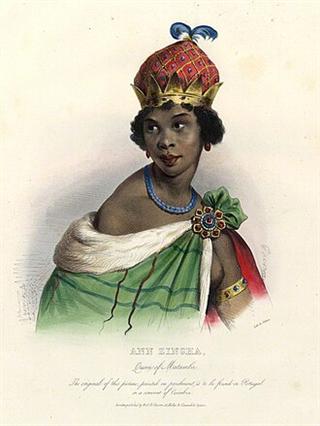
The ngola ruled from Kabasa with a council of nobles, the makota, and a body of officials. The highest, the tendala, acted as chief minister and could govern in the king’s absence; below him the ngolambole commanded the army. Both were usually drawn from the kijiko class, which made them dependent on the king rather than on any noble lineage. Beyond the court, the kingdom was a federation of districts governed by hereditary lords, the sobas, who paid tribute in cattle, salt, cloth and captives and led their men in war. This structure gave the ngola wide reach but loose control: when Portugal offered protection, sobas could change sides, and the contest for their loyalty dominated politics after 1580. Successions were disputed, and Ngola Mbandi killed many rivals on his accession in 1617. When he died in 1624 his sister Njinga Mbande took power. She had led his embassy to Luanda in 1621–1622, where she was baptised as Ana de Sousa and negotiated a peace, but as ruler she faced objections that a woman, and the child of a slave wife, could not reign. Portugal exploited them, recognising a rival, Hari a Kiluanje, in 1626 and, after his death from smallpox, Ngola Hari, baptised Filipe, who ruled from the rock fortress of Pungo Andongo as a Portuguese vassal.
Global & Regional Impact
Ndongo’s most lasting mark is a name: the Portuguese called the ngola’s country Angola, and the colony founded at Luanda in 1576 grew into the modern state that kept it. The kingdom’s wars also shaped the early Atlantic world. Captives from the Portuguese campaigns against Ndongo were shipped from Luanda in large numbers, and the historian John Thornton has argued that the ‘20. and odd Negroes’ landed at Point Comfort in English Virginia in August 1619 were probably among the thousands captured in 1618–1619, taken from Luanda on a slave ship bound for Veracruz and seized at sea by English privateers. Linda Heywood and John Thornton have argued that Central Africans of this kind, many of them familiar with Christianity and Portuguese ways, formed the first generations of Africans in the English and Dutch colonies of the Americas. Njinga became one of the best-documented African rulers of her century, the subject of biographies by the Capuchin missionaries Antonio da Gaeta, published in 1669, and Giovanni Antonio Cavazzi, who knew her court. European writers of the eighteenth and nineteenth centuries turned her into a figure of exotic cruelty, but in the twentieth century she became a symbol of resistance during the Angolan War of Independence. A statue of her stands in Kinaxixi Square in Luanda, and she is honoured in Angola as a national heroine.
Decline & Fall
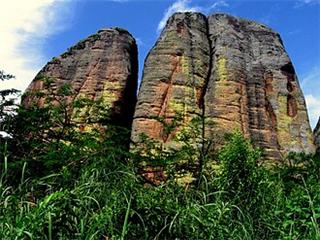
From 1626 Ndongo was a divided kingdom. Driven from the Kindonga islands of the Kwanza in 1626 and again in 1628, Njinga allied with the Imbangala leader Kasanje, rebuilt her army and in 1631 overthrew the queen of Matamba, to the east, whose kingdom became her base. When the Dutch West India Company seized Luanda in August 1641 she allied with the Dutch and recovered much of Ndongo, defeating the Portuguese at Ngoleme in 1644 and at Kombi in 1647, although she lost a battle at Kavanga in 1646 in which her sister Kambu was captured. The Portuguese recapture of Luanda in August 1648 ended the Dutch alliance, and in 1656 Njinga made peace, accepting the Lukala as the border and recovering her sister. She died in Matamba on 17 December 1663, and Kambu, known as Dona Barbara, succeeded her there. In the west Ngola Hari served Portugal loyally for decades, supplying much of its army, but his son and successor resented the peace that had recognised Njinga as queen of Ndongo and rose in revolt in 1670. After a long siege the Portuguese took Pungo Andongo in 1671, ending the kingdom. They built a fort on the site and absorbed its lands into the colony of Angola, while Matamba remained outside Portuguese rule for decades under Njinga’s successors.
The Kingdom of Ndongo, the Mbundu state of the ngola between the Lukala and Kwanza rivers, gave its rulers’ title to Angola; its long war with the Portuguese, led for three decades by Queen Njinga, fed the Atlantic slave trade with captives who were among the first Africans in English Virginia.
References
- Birmingham, D. (1966) Trade and Conflict in Angola: The Mbundu and Their Neighbours under the Influence of the Portuguese, 1483–1790. Oxford: Clarendon Press.
- Heywood, L.M. (2017) Njinga of Angola: Africa’s Warrior Queen. Cambridge, MA: Harvard University Press.
- Heywood, L.M. and Thornton, J.K. (2007) Central Africans, Atlantic Creoles, and the Foundation of the Americas, 1585–1660. Cambridge: Cambridge University Press.
- Miller, J.C. (1976) Kings and Kinsmen: Early Mbundu States in Angola. Oxford: Clarendon Press.
- Thornton, J.K. (1999) Warfare in Atlantic Africa, 1500–1800. London: UCL Press.
- Thornton, J.K. (2020) A History of West Central Africa to 1850. Cambridge: Cambridge University Press.
Connections
Open the full connections map →