
Sub-Saharan Africa
Lunda Empire
At a glance
- The Lunda Empire was a tributary state of the Central African savanna, ruled by a sacred king titled the Mwaant Yaav.
- Positional succession and perpetual kinship let it absorb chiefdoms without removing their rulers, linking the interior to Atlantic trade.
- Succession disputes, the rise of the Chokwe and colonial partition in the 1890s broke it up, though the Mwaant Yaav title survives.
Rise & Fall
- 16th centuryTradition: Luba hunter-prince Chibinda Ilunga marries the Lunda heiress Lueji, bringing sacred kingship
- Late 17th centuryMwaant Yaav I, traditionally Naweej I, rules a regional power from the royal musumba
- c. 1740An eastern expedition founds the kingdom of Kazembe on the Luapula River
- Mid-1880sThe Chokwe, armed through the rubber, wax and ivory trades, overrun the Lunda capital
- 1890sLunda lands are partitioned between the Congo Free State, Portuguese Angola and Northern Rhodesia
Foundation

The Lunda Empire took shape in the sixteenth and early seventeenth centuries in the region now divided between the south-western Democratic Republic of Congo, north-eastern Angola and north-western Zambia. Its formation was closely linked to the influence of the Luba: tradition holds that the Luba hunter-prince Chibinda Ilunga married Lueji (Rweej), heiress of a Lunda ruling line, thereby introducing the Luba model of sacred kingship and its associated institutions. This union provided political legitimacy and institutional continuity, and it gave rise to a hereditary monarchy whose rulers bore the title Mwaant Yaav (Mwata Yamvo). The state's growth was helped by fertile river valleys and by its position between the copper-producing lands to the south-east and the trade routes of the Congo basin and Angola. Over the following decades the Lunda drew neighbouring chiefdoms into their orbit through diplomacy, marriage alliances and military campaigns. By the later seventeenth century, under Mwaant Yaav I, traditionally Naweej I, the kingdom had become a regional power ruled from a royal capital, the musumba, institutionalising governance and ritual practices derived from Luba traditions and sustaining central authority over an increasingly multi-ethnic territory.
Socioeconomy
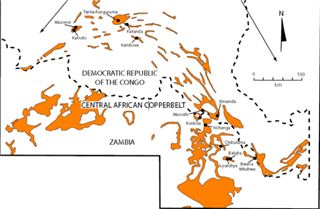
The Lunda economy combined agriculture, trade and tribute. Society was stratified, with the Mwaant Yaav and nobility controlling key resources such as salt, copper and ivory, while commoners cultivated cassava, millet, sorghum and yams and harvested palm oil. Obligations to the state and royal court were enforced through a tributary system that drew subject chiefdoms into the imperial economy. Trade networks reached the Copperbelt and neighbouring polities, linking Lunda markets with the Luba, Luvale (Lwena) and other Central African peoples, and westwards through the Imbangala kingdom of Kasanje to Portuguese Angola. Artisans and metalworkers produced copper and iron tools, weapons and ritual regalia that reinforced both economic and symbolic authority. The empire was deeply involved in the slave trade, supplying captives to Atlantic markets via Angolan intermediaries alongside its trade in ivory, wax and other goods. The capital and provincial courts functioned as administrative and commercial hubs, redistributing tribute and supporting the ruling elite. This integrated system sustained territorial expansion while maintaining cultural cohesion.
Military
The Lunda military relied on local levies supplemented by warrior retinues drawn from vassal chiefdoms. Infantry armed with spears, bows and iron weapons formed the whole of the army; horses could not survive in the tsetse-infested region, and firearms obtained through Atlantic trade became significant only later. Military organisation was tied closely to political hierarchy, with chiefs mobilising forces under the authority of the Mwaant Yaav. Expansion in the late seventeenth and eighteenth centuries carried Lunda power into the Kasai region and towards Angola, while an eastern expedition founded the kingdom of Kazembe on the Luapula River around 1740, consolidating tributary states and securing trade corridors. Warfare served not only conquest but also the symbolic assertion of royal authority, often accompanied by ritual displays to reinforce loyalty and deter rebellion. Fortifications were few but positioned to control river crossings and trade nodes. The military also enforced tribute collection and compliance among subordinate communities, and its effectiveness depended on both central coordination and the cooperation of local leaders.
Governance & Law
The Lunda Empire was governed through a hierarchy anchored in the sacred kingship of the Mwaant Yaav. Authority was hereditary within the royal lineage and legitimised through ritual and ancestral veneration, while a court council of titled office-holders, including the Lukonkesh (queen mother), advised on succession, disputes and resource allocation. Provincial chiefs administered outlying territories, collecting tribute and maintaining order while remaining answerable to the capital. Two distinctive principles, positional succession and perpetual kinship, allowed each new office-holder to inherit the identity and relationships of his predecessor, binding incorporated chiefdoms to the centre without displacing local rulers. Customary law, transmitted orally, regulated property, succession, trade and ritual obligations, with the king as ultimate arbiter. Rituals, regalia and symbolic objects consolidated legitimacy and communicated authority across vast and ethnically diverse territories. This structure enabled the Lunda to integrate conquered communities and administer extensive trade networks effectively.
Global & Regional Impact

The Lunda Empire exerted significant influence over Central Africa, both culturally and economically. Its political model, itself adapted from the Luba, was carried by migrating Lunda chiefs and emulated by neighbouring peoples, shaping states such as Kazembe on the Luapula and the chiefdoms of the Luvale, Ndembu and others in present-day Zambia and Angola. Trade networks moved copper, ivory, iron goods and agricultural products, integrating the interior with the Atlantic economy through Angolan intermediaries. The Lunda model of positional succession and perpetual kinship offered a flexible means of incorporating diverse communities and influenced successor states. Artistic and ritual traditions, including ceremonial regalia and the initiation practices of secret societies, spread throughout the region and left a durable cultural imprint. By mediating between forest and savanna zones, the Lunda also shaped migration, settlement patterns and inter-ethnic relations. Their legacy remains visible in the cultural and political institutions of Zambia, Angola and the Democratic Republic of Congo.
Decline & Fall
The decline of the Lunda Empire began in the nineteenth century through internal fragmentation and external pressure. Succession disputes weakened central authority and allowed local chiefs to assert their autonomy. Reliance on tributary relationships left the empire vulnerable to rebellion and to rising neighbours, above all the Chokwe, who grew powerful through the rubber, wax and ivory trades and firearms, and who overran the Lunda capital in the mid-1880s. European colonial penetration intensified these pressures: by the 1890s Lunda lands were partitioned between Leopold II's Congo Free State, Portuguese Angola and British-ruled Northern Rhodesia, disrupting trade networks and imposing new political structures. By the end of the nineteenth century the authority of the Mwaant Yaav had largely disintegrated, with former subordinates either independent or absorbed into colonial administrations. Many Lunda cultural, political and ritual practices nevertheless persisted, and the Mwaant Yaav title survives to this day as a traditional office.
The Lunda Empire's legacy lies in how it adapted the Luba model of sacred kingship into a far-reaching tributary state that linked the copper and ivory trade of the Central African interior to wider regional economies, leaving traditions still visible in Zambia, Angola, and the Democratic Republic of Congo.
References
- Birmingham, D. (1966) Trade and Conflict in Angola: The Mbundu and Their Neighbours under the Influence of the Portuguese, 1483–1790. Oxford: Clarendon Press.
- Coquery-Vidrovitch, C. (1985) Africa: Endurance and Change South of the Sahara. Translated by D. Maisel. Berkeley: University of California Press.
- Cunnison, I. (1959) The Luapula Peoples of Northern Rhodesia: Custom and History in Tribal Politics. Manchester: Manchester University Press.
- Hoover, J.J. (1978) 'The Seduction of Ruwej: Reconstructing Ruund History (The Nuclear Lunda: Zaire, Angola, Zambia)'. PhD thesis, Yale University.
- Miller, J.C. (1976) Kings and Kinsmen: Early Mbundu States in Angola. Oxford: Clarendon Press.
- Vansina, J. (1966) Kingdoms of the Savanna. Madison: University of Wisconsin Press.
Connections
Open the full connections map →