
Religion · South & Southeast Asia
Sikhism
At a glance
- Sikhism began with Guru Nanak’s teaching in the Punjab around 1500: one God, remembered in prayer, served through honest work and sharing, and found by all people equally, whatever their caste.
- Nine Gurus after him built its institutions: the Golden Temple at Amritsar, the scripture of the Guru Granth Sahib and, under Guru Gobind Singh in 1699, the Khalsa order of initiated Sikhs.
- Persecuted under the later Mughals, Sikhs built their own empire under Ranjit Singh, and today some 25 to 30 million Sikhs live in the Punjab and across the world.
Timeline
- c. 1499Guru Nanak’s spiritual experience at the river Bein near Sultanpur Lodhi begins his mission
- 1577Guru Ram Das founds the city of Amritsar around its sacred pool
- 1604Guru Arjan installs the Adi Granth, the Sikh scripture, in the Harmandir Sahib at Amritsar
- 1606Guru Arjan is executed under the Mughal emperor Jahangir
- 1675Guru Tegh Bahadur is executed in Delhi on the orders of Aurangzeb
- 1699Guru Gobind Singh founds the Khalsa at Anandpur on the festival of Vaisakhi
- 1799Ranjit Singh takes Lahore and goes on to found the Sikh Empire
- 1984The Indian army’s Operation Blue Star at the Golden Temple, followed by the assassination of Indira Gandhi and anti-Sikh violence
Spread through the centuries
Where it began, how it spread, and where it was a main faith (a bright glow) or held communities (a faint one), century by century to today. Press Play or move the slider, turn the globe, and tap a glow or a mark to read about it.
The map opens here once the page has loaded.
Origins
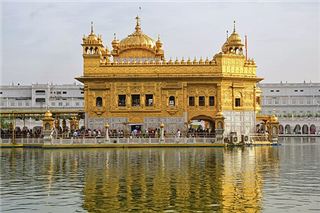
Sikhism takes its name from the Punjabi word sikh, “disciple” or “learner”: Sikhs are disciples of the Guru. Its founder, Guru Nanak, was born in 1469 into a Hindu family of the Khatri caste at Talwandi, now Nankana Sahib in Pakistan, in the Punjab, a land where Hindu and Muslim traditions met. He worked as a storekeeper at Sultanpur Lodhi, where, according to the traditional accounts of his life, around 1499 he disappeared while bathing in the river Bein and returned three days later with the words “There is no Hindu, there is no Muslim”, proclaiming that God is beyond all religious divisions.
Nanak spent much of the following years travelling, according to tradition as far as Sri Lanka, Tibet and Mecca, accompanied by the Muslim musician Mardana, singing hymns of praise to the one God. He criticised empty ritual, the authority of priests and the caste system, and taught that liberation comes through devotion and the grace of God, open to all. In his later years he settled at Kartarpur on the Ravi river, where a community of followers lived by his teaching, farming, praying and eating together.
Before his death in 1539 Nanak chose as his successor not one of his sons but a disciple, Angad, setting the pattern of a line of ten human Gurus. Guru Angad developed the Gurmukhi script in which the Sikh scriptures are written. Guru Amar Das organised the community into districts and made the communal kitchen, the langar, a requirement for all who came to see him. Guru Ram Das founded the town that became Amritsar around a sacred pool in 1577.
The fifth Guru, Arjan, built the Harmandir Sahib, later known as the Golden Temple, in the middle of the pool, and in 1604 compiled the Adi Granth, the first Sikh scripture, gathering the hymns of the Gurus and of Hindu and Muslim saints. The growing community attracted the suspicion of the Mughal authorities, and in 1606 Guru Arjan was executed under the emperor Jahangir, becoming the first Sikh martyr.
His son, Guru Hargobind, wore two swords, symbols of spiritual and temporal authority, and gave the community the means to defend itself, a turning point that shaped Sikh identity in the century that followed.
Beliefs & Practice
At the heart of Sikhism is belief in one God, the creator, without form, beyond birth and death, present in all creation. The scripture opens with the words “Ik Onkar”, “there is one God”, the beginning of the Mul Mantar, the Sikh statement of faith. Sikhs most often call God Waheguru, “wonderful Lord”.
Human beings, in Sikh teaching, are separated from God by haumai, self-centredness, which binds them to the cycle of rebirth through the five vices of lust, anger, greed, attachment and pride. Release, mukti, comes through God’s grace and through nam simran, the loving remembrance of God’s name in meditation and hymn singing. The ideal is the gurmukh, the person oriented towards the Guru, as opposed to the manmukh, who follows only their own will.
Guru Nanak’s teaching is often summed up in three duties: to remember God (nam japna), to earn an honest living (kirat karni) and to share with others (vand chakna). Sikhism rejects renunciation of the world: the ideal is the householder who lives in the world, works, marries and serves others. It teaches the equality of all people regardless of caste, religion or sex; service to others, seva, is a central religious act.
The Sikh Gurus rejected idol worship, pilgrimage as a means of merit, fasting and ritual purity. Worship centres on the reading and singing of the scripture. Sikhs believe that the light of the one Guru passed through all ten human Gurus, and that since 1708 the Guru has been present in the scripture, the Guru Granth Sahib, and in the community of initiated Sikhs, the Khalsa Panth.
Initiated Sikhs of the Khalsa keep the five Ks: kesh, uncut hair, usually covered by a turban; kangha, a wooden comb; kara, a steel bracelet; kachera, cotton undershorts; and kirpan, a sword or dagger, a symbol of the duty to defend the weak. Men take the name Singh, “lion”, and women Kaur, “princess”.
Texts & Teachers
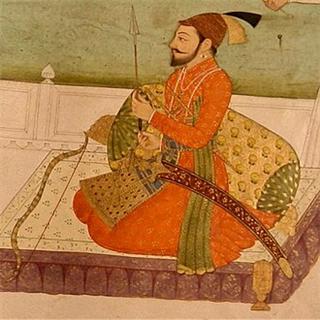
The Guru Granth Sahib is the central scripture of Sikhism and is treated as a living Guru. It was first compiled by Guru Arjan in 1604 as the Adi Granth, the “first book”, from the hymns of the first five Gurus and of saints of other traditions, among them the weaver-poet Kabir, the Sufi Shaikh Farid, the leatherworker Ravidas and the tailor Namdev. Guru Gobind Singh added the hymns of his father, Guru Tegh Bahadur, and before his death in 1708 declared that the Granth would be the Guru after him.
Its standard printed edition has 1,430 pages, and its hymns are arranged not by author but by the musical ragas in which they are sung. They are written in the Gurmukhi script, in a language that blends Punjabi with other north Indian languages and vocabulary from Sanskrit, Persian and Arabic. The text is poetry meant for singing: kirtan, the singing of its hymns with music, is the heart of Sikh worship.
In the gurdwara the Guru Granth Sahib is placed on a raised platform under a canopy, attended by a reader who waves a whisk over it as a sign of honour; it is opened each morning, read at random for the day’s guidance, and laid to rest at night. A continuous reading of the whole scripture, the akhand path, takes about forty-eight hours and marks weddings, funerals and festivals.
A second collection, the Dasam Granth, contains writings attributed to Guru Gobind Singh, though the authorship of parts of it is debated. Other texts include the janamsakhis, collections of stories about the life of Guru Nanak written from the 16th and 17th centuries, and the rahit-namas, manuals of conduct for the Khalsa. The Sikh Rahit Maryada, issued in the 20th century, codifies the community’s code of conduct.
The Gurus’ insistence on a scripture in the language of the people, in a script of their own, gave Punjabi a literary standing and made literacy part of Sikh religious life.
Spread

For its first two centuries Sikhism grew among the peasants, traders and artisans of the Punjab, especially among the Jats, a large farming community. Its growth, and its development of a distinct identity and armed defence, brought conflict with the Mughal authorities. The ninth Guru, Tegh Bahadur, was executed in Delhi in 1675 on the orders of the emperor Aurangzeb; Sikh tradition remembers him as giving his life to defend the religious freedom of Hindus being forced to convert.
His son, Guru Gobind Singh, founded the Khalsa on the festival of Vaisakhi in 1699 at Anandpur, initiating the first five members, the Panj Pyare or “five beloved ones”, with sweetened water stirred with a sword, and then being initiated by them in turn. The Khalsa gave Sikhs a disciplined community of soldier-saints. Gobind Singh fought the Mughals and the hill chiefs, lost all four of his sons and died in 1708.
After his death Banda Singh Bahadur led a peasant rebellion that briefly ruled parts of the Punjab before he was captured and executed in Delhi in 1716. Through the 18th century Sikhs endured persecution and the invasions of Nader Shah and Ahmad Shah Durrani, who blew up the Harmandir Sahib in 1762, and organised themselves into confederacies, the misls, which gradually took control of the Punjab as Mughal power collapsed.
In 1799 Ranjit Singh, leader of one of the misls, took Lahore and built the Sikh Empire, which ruled the Punjab, Kashmir and the north-west frontier until after his death. He covered the upper part of the Harmandir Sahib in gilded copper, giving it the name of the Golden Temple. Defeated in two wars with the British East India Company, the Sikh state was annexed in 1849.
Under British rule Sikhs were recruited in large numbers into the army and emigrated to Malaya, Hong Kong, East Africa, Canada and Britain. The partition of the Punjab in 1947 divided the Sikh homeland and forced most Sikhs in the west to flee to India. Migration since then has created large communities in Britain, Canada and the United States.
Community & Society

The centre of Sikh community life is the gurdwara, “the door of the Guru”, where the scripture is installed. Anyone may enter, regardless of religion, provided they cover their head and remove their shoes. Worship consists of hymn singing, readings and the ardas, the communal prayer, followed by karah prashad, a sweet offering shared by all.
Every gurdwara has a langar, a free communal kitchen, introduced by the early Gurus to break down the barriers of caste: everyone sits together on the floor and eats the same simple vegetarian meal, prepared and served by volunteers. The langar of the Golden Temple at Amritsar serves tens of thousands of people every day.
The Khalsa, the order of initiated Sikhs, takes its members through the amrit ceremony, in which they vow to keep the five Ks and the code of conduct and to abstain from tobacco and intoxicants. Many Sikhs are not formally initiated but keep some or all of its outward signs; the turban has become a distinctive symbol of Sikh identity around the world.
Sikhism has no priesthood. Authority rests with the scripture and with the community gathered in its presence. The Akal Takht, the “throne of the timeless one” facing the Golden Temple, founded by Guru Hargobind, is the highest seat of temporal authority, and since the 1920s the Shiromani Gurdwara Parbandhak Committee, an elected body formed during a movement to free the gurdwaras from hereditary custodians, has managed the main shrines of the Punjab.
Equality between men and women is a principle of the Gurus’ teaching: women may lead prayers and read the scripture. In practice caste distinctions have persisted in Sikh society, a tension that reformers within the community have long addressed.
Modern Sikh history has also known great suffering. In June 1984 the Indian army stormed the Golden Temple, where armed militants led by Jarnail Singh Bhindranwale had fortified themselves; many were killed, including pilgrims. In October Prime Minister Indira Gandhi was assassinated by two of her Sikh bodyguards, and thousands of Sikhs were killed in the violence that followed in Delhi and other cities.
Legacy
Sikhism is one of the youngest of the world’s major religions and, with some 25 to 30 million followers, among the largest. Most Sikhs live in the Punjab, where they form the majority of the population of the Indian state, and the diaspora has made the turban and the gurdwara familiar in cities from London and Toronto to Vancouver and New York.
Its teaching of one God, open to all, its insistence on honest work and sharing, and its rejection of caste and ritual made it a powerful reforming movement in the religious history of India. The langar, which feeds anyone who comes, has become a model of community service; Sikh organisations run free kitchens in times of disaster around the world.
The Golden Temple at Amritsar, with its gilded sanctuary reflected in the sacred pool, is one of the most visited places of worship on earth. Sikh devotional music, the kirtan, is a distinctive tradition of Indian music, and the Guru Granth Sahib is among the great collections of devotional poetry of South Asia.
Sikh soldiers served in large numbers in the British Indian Army in both world wars, and Sikhs have played a prominent part in the politics, agriculture and economy of modern India. Their history of persecution, martyrdom and resistance, from the execution of Guru Arjan to the violence of 1984, remains central to Sikh memory and identity.
Sikhism, founded by Guru Nanak in the Punjab around 1500 and shaped by nine Gurus after him, teaches devotion to one God, honest work, sharing and the equality of all people. The Khalsa founded by Guru Gobind Singh in 1699 and the Guru Granth Sahib, its living scripture, define its community, which today numbers some 25 to 30 million people in the Punjab and around the world.
References
- Grewal, J.S. (1990) The Sikhs of the Punjab. The New Cambridge History of India II.3. Cambridge: Cambridge University Press.
- Mandair, A.-P.S. (2013) Sikhism: A Guide for the Perplexed. London: Bloomsbury.
- McLeod, W.H. (1968) Guru Nanak and the Sikh Religion. Oxford: Clarendon Press.
- Nesbitt, E. (2016) Sikhism: A Very Short Introduction. 2nd edn. Oxford: Oxford University Press.
- Oberoi, H. (1994) The Construction of Religious Boundaries: Culture, Identity and Diversity in the Sikh Tradition. Chicago: University of Chicago Press.
- Singh, P. and Fenech, L.E. (eds) (2014) The Oxford Handbook of Sikh Studies. Oxford: Oxford University Press.