Religion · Europe
Norse religion
At a glance
- The pre-Christian religion of Scandinavia worshipped gods such as Odin, Thor, Freyr and Freyja, with sacrifices, feasts and rituals led by chieftains and kings, in a world of nine realms around the world tree Yggdrasil.
- Its myths, of a world made from the body of a giant and destroyed at Ragnarök, are known mainly from Icelandic texts written down by Christians in the 13th century, two centuries after the conversion.
- Displaced by Christianity between the 10th and 12th centuries, it gave English four of its weekday names and a mythology that has inspired art and literature from Wagner to Tolkien and modern film.
Timeline
- 793The Viking raid on the monastery of Lindisfarne opens the Viking Age
- c. 965King Harald Bluetooth raises the Jelling stone, recording that he made the Danes Christian
- c. 1000The Icelandic assembly, the Althing, adopts Christianity, allowing pagan worship in private for a time
- c. 1075Adam of Bremen describes the temple at Uppsala with images of Thor, Odin and Freyr
- c. 1220Snorri Sturluson writes the Prose Edda, a handbook of Norse myth and poetry
- c. 1270The Codex Regius, the manuscript of the Poetic Edda, is written in Iceland
- 1973Iceland recognises the modern Ásatrú fellowship as a religion
Spread through the centuries
Where it began, how it spread, and where it was a main faith (a bright glow) or held communities (a faint one), century by century to its last places. Press Play or move the slider, turn the globe, and tap a glow or a mark to read about it.
The map opens here once the page has loaded.
Origins

Norse religion was the Scandinavian branch of the religion of the Germanic peoples, which had developed over many centuries before the Viking Age. Bronze Age rock carvings in Sweden and Norway show ships, sun symbols and figures with axes, and the Trundholm sun chariot from Denmark, of about 1400 BCE, shows a horse drawing the sun, but how these relate to the later gods is uncertain.
In the early centuries CE, the Roman historian Tacitus described the Germanic peoples worshipping gods he identified with Mercury, Hercules and Mars, probably Wodan, Thor and Tiw, and the earth goddess Nerthus, whose image was carried in a wagon; they worshipped, he wrote, in sacred groves rather than temples. In Scandinavia, great offerings of weapons were sunk in lakes and bogs, as at Illerup in Denmark, probably after victories in war.
In the Migration Period, from the 5th and 6th centuries, gold medallions called bracteates show a head above a horse-like beast, often read as Odin, and the picture stones of the island of Gotland depict scenes from myth. The gods of the north were shared, under related names, with the Anglo-Saxons, who worshipped Woden, Thunor and Tiw before their conversion in the 7th century, and with the continental Germans.
Norse religion is best known from the Viking Age, which began with the raid on Lindisfarne in 793 and lasted until the late 11th century, when Scandinavians traded, raided and settled from Russia to Newfoundland and came into close contact with Christian Europe. It was never a single, uniform religion: beliefs and rituals varied between regions, social classes and centuries.
Beliefs & Practice
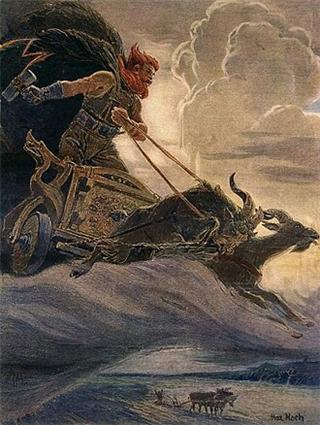
The Norse gods were of two families, the Æsir and the Vanir, who according to myth fought a war and then made peace by exchanging hostages. Odin, chief of the Æsir, was the god of wisdom, poetry, magic, war and the dead: he gave an eye to drink from the well of wisdom and hanged himself for nine nights on the world tree to win the knowledge of the runes, and his two ravens flew across the world to bring him news. Thor, armed with his hammer Mjöllnir, was the god of thunder and the protector of gods and humans against the giants, and in the Viking Age the most popular god of all. Other gods included Tyr, the god of law and war, who lost his hand to the wolf Fenrir; Baldr, the beautiful son of Odin, whose death brought grief to the world; Heimdall, the watchman of the gods; and Frigg, Odin’s wife.
The Vanir were gods of fertility and prosperity: Njord, god of the sea and wealth, and his children Freyr, who brought peace and good harvests, and Freyja, goddess of love and of seidr, a form of magic, who received half of those slain in battle. Between the gods and their enemies stood Loki, a shape-shifting trickster who helped and harmed them.
The myths imagined a world that began in Ginnungagap, a yawning void between a realm of fire and a realm of ice. From the meeting of fire and ice arose the giant Ymir, whom Odin and his brothers killed, making the earth from his flesh, the sea from his blood, the mountains from his bones and the sky from his skull; the first humans, Ask and Embla, were shaped from two trees. The cosmos was held together by the ash tree Yggdrasil, whose roots and branches linked nine worlds, among them Asgard of the gods, Midgard of humans, Jotunheim of the giants and Hel of the dead. The Norns, women who spun fate, lived at its foot.
Fate ruled gods and men alike. At Ragnarök, the gods would fight the giants and monsters in a final battle: Odin would be swallowed by Fenrir, Thor would kill the Midgard serpent and die of its poison, and the world would burn and sink into the sea, to rise again green and renewed. Warriors chosen by the valkyries went to Odin’s hall, Valhalla, to feast and fight until that day; others went to Freyja, to Hel or to the sea goddess Rán.
Worship centred on the blót, a sacrifice of animals, above all horses and cattle, followed by a feast at which the meat was eaten and toasts drunk to the gods; the blood was sprinkled on altars and people. Great sacrifices were held at the turn of winter, at midwinter, the feast of Yule, and in summer.
Texts & Teachers
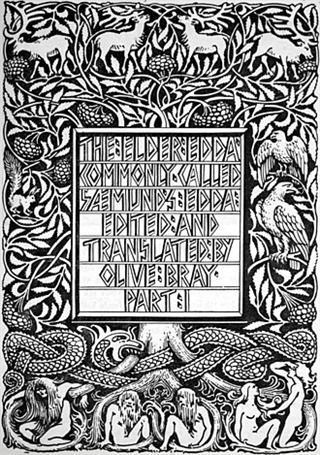
Norse religion was not a religion of books, and almost everything known of its myths was written down after the conversion, by Christians. The earliest evidence comes from the Viking Age itself: runic inscriptions, some of which call on Thor to hallow the stone; picture stones and carvings, such as the stone of Altuna in Sweden and a carved stone at Gosforth in England that show Thor fishing for the Midgard serpent; and skaldic poems, intricate verses composed by court poets from the 9th century and preserved in later writings, some of which describe myths painted on shields or carved in halls.
The richest source is the Poetic Edda, a collection of anonymous poems about the gods and heroes preserved mainly in a single Icelandic manuscript, the Codex Regius, written around 1270, which Denmark returned to Iceland in 1971. Its first poem, Völuspá, “the prophecy of the seeress”, tells the history of the world from creation to Ragnarök and its renewal; Hávamál, “the sayings of the High One”, gathers Odin’s wisdom and tells how he won the runes; other poems tell comic and tragic tales of Thor, Loki and the heroes.
The Prose Edda, written around 1220 by the Icelandic chieftain and historian Snorri Sturluson, was a handbook for poets, who needed to understand the allusions of the old poetry. Its first part, Gylfaginning, retells the myths in a systematic and vivid form, and it is the main source of most modern retellings. In his Heimskringla, the history of the kings of Norway, Snorri presented Odin as a human king from Asia later worshipped as a god.
Other sources are written by outsiders: the Danish historian Saxo Grammaticus, around 1200, retold Norse myths as history in Latin, including the story of Amleth, the original of Shakespeare’s Hamlet; the German chronicler Adam of Bremen described the temple at Uppsala around 1075; and the Arab envoy Ibn Fadlan described the ship funeral of a chieftain of the Rus on the Volga in 922. Scholars debate how far these sources, all written by Christians or foreigners, reflect the beliefs of the pagan north.
Spread

In the Viking Age, Scandinavian raiders, traders and settlers carried their gods across a vast area: to England and Ireland, where they founded kingdoms and towns such as York and Dublin; to Normandy; to the Faroe Islands, Iceland, settled from around 870, and Greenland; along the rivers of Russia and Ukraine to Constantinople and the Caspian Sea; and briefly to Newfoundland around 1000. Thor’s hammer amulets and pagan graves mark their path. In the lands where they settled among Christians, they usually converted within a few generations.
Christianity came to Scandinavia through missionaries, trade and the ambitions of kings. The monk Ansgar preached in Denmark and Sweden in the 9th century with little lasting success. In Denmark, King Harald Bluetooth was baptised around 965, and the great runestone he raised at Jelling records that he “made the Danes Christian”. In Norway, the kings Olaf Tryggvason, at the end of the 10th century, and Olaf Haraldsson, killed at the battle of Stiklestad in 1030 and soon venerated as a saint, imposed Christianity, often by force.
In Iceland the conversion was decided by law. Around 1000, with the island divided and Norway’s king pressing for conversion, the Althing asked the lawspeaker Thorgeir, himself a pagan, to decide; after lying silent under his cloak for a day and a night, he ruled that all Icelanders should be baptised, but that pagan sacrifice in private would be tolerated for a time.
Sweden was the last stronghold of the old religion. Adam of Bremen described, around 1075, the temple at Uppsala with images of Thor, Odin and Freyr and great sacrifices every nine years, and the old cult was still defended by a king remembered as Blot-Sweyn in the 1080s. By the 12th century Christianity had prevailed throughout Scandinavia, though beliefs in elves, trolls and land spirits survived in folklore for centuries.
Community & Society
Norse religion had no separate priesthood or church. Religious rituals were led by the heads of households, by chieftains and by kings, who presided over the great sacrifices and feasts in their halls; in Iceland the chieftains were called goðar, a word related to “god”, and combined religious, legal and political leadership. Women could hold religious roles: the gyðja, a priestess, and the völva, a seeress who travelled from farm to farm to foretell the future.
Worship took place in the halls of the powerful, in small cult buildings such as the one excavated at Uppåkra in southern Sweden, and in the open air: at groves, springs, stone altars and sanctuaries whose names survive in place names such as Odense, “Odin’s sanctuary”, in Denmark. Religion was bound up with the assembly, the thing, where laws were made, disputes settled and oaths sworn on a sacred ring.
The household honoured the protective spirits of the farm, the elves and the female spirits called dísir, with offerings, and the land spirits had to be respected: the first law of Iceland, according to the medieval Book of Settlements, ordered ships to remove the dragon heads from their prows when approaching land so as not to frighten them.
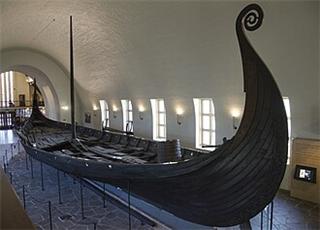
Death and burial were occasions of great ritual. The dead were cremated or buried with weapons, tools, animals and even ships, as in the magnificent ship burials of Oseberg, of 834, and Gokstad in Norway. Ibn Fadlan’s account of a Rus chieftain’s funeral describes a ship burned with the dead man, his possessions and a slave woman sacrificed to accompany him.
Legacy
Norse religion has left traces in everyday language: four days of the English week are named after the Anglo-Saxon forms of its gods, Tuesday after Tiw, the Norse Tyr, Wednesday after Woden, the Norse Odin, Thursday after Thor and Friday after Frigg. Place names across Scandinavia and England preserve the names of gods and sanctuaries.
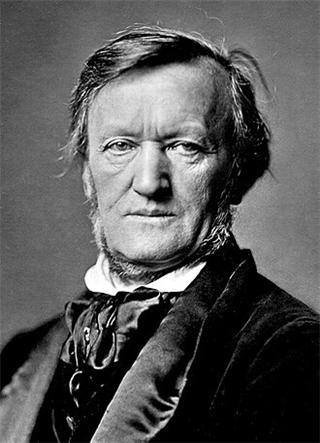
Its myths, rediscovered in the 17th and 18th centuries, became a powerful inspiration for Romantic literature and Scandinavian and German nationalism in the 19th century. Richard Wagner drew on the Eddas and related sagas for his opera cycle The Ring of the Nibelung, and J.R.R. Tolkien, a scholar of Old Norse, took the names of his dwarves and of Gandalf from the Völuspá. In the 20th and 21st centuries, comics, novels, films, television and video games have made Odin, Thor and Loki familiar around the world.
Norse symbols have also been misused, by the Nazis and by modern white supremacists, a misuse that many modern followers of the old gods firmly reject.
The modern revival of the worship of the Norse gods, often called Heathenry, has grown since the 1970s; in Iceland the Ásatrú fellowship, founded in 1972 by the poet Sveinbjörn Beinteinsson and recognised by the state in 1973, has become one of the country’s largest non-Christian religious bodies. For historians, the religion remains a field of lively debate, as archaeology, place names and the critical reading of medieval texts reveal a more varied and local religion than the systematic mythology of Snorri.
Norse religion, the pre-Christian faith of Scandinavia, worshipped Odin, Thor, Freyr, Freyja and other gods with sacrifices and feasts led by chieftains and kings, and imagined a world of nine realms around the tree Yggdrasil, destined to end at Ragnarök. Displaced by Christianity between the 10th and 12th centuries, it survives in the myths written down in medieval Iceland, which still inspire literature and art.
References
- Brink, S. and Price, N. (eds) (2008) The Viking World. London: Routledge.
- DuBois, T.A. (1999) Nordic Religions in the Viking Age. Philadelphia: University of Pennsylvania Press.
- Lindow, J. (2001) Norse Mythology: A Guide to the Gods, Heroes, Rituals, and Beliefs. Oxford: Oxford University Press.
- Price, N. (2020) Children of Ash and Elm: A History of the Vikings. London: Allen Lane.
- Sturluson, S. (1987) Edda. Translated by A. Faulkes. London: Everyman.
- Turville-Petre, E.O.G. (1964) Myth and Religion of the North. London: Weidenfeld and Nicolson.