
Religion · Europe
Slavic paganism
At a glance
- The Slavs worshipped a supreme god of the sky and thunder, later known as Perun, alongside Veles of the underworld, Mokosh, Dazhbog and a host of spirits of waters, forests, fields, households and ancestors.
- West Slavic temples held many-headed idols, such as the four-headed Svetovid at Arkona and the three-headed Triglav of Wolin, kept by priests called volkhvs.
- Rulers adopted Christianity in Great Moravia (863), Bulgaria (864), Poland (966) and Kievan Rus’ (988), but popular resistance lasted for centuries, and the old rites lived on in a “double faith”.
Timeline
- 6th centuryProcopius of Caesarea writes that the Slavs and Antes hold the god of lightning to be lord over all and sacrifice bulls to him
- 864Bulgaria adopts Christianity, a year after Great Moravia
- 966Mieszko I, the first historical ruler of Poland, is baptised with much of his court
- 980Vladimir the Great raises idols of Perun, Dazhbog, Stribog, Simargl and Mokosh on a hill at Kiev
- 988Vladimir is baptised with his subjects, and the idols of Kiev are burned or thrown into the Dnieper
- 1035–1037An uprising against Christianity among the West Slavs reaches its height
- 1168Arkona on Rugia surrenders to King Valdemar I of Denmark, and Bishop Absalon destroys the temple of Svetovid
- 1331A holy place of trees and springs at Kobarid, in present-day Slovenia, is stamped out in a “crusade”
Spread through the centuries
Where it began, how it spread, and where it was a main faith (a bright glow) or held communities (a faint one), century by century to its last places. Press Play or move the slider, turn the globe, and tap a glow or a mark to read about it.
The map opens here once the page has loaded.
Origins
Slavic paganism was the religion of the Slavic peoples before their gradual Christianisation between the 8th and 13th centuries. The Early Slavs, from the 5th to the 10th centuries CE, lived across central, eastern and southeastern Europe and spoke closely related languages that split from Proto-Slavic in the 6th century. Their words for religious ideas were almost identical, which implies a shared religion, and it has been argued that Slavic identity was at first ethno-religious, set by belief and practice rather than by birth.
Vyacheslav Ivanov and Vladimir Toporov saw the religion as an outgrowth of Proto-Indo-European religion, close to the beliefs of the Balts, Thracians and Phrygians. It shares much with Indo-Iranian religion: the word for sky, nebo, replaced the old sky god *Dyeus, div came to mean an evil being, and bog, “god”, also means “wealth” and its “giver”. Neighbouring Finnic peoples probably influenced it in Russia. Because it was widely practised for centuries rather than reshaped by elites, historians count it among the more conservative Indo-European traditions.
A unified pan-Slavic pantheon probably never existed, but core gods and ideas were shared by the East, West and South Slavs. Boris Rybakov traced its growth from devotion to life-giving forces, ancestors and a supreme god, Rod, to the “high mythology” of the official religion of early Kievan Rus’.
Beliefs & Practice
According to Helmold, the 12th-century chronicler, the Slavs believed in a single heavenly god who begat the lesser gods that governed nature. Procopius wrote in the 6th century that they held the maker of lightning to be lord over all and sacrificed bulls to him. In Rybakov’s reading this supreme god was Rod, from whom came a duality of Belobog, the “White God”, and Chernobog, the “Black God”. Perun, god of thunder, law and war, was worshipped mainly by the aristocracy; Veles was god of horned livestock, wealth and the underworld, and their struggle stood for that of heaven and earth. Mokosh, linked with the later “Damp Mother Earth”, was the only goddess in Vladimir’s pantheon, beside Dazhbog, god of the sun’s life-giving power, Stribog and Simargl.
Spirits filled the world: the rusalka and mavka of the waters, spirits of forests, fields and households such as the domovoy, and above all the ancestors, so that the religion has been called a worship of ancestors. The moon was a male god of abundance and health, the sun female. The world was seen as a tree of three levels: heaven, the earth of humans, and the underworld of Veles.
Holy places were springs, rivers, groves and rounded hilltops. Rites followed the farming year, from Koliada at Christmastide to the fire and water festivals of Yarilo and Kupala.
Texts & Teachers
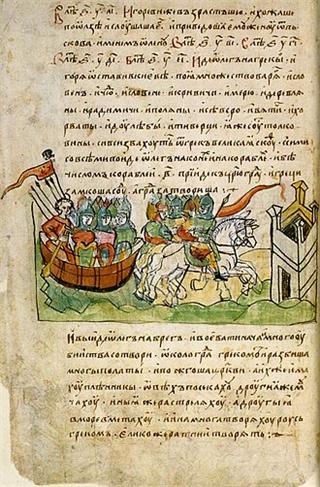
No original mythological texts survive, so Slavic religion is known from outsiders, from Christian writers and from reconstruction. Procopius of Caesarea and Jordanes recorded a few beliefs in the 6th century. The Arab historian al-Masudi wrote that in the capital of the Khazar khaganate one of seven judges judged the Slavs, Rus’ and other pagans “according to the law of paganism, that is, according to the law of reason”.
For the East Slavs, the Primary Chronicle, compiled in Kiev around 1111, and the Novgorod First Chronicle tell of the destruction of the official religion of Kiev and Novgorod; the Primary Chronicle also keeps the treaties of the Rus’ with the Greeks (945 and 971) with their pre-Christian oaths. Sermons against paganism, such as The Word of St. Gregory about idols, show what the church fought. For the West Slavs between the Vistula and the Elbe, the chronicles of Thietmar of Merseburg, Adam of Bremen and Helmold, the lives of Otto of Bamberg, Saxo Grammaticus’ Gesta Danorum and the Knýtlinga saga describe temples and cults in detail.
Modern scholars, from Lubor Niederle and Aleksander Gieysztor to Ivanov, Toporov, Marija Gimbutas and Rybakov, have rebuilt the religion by comparison with other Indo-European traditions and from 19th- and 20th-century folklore, though some of these studies are contested.
Spread

The South Slavs probably settled in Southeastern Europe in the 6th and 7th centuries, on the borders of the Byzantine Empire, and soon met Eastern Christianity. Cyril and Methodius created the first Slavic script, Glagolitic, in 855; Great Moravia adopted Christianity in 863 and Bulgaria in 864, and the conversion of the South Slavs ended under the emperor Basil I (867–886). Among the West Slavs, the Moravians accepted Christianity as early as 831, the Bohemian dukes in 845 and Mieszko I of Poland in 966.
In Kievan Rus’, Vladimir the Great raised idols of the gods on a hill at Kiev in 980 and in 988 was baptised with his subjects; the idols were burned or thrown into the Dnieper, and churches replaced temples throughout Rus’. The old religion held on longest in the north, around Novgorod, Suzdal and Belozersk, while even near Kiev volkhvs led rebellions for centuries.
The West Slavs of the Baltic held out longest. Their pagan culture was “still in full working order” in the 11th century, when an uprising broke out in the 1030s, but in the 12th century Catholicism was imposed by force in the Northern Crusades, bound up with Germanisation. In 1168 Arkona on Rugia surrendered to King Valdemar I of Denmark, and Bishop Absalon destroyed the temple of Svetovid. A holy place at Kobarid, in present-day Slovenia, was stamped out as late as 1331.
Community & Society

Priests called volkhvs kept the temples and led rituals and festivals. They enjoyed great prestige and received tribute and a share of war booty from the chiefs of the kin groups. Common people were usually not allowed to see the images of the gods, a privilege of the priests, and many idols were described only at the moment Christian missionaries destroyed them.
Among the West Slavs, temples called continae, “dwellings”, were wooden houses of the gods on raised platforms, on hills or where rivers met, with an inner cell holding the idol, set within walled enclosures. Different kin groups owned different continae and held ritual banquets there for their ancestor gods, banquets that live on as the bratchina of Russia, the slava of Serbia and the sobor or kurban of Bulgaria; with Christianisation the ancestor gods gave way to patron saints. At Arkona the four-headed Svetovid held a horn of precious metal used for divination at his great yearly festival. Other holy places had no buildings, only trees and springs, as Otto of Bamberg found at Szczecin.
Religion bound rulers and people. Vladimir’s reforms of the 970s and 980s aimed to keep the traditions of the kin groups and make Kiev the spiritual centre of East Slavdom, and his baptism in 988 made Christianity the faith of the state.
Legacy
Christianisation was slow and often superficial. The church co-opted the old faith: Perun merged with Saint Elias, Veles with Saint Blasius and Yarilo with Saint George, and Christian feasts fell on pagan dates. Medieval sources “leave no doubt whatsoever”, in Linda Ivanits’s words, that common people kept worshipping the old gods for centuries. E. V. Anichkov and V. G. Vlasov argued that the Russian countryside was Christianised only in the 15th to 17th centuries, citing mound burials that persisted into the 1530s; scholars still debate how pagan the resulting “double faith”, dvoeverie, was.
Much lived on in folk religion: the rites of Koliada, Kupala and Marzanna, the burning and drowning of seasonal effigies, devotion to Damp Mother Earth, to whom Russian peasants confessed their sins into the 20th century, and stone “mushroom” idols visited for healing until the end of the 20th century. Old Russian church architecture, with its many domes and wooden forms, drew on pre-Christian building, and some scholars find early Slavic ideas among the Old Believers who split from the church after Patriarch Nikon’s reform of 1656.
Since the early 20th century the movement of Slavic Native Faith, Rodnovery, has reinvented Slavic religion, drawing on folk religion and often on Hinduism; some groups use writings presented as centuries-old documents, such as the Book of Veles.
In the Research Series
Slavic paganism was the polytheistic and animistic religion of the Slavic peoples, centred on a god of sky and thunder, Perun, the underworld god Veles, Mother Earth and the spirits of nature and the ancestors. Rulers from Great Moravia to Kievan Rus’ adopted Christianity in the 9th and 10th centuries and the Baltic West Slavs were converted by force in the 12th, but the old gods lived on for centuries in folk religion and a “double faith”.
Test yourself
5 questions on this page, from its key events and facts.
The questions open here once the page has loaded.
References
- Juan Antonio Álvarez-Pedrosa (ed.), Sources of Slavic Pre-Christian Religion (Brill, 2021)
- Paul M. Barford, The Early Slavs: Culture and Society in Early Medieval Eastern Europe (Cornell University Press, 2001)
- Marija Gimbutas, The Slavs (Praeger, 1971)
- Judith Kalik and Alexander Uchitel, Slavic Gods and Heroes (Routledge, 2019)
- Stanisław Rosik, The Slavic Religion in the Light of 11th- and 12th-Century German Chronicles (Brill, 2020)
- Boris Rybakov, Iazychestvo drevnykh slavian [Paganism of the Ancient Slavs] (Moscow, 1981)