
Religion · Europe
Mithraism
At a glance
- Initiates, the syndexioi or “those united by the handshake”, passed through seven grades and met for ritual meals in small underground temples, the mithraea, made to represent the cave where Mithras killed the bull.
- Soldiers were strongly represented, with merchants, customs officials, freedmen and slaves, and the cult spread through Rome and Ostia, the Rhine and Danube frontiers, North Africa and Britain.
- Its origins are still debated: Franz Cumont saw it as the Roman form of the Persian religion, but since the 1970s scholars have generally rejected his model, many seeing a new creation of the Roman world.
Timeline
- 67 BCECilician pirates are said to practise “secret rites” of Mithras, though whether this bears on the origins of the mysteries is unclear
- 66Tiridates I of Armenia, crowned by Nero, tells the emperor that he reveres him “as Mithras”
- c. 80Statius’s Thebaid, one of the earliest literary references, pictures Mithras in a cave; the first mithraea appear
- c. 145Justin Martyr charges the cult of Mithras with imitating the Christian communion
- 184The Virunum album records a Mithraic festival of commemoration on 26 June
- 4th centuryMithraists face persecution from Christians, and their sanctuaries are destroyed
- c. 395Votive coins at Sarrebourg end with the reign of Theodosius I, near the end of the cult
- 1971At the First International Congress of Mithraic Studies, John R. Hinnells and R. L. Gordon severely criticise Cumont’s theory of Persian origins
Spread through the centuries
Where it began, how it spread, and where it was a main faith (a bright glow) or held communities (a faint one), century by century to its last places. Press Play or move the slider, turn the globe, and tap a glow or a mark to read about it.
The map opens here once the page has loaded.
Origins
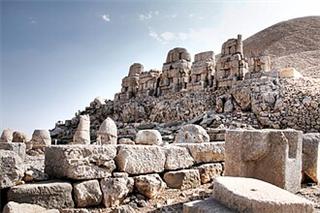
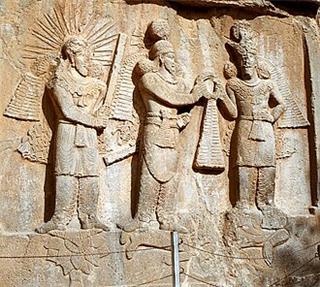
The Roman Mithras takes his name from Mithra, an old pre-Zoroastrian and later Zoroastrian god of Iran; the related Mitra is praised in the Rigveda, and the form mi-it-ra- appears in a treaty between the Hittites and Mitanni of about 1400 BCE. In the 1st century BCE King Antiochus I of Commagene set up colossal statues at Mount Nemrut in which Mithras, beardless and in Parthian dress, sat among the gods, named Apollo-Mithras-Helios, but this shows reverence for Mithras, not the mysteries. Whether these names refer to one god is disputed: John R. Hinnells writes of a single deity, while David Ulansey sees the bull-slaying Mithras as a new god given an old name.
The origins of the mysteries are intensely debated. Plutarch wrote that the pirates of Cilicia celebrated secret rites of Mithras, and Ulansey dates the first evidence to the middle of the 1st century BCE; Manfred Clauss holds that the mysteries were not practised until the 1st century CE, and C. M. Daniels finds the link unclear. Their underground temples appear suddenly in the archaeology in the last quarter of the 1st century CE.
Merkelbach suggested that a Greek-speaking founder from an eastern province created the mysteries in Rome, perhaps among the imperial bureaucracy; Beck calls this the most likely scenario, and Lewis M. Hopfe finds the cult’s epicentre in Rome. A. D. H. Bivar, L. A. Campbell and G. Widengren instead see a continuation of Iranian Mithra worship.
Beliefs & Practice
At the heart of every temple was the image of Mithras killing a bull, the tauroctony. In Anatolian dress and a Phrygian cap he kneels on the exhausted bull, holds it by the nostrils and stabs it, looking back towards the sun god Sol; a dog and a snake reach for the blood, a scorpion seizes the bull’s genitals, ears of wheat spring from its tail, and the torch-bearers Cautes and Cautopates stand on either side. Other scenes show Mithras born from a rock, striking water from stone, shaking hands with Sol, feasting with him on the bull’s hide and rising to heaven in a chariot. A lion-headed figure entwined by a serpent, perhaps named Arimanius, is generally thought to be linked with time and the seasons.
Initiates swore an oath of secrecy. Most rituals involved feasting, and many seem to have re-enacted episodes of the Mithras narrative, with the senior officers playing Mithras and Sol. Prayers were addressed to the Sun three times a day, and Sunday was especially sacred. Cherry stones point to midsummer festivities; whether Mithras’s birthday fell on 25 December is disputed.
The temples, mithraea, were small, windowless and underground, representing the cave of the bull-slaying, often near springs, with benches for 15 to 30 diners. Porphyry reports moral demands on initiates of the Lion grade, and Julian speaks of “commandments of Mithras”, but doctrine may have varied from place to place, with no central authority.
Texts & Teachers
No written narratives or theology of the religion survive. Apart from an oath and a fragment of a catechism for the Lion grade on an Egyptian papyrus, the main Mithraic texts are the graffiti on temple walls and the inscriptions on monuments, about 1,000 of them. The Mithras Liturgy, part of the Paris Greek Magical Papyrus from 4th-century Egypt, calls Mithras “the great god” and identifies him with Helios, but scholars disagree whether it is Mithraic: Franz Cumont thought not, Marvin Meyer thinks so, and Hans Dieter Betz sees a blend of Greek, Egyptian and Mithraic traditions. Monographs on Mithras by Pallas and Euboulus are lost.
Outside writers give only glimpses. According to Mary Boyce the earliest literary references are by Statius, whose Thebaid (c. 80 CE) pictures Mithras in a cave wrestling with something horned, and Plutarch (c. 100 CE). Justin Martyr, about 145, charged the cult with imitating the Christian communion, Jerome lists the seven grades, and Tertullian and Firmicus Maternus attacked the cult.
In his Cave of the Nymphs the philosopher Porphyry, citing Euboulus, wrote that Zoroaster consecrated a natural cave in the mountains of Persia to Mithras, creator of the world, and linked Mithras with Aries and Mars. Robert Turcan doubts that Porphyry reports what Mithraists believed, while Roger Beck holds his work the only clear ancient text on the intent of the mysteries.
Spread
The earliest traces lie in Rome and on the frontiers. An altar on the Esquiline in Rome to Sol Invictus Mithras by the imperial freedman T. Flavius Hyginus probably dates from 80–100 CE, and the earliest bull-slaying monument, also from Rome, from 98–99 at the earliest. Roger Beck lists the places of the earliest phase (c. 80–120 CE): Rome, Nida and Mogontiacum in Germania, Pons Aeni in Noricum, Carnuntum in Pannonia, Novae and Oescus in Moesia, and Caesarea Maritima in Judaea. The earliest military inscription, by a centurion of the Fifteenth Legion, comes from Carnuntum on the Danube, probably before 114; C. M. Daniels names the Danube and Italy as the regions where the cult first took root. Altars of 140 CE at Inveresk in Scotland are believed to come from the empire’s most northerly temple of Mithras.
The first important expansion came late in the reign of Antoninus Pius and under Marcus Aurelius, and the cult reached the height of its popularity in the 2nd and 3rd centuries, spreading at an “astonishing” rate. Temples were numerous in Rome, Ostia, Numidia, Dalmatia, Britain and along the Rhine and Danube, as far east as Dacia, and fewer in Greece, Egypt and Syria, where Hopfe counts only three; Dura-Europos marks the cult’s eastern limit. About 420 sites have yielded remains. F. Coarelli estimated that Rome had not less than 680–690 mithraea, while Leonard Boyle counted fifty known in the city.
Community & Society
Initiates called themselves syndexioi, “those united by the handshake”: admission ended with a handshake with the pater, as Mithras had shaken hands with Sol. There were seven grades of initiation, which Manfred Clauss connects with the planets; a mosaic in the Mithraeum of Felicissimus at Ostia shows them with their emblems. The highest, pater, is the commonest on inscriptions. Each grade seems to have demanded an ordeal of heat, cold or peril: an ordeal pit of the early 3rd century was found at Carrawburgh, though by the later 3rd century such pits were floored over. Clauss, noting that only about 14% of names inscribed before 250 CE give a grade, argues that the grades were a class of priests; Richard Gordon holds the older view that every initiate had one.
Membership lists, such as the graffiti of Dura-Europos and the bronze album of Virunum, name only men, and Gordon concludes that the cult was for men only, though Porphyry refers to female initiates and David Jonathan has suggested that women took part in some places. Soldiers were strongly represented, with merchants, customs officials, minor bureaucrats and many freedmen and slaves; few came from aristocratic or senatorial families before the pagan revival of the mid-4th century. Each temple had its own officers, and initiates could move with their grades from one mithraeum to another. The small congregations may have served, like the Roman collegia, as clubs for the unclubbed.
Legacy
Mithraism is viewed as a rival of early Christianity. Christian apologists noted similarities and called them devilish imitations: Justin Martyr compared its bread and cup with the Eucharist, and Tertullian likened its ritual bath and mark on the forehead to baptism. In the 4th century Mithraists faced persecution from Christians, and the religion ended between that century’s last decade and the 5th century. L. H. Martin dates its end to the anti-pagan decrees of Theodosius; Beck holds that early in the century it was already as good as dead, though senators of the pagan revival still named Mithras among their cults. Coins at Sarrebourg show its temple in use until near the century’s end, and Cumont thought the cult may have survived in remote cantons of the Alps and Vosges into the 5th century. Churches such as Santa Prisca and San Clemente were built over mithraea, and Mithras, unlike Isis, was forgotten in late antiquity.
Modern study began with Franz Cumont’s collection of texts and monuments (1894–1900), which presented the cult as the Roman form of Mazdaism, the Persian state religion. At the First International Congress of Mithraic Studies in 1971 John R. Hinnells and R. L. Gordon severely criticised this view. In 1882 Ernest Renan wrote that had Christianity been arrested, “the world would have been Mithraic”; Leonard Boyle and J. A. Ezquerra think the threat overstated.
In the Research Series
Mithraism was a Roman mystery religion of the god Mithras, whose initiates, many of them soldiers, passed through seven grades and feasted in small cave-like temples centred on the image of Mithras slaying a bull. It spread through the western empire from the late 1st century CE under an Iranian god’s name, though how much else came from Persia is debated. Christians suppressed it by the end of the 4th century.
Test yourself
5 questions on this page, from its key events and facts.
The questions open here once the page has loaded.
References
- Franz Cumont, Textes et monuments figurés relatifs aux mystères de Mithra (2 vols, 1894–1900)
- Franz Cumont, The Mysteries of Mithra (1903)
- Maarten J. Vermaseren, Corpus Inscriptionum et Monumentorum Religionis Mithriacae (2 vols)