
Religion · Central & East Asia
Bon
At a glance
- Bonpos hold that Bon is Tibet’s original religion, taught by the Buddha Tonpa Shenrab and brought to Tibet through Zhangzhung; many Western scholars see it as a form of Buddhism that keeps genuinely ancient pre-Buddhist elements.
- Its teachings closely resemble Tibetan Buddhism, especially the Nyingma school, with karma, rebirth, monasticism and Dzogchen, but its authority comes from Zhangzhung rather than India, and it keeps rituals for divination, the dead and local gods.
- Long cast as an adversary in Buddhist histories, Bon suffered in the Dzungar invasion of 1717 and in the Cultural Revolution, and was recognised as a Tibetan religion by the Fifth Dalai Lama and again, in exile, in 1979.
Timeline
- c. 100 BCEAccording to Robert Thurman, King Pudegungyal of the Yarlung dynasty institutes a Bon court religion
- 8th centuryBon declines under the Buddhist king Trisong Detsen (r. 740–797); Bon histories say its texts were hidden as treasures
- 11th centuryTreasure revealers such as Shenchen Luga (996–1035) bring out Bon texts as Yungdrung Bon takes shape
- 14th centuryLoden Nyingpo (1360–1385) reveals the Zibji, the life of Tonpa Shenrab, and New Bon begins in eastern Tibet
- 1405Menri monastery, the most important Bon monastery, is built in Tsang
- 1717Many Bonpos and Nyingmapas are executed during the Dzungar invasion of Tibet
- 1950China invades Tibet, where there are about 300 Bon monasteries; Bonpo scholars begin to reach Europe and North America
- 1979The Central Tibetan Administration in exile accepts Bon as a religious group with the same rights as the Buddhist schools
Spread through the centuries
Where it began, how it spread, and where it was a main faith (a bright glow) or held communities (a faint one), century by century to today. Press Play or move the slider, turn the globe, and tap a glow or a mark to read about it.
The map opens here once the page has loaded.
Origins
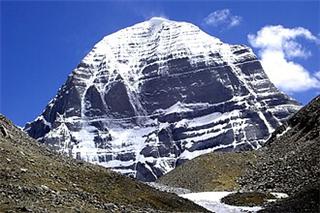
Bon, also called Yungdrung Bon, “eternal Bon”, is the indigenous religion of Tibet. Its followers, the Bonpos, believe that it was taught by the Buddha Tonpa Shenrab in Olmo Lungring or Tazig, a semi-mythical land west of Tibet, several hundred years before the Buddha Sakyamuni, and that it came first to the kingdom of Zhangzhung, around Mount Kailash, and then to Tibet. One of the dates given for Tonpa Shenrab’s birth corresponds to 1917 BCE, though no available source establishes that he lived.
Scholars disagree about how old the tradition is. Little is known of the pre-Buddhist religion of Tibet: the word bon may first have named a kind of priest, such as the priests of the Yarlung kings, who propitiated local spirits and guided the dead. Robert Thurman describes a court religion instituted around 100 BCE by King Pudegungyal, perhaps on Iranian models; some derive Bon from Zoroastrianism, others from Kashmiri Buddhism, and David Snellgrove and John Powers think a form of Buddhism may have reached western Tibet from Central Asia before it reached the central provinces.
Scholars therefore distinguish an ancient Bon of the era before 618 CE, a classical Yungdrung Bon that emerged in the 10th and 11th centuries, and a New Bon from the 14th century. Per Kvaerne uses the name only for the tradition from the 10th and 11th centuries, while Samten Karmay takes seriously the Bonpos’ own account of a separate origin.
Beliefs & Practice
In the Bon worldview, bon means “truth”, “reality” and “the true doctrine”. All reality is pervaded by a transcendent principle, an empty, dynamic potentiality with a male aspect, Kuntuzangpo, “All-Good”, and a female aspect, Kuntuzangmo; it is also called the “bon body” and “bon nature”, much like the Buddhist Dharmakaya and Buddha nature, and liberation comes through insight into it. Like Buddhists, Bonpos see the world as a place of suffering and teach karma, rebirth and the six realms of existence. In Bon Dzogchen, the Great Perfection, the world is an emanation of luminous mind, and those who awaken may dissolve into a rainbow body.
The deities are peaceful or wrathful. The Four Transcendent Lords are the Mother, Satrig Ersang; the God, Shenlha Ökar; the Procreator, Sangpo Bumtri; and the Teacher, Tonpa Shenrab. Beside them stand meditation deities such as Purpa, protectors, siddhas and dakinis, and many worldly gods: the 360 Kékhö of Mount Kailash, the sky god Gyalpo Pehar, protector of Zhangzhung, and household gods. The yungdrung, a left-facing swastika, stands for indestructibility and eternity.
Bon keeps many practical rituals less common in Buddhism: divination, ransom rituals to appease local deities, rites to call back fortune and the soul, and funeral rites that guide the dead to higher realms.
Texts & Teachers
The Bon canon is divided like the Buddhist one. The Kanjur holds the words of the Buddha Shenrab in four classes, sutras, Perfection of Wisdom, tantras and the “treasure-house” of the highest meditation; the Tenjur holds commentaries and treatises, external, internal and secret. Per Kvaerne finds no text in the Kanjur later than 1386 and suggests it was assembled by 1450. The canon of about three hundred volumes was carved on woodblocks in the mid-19th century and kept at Trochu in eastern Tibet; the blocks were destroyed in the Cultural Revolution, but most texts were taken to India or hidden.
Most of the canon is terma, treasure texts which Bonpos believe were hidden during the persecutions, by masters such as Drenpa Namkha, and rediscovered from the 10th century by treasure revealers: Shenchen Luga (996–1035), whose Cavern of Treasures is a source for the Zhangzhung language, Khutsa Dawo (b. 1024) and Zhodton Ngodrub Dragpa, who found a Dzogchen treasure inside a statue in 1080. Three scriptures tell the life of Tonpa Shenrab: two treasures of the 10th and 11th centuries and the Zibji, dictated by Loden Nyingpo in the 14th century.
Scholars long assumed that Bon texts copied Buddhist ones; since the work of Snellgrove and others, most hold that the borrowing went both ways and that Buddhist texts sometimes reproduce Bon texts.
Spread
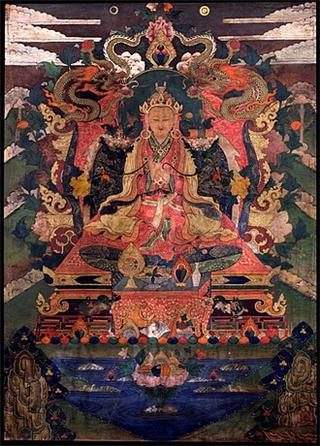
In the early Tibetan Empire, Bon priests served the royal cult, performing ceremonies to protect the king and the country and to win the help of spirits in war. As Buddhism grew the two faiths clashed: some sources tell of a debate after which a king declared Buddhism the winner and banished Bon priests to the border regions, though Bon priests and Buddhist monks also performed rituals together. Bon histories blame the decline of Bon on persecutions under Drigum Tsenpo and the Buddhist king Trisong Detsen (r. 740–797).
Yungdrung Bon took shape in the 10th and 11th centuries, during the later spread of Buddhism, among hereditary ritual practitioners like those from whom the Nyingma school arose. A monastic tradition followed, shaped by Nyamme Sherab Gyaltsen (c. 1356–1415), and Menri monastery, built in Tsang in 1405, became the foremost Bon monastery. New Bon began in eastern Tibet with Loden Nyingpo (1360–1385), its treasures still revealed into the 18th century, and in the 19th and 20th centuries Bon flourished in eastern Tibet under lamas such as Shardza Tashi Gyaltsen.
By the Chinese invasion of 1950 there were about three hundred Bon monasteries in Tibet and the rest of western China. Bon suffered with Tibetan Buddhism in the Cultural Revolution, and its monasteries were allowed to rebuild after 1980. In exile Menri was refounded at Dolanji in India, and Bon establishments stand in Nepal and Bonpo centres in cities around the world.
Community & Society
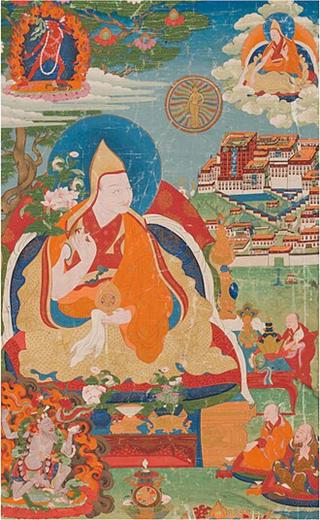
Bon has celibate monks, called trangsong, a word that translates the Sanskrit rishi, who study scripture, train in a debate tradition modelled on the Gelug school and perform rituals, and it has a strong tradition of lay yogis; most of the early treasure revealers were laymen. The present spiritual head of Bon is Menri Trizin Rinpoché, successor of Lungtok Tenpai Nyima (1929–2017), in the line of the abbots of Menri. Families matter too: the 5th Panchen Lama, Lobsang Yeshe (1663–1737), came from the Dru, an important Bon family.
Bonpos have long stood apart. Buddhist histories cast Bon in a hostile light, and Tibetans still call Buddhists nangpa, “insiders”, and Bonpos sometimes chipa, “outsiders”. The Fifth Dalai Lama converted some Bon monasteries to the Gelug school by force, yet officially recognised Bon as a Tibetan religion, and Samten Karmay sees his choice of a Dru son as Panchen Lama as a gesture of reconciliation. In 1717 many Bonpos were executed during the Dzungar invasion.
In exile Bonpos were stigmatised and for twenty years received none of the aid that passed through the Dalai Lama’s office, until in 1979 the 14th Dalai Lama advised the Central Tibetan Administration to accept them. Bon has since had the same rights as the Buddhist schools; in 1987 the Dalai Lama forbade discrimination against Bonpos, and he counts Bon as the fifth Tibetan religion.
Legacy
Bon today is a living minority faith. Scholars estimated about 400,000 followers on the Tibetan Plateau in 2019, especially in the east, and Bon is also practised in the Himalayan regions around Tibet, in the Tibetan diaspora and at Bonpo centres in cities around the world. Some reports say the Chinese government promotes Bon and links it with Confucianism. Bon’s leading monastery in India is the refounded Menri at Dolanji in Himachal Pradesh, and in Nepal Triten Norbutse stands on the western outskirts of Kathmandu.
Its relationship with Tibetan Buddhism is much debated. Geoffrey Samuel calls it “essentially a variant of Tibetan Buddhism” that keeps genuinely ancient pre-Buddhist elements, Snellgrove a heterodox Buddhism, and Powers argues that it became a self-conscious system only under Buddhist influence, while Bonpos, and scholars such as Karmay, hold it to be a tradition of its own. Some Buddhists in Bhutan and Amdo practise both, and the Dongba rites of the Nakhi and the Hangui religion of the Pumi are believed to come from Bon. The village priests called bon or lhabon throughout the Himalayas are lay ritual specialists, not part of Bon proper.
Western scholars began to take Bon seriously in the 1960s, inspired by David Snellgrove, and Helmut Hoffmann’s 1950 picture of it as animism and shamanism has been challenged. Within Tibetan Buddhism, the Rimé movement encouraged friendlier attitudes between Bonpos and Buddhists.
In the Research Series
Bon is the indigenous religion of Tibet, which its followers trace to the Buddha Tonpa Shenrab and the ancient kingdom of Zhangzhung around Mount Kailash. Scholars date its classical form, Yungdrung Bon, to the 10th and 11th centuries and debate how much it keeps of pre-Buddhist Tibetan religion; its teachings, monasteries and Dzogchen closely resemble Tibetan Buddhism. About 400,000 Bonpos lived on the Tibetan Plateau in 2019.
Test yourself
5 questions on this page, from its key events and facts.
The questions open here once the page has loaded.
References
- Christopher Baumer, Bon: Tibet’s Ancient Religion (Wisdom, 2002)
- John Vincent Bellezza, Spirit Mediums, Sacred Mountains and Related Bön Textual Traditions in Upper Tibet (Brill, 2005)
- Dmitry Ermakov, Bѳ and Bön: Ancient Shamanic Traditions of Siberia and Tibet in their Relation to the Teachings of a Central Asian Buddha (Vajra Publications, 2008)
- D. Rossi, The Philosophical View of the Great Perfection in the Tibetan Bon Religion (Snow Lion, 1999)
- Geoffrey Samuel, Civilized Shamans (Smithsonian Institution Press, 1993)