
Religion · Central & East Asia
Tengrism
At a glance
- Tengrism centres on Tengri, the eternal blue sky, with the earth mother and many other gods and spirits; many scholars see it as originally polytheistic, with a monotheistic form growing up among rulers.
- It was the faith of the Xiongnu, the Göktürks, the Bulgars, the Khazars and the Mongol Empire, whose khans held that they ruled because “Heaven so ordained”.
- Turkic and Mongol peoples largely turned to Islam and Buddhism from the 14th century; since the 1990s Tengrism has been revived in Central Asia and Siberia, a modern and monotheistic movement distinct from the historical religion.
Timeline
- 4th century BCEChinese chronicles first record Tengri, as the sky god of the Xiongnu
- 209 BCEThe Xiongnu empire is founded, the first of a succession of steppe khanates and empires that practised Tengrism
- 8th–10th centuriesThe Orkhon inscriptions in Old Turkic script record that the khagans acted because “Heaven so ordained”
- 1240The Secret History of the Mongols is written, tracing Genghis Khan’s line to Borte Chino, born with “destiny from Tengri”
- 1262Hulegu Khan writes from Maragheh to Louis IX of France, in a letter that treats Nestorian Christianity as part of the khans’ Tengrism
- 14th centuryÖzbeg Khan of the Golden Horde turns to Islam, and the Turkic and Mongolic peoples of Central Asia largely convert
- 1990–1993The Yakut philologist Lazar Afanasyev-Teris founds the Tengrist organisation Kut-Siur, later Aiyy Faith
- 2005Dastan Sarygulov founds Tengir Ordo in Kyrgyzstan to promote the values and traditions of Tengrism
Spread through the centuries
Where it began, how it spread, and where it was a main faith (a bright glow) or held communities (a faint one), century by century to today. Press Play or move the slider, turn the globe, and tap a glow or a mark to read about it.
The map opens here once the page has loaded.
Origins
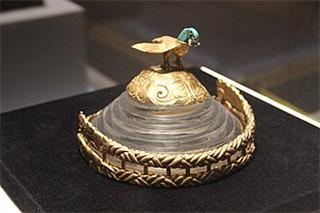
Tengrism (also Tengriism or Tengrianism) is a belief system that arose on the Eurasian steppes, based on shamanism and animism and centred on the sky god Tengri. It formed from the folk religions of the Turkic and Mongolic peoples, which honoured many deities and spirits and resembled other traditions of Siberia, Central Asia and Northeast Asia. Chinese chronicles first recorded the name in the 4th century BCE, as chēnglí, the sky god of the Xiongnu. It may come from Old Turkic words for “daybreak” or “dawn”, or, as Stefan Georg has proposed, from a Proto-Yeniseian word for “high”.
Tengrism was the faith of a continuous succession of pastoral, semi-sedentary khanates and empires, from the Xiongnu empire, founded in 209 BCE, to the Mongol Empire of the 13th century. Its nature is debated. Many scholars hold that it was at first polytheistic and that a monotheistic branch, with Kök-Tengri as supreme being, grew up to legitimise dynasties, perhaps only among the aristocracy and only by the 12th and 13th centuries. Jean-Paul Roux saw monotheism as a later development, while the Turkish historian Ahmet Taşağıl argues that the ancient Turks were not shamanists but held a distinct faith in an abstract god of heaven.
The word “Tengrism” itself is new: it appears in the works of the 19th-century Kazakh ethnographer Shoqan Walikhanov and entered scholarship with Roux in 1956.
Beliefs & Practice
Tengrists see their existence as sustained by the eternal blue sky, Tengri, by the fertile mother earth, Eje, and by a ruler chosen by the holy spirit of the sky. Heaven, earth, the spirits of nature and the ancestors provide for every need, and a person who lives an upright, respectful life keeps the world in balance and perfects his Wind Horse, or spirit. Gök Tengri remains abstract and is never depicted, but other gods are personified: Itugen, an earth deity; Umay, goddess of children; Kayra and his son Ülgen, god of goodness; and Erlik, ruler of the underworld. One tradition counts 99 tngri, 55 benevolent and 44 terrifying, called upon only by leaders and great shamans.
The cosmos has three worlds, heaven, the earth and the underworld, joined by a world tree, the upper and lower worlds often divided into seven layers. A shaman, or kam, can travel among them, riding a black bird, a deer or a horse, and may plead with Erlik for a sick person’s life. People and animals have several souls, usually three, so animals too must be respected. Humans are the children of Father Heaven and Mother Earth: “When the blue Heaven above and the brown Earth beneath arose, between them twain Mankind arose,” an Old Turkic inscription says.
Ancestor worship plays an important part, and Tengrism places humans within nature rather than above it.
Texts & Teachers

Unlike Siberian shamanism, which has no written tradition, Tengrism can be traced in Turkic and Mongolic historical texts, though these are histories rather than scriptures with set doctrines. The Orkhon inscriptions, in the Old Turkic script of the Göktürks and other khanates of the 8th to 10th centuries, show Tengri choosing and guiding the khagan, whose deeds were done because “Heaven so ordained”. The Irk Bitig, a 9th-century book of divination from the Uyghur Khaganate, calls Tengri Türük Tängrisi, “God of the Turks”.
The Secret History of the Mongols, written in 1240, names Tengri many times. It begins with Genghis Khan’s ancestor Borte Chino, the Blue Wolf, born with “destiny from Tengri”, calls a later ancestor a “son of Tengri” and tells how Genghis Khan met Tengri in the mountains at the age of twelve. Mongol letters to Europe set out the faith of the khans: Hulegu wrote to Louis IX of France in 1262, and Arghun’s letters, headed by the name of Möngke Tengri, “Eternal Heaven”, joined the power of Tengri to the majesty of the khan. The 17th-century chronicle Altan Tobchi ends with a Tengrist prayer.
In one view Tengrism rests on a personal relationship with gods and spirits that cannot be set in writing, and so has no prophets, holy scriptures, clergy or dogma.
Spread
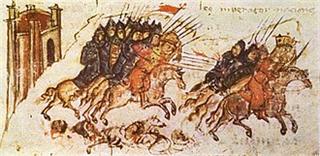
Tengrism was the prevailing religion of the Xiongnu, Huns, Xianbei, Göktürks, Bulgars, Yeniseians and Mongolic peoples, and a state religion of the First, Western and Eastern Turkic Khaganates, Old Great Bulgaria, the First Bulgarian Empire, Volga Bulgaria, Khazaria and the Mongol Empire. Nomads embraced it more than Turks of the lower mountains and forests. The Huns of the northern Caucasus reportedly sacrificed horses to Tangri Han, and Hungarian archaeologists hold that the religion of the Magyars until the end of the 10th century was a form of Tengrism.
Genghis Khan and several generations of his successors were Tengrist “shaman-kings”, open to other faiths: Hulegu, who ruled from Maragheh in Iran, had Nestorian Christians in his family. The Turks first met Islam at the Battle of Talas and converted largely through Sufism; in the 14th century Özbeg Khan of the Golden Horde turned to Islam, and the Turkic and Mongolic peoples of Central Asia largely converted. From then on Tengrism was mostly submerged by other faiths.
In Mongolia it was absorbed into Mongolian Buddhism, surviving unabsorbed only in the far north, around Lake Khövsgöl and Lake Baikal. Kalmyk regiments carried the banner of the war god Daichin Tengri through the Napoleonic Wars as far as Paris, and traditional Tengrism persists in Sakha, Buryatia and Tuva alongside other religions.
Community & Society

The steppe empires joined religion to power. In the Orkhon inscriptions Tengri chooses the khagan and guides his acts, and in Mongol thought the khan’s majesty, suu, was a divine stamp given by Tengri to the one he chose. Some 20th-century scholars proposed an imperial cult of the khagan, and Jean-Paul Roux saw monotheism as a support for dynasties: “As there is only one God in Heaven, there can only be one ruler on the earth.” In Mongolian folk religion Genghis Khan is considered an embodiment of Tengri’s will.
Shamans served the clans. The tngri were called upon only by leaders and great shamans, while the souls of great shamans became protector spirits and those of lesser shamans guardians of a clan’s mountains and rivers. The words for a female shaman in Mongol, Yakut and Buryat share one root with the name of the earth goddess Etügen, which Maria Czaplicka linked to the theory that shamans were originally female. Hulegu’s letter names a supreme shaman, Kokochu Teb Tengri.
Tengrist rule was flexible. Arghun told Pope Nicholas IV in 1290 that whether some received baptism or not was “only for Eternal Tengri to know”. Jonathan Brack describes khans who staged religious debates and judged them by practical proof, and a faith that took in new ideas, as when Buddhists identified Genghis Khan with the Cakravartin, the world ruler.
Legacy

Tengrist ideas survived inside the faiths that replaced it. In Mongolia its formulas and ceremonies were absorbed into the Buddhist state religion. Among Turkic Muslims the writings of Ahmad Yasawi join Tengrist and Islamic themes, God being called both Gök Tengri and Allah, and Tengrism influenced Sufism and folk Islam, especially Bektashism. Shoqan Walikhanov wrote that only the names became Islamic while the ideas stayed shamanic, though other scholars now challenge the theory of syncretism.
The modern revival is a movement of its own, whose “political” adherents are all monotheists. After 1923 Turanism and Kemalism encouraged it in Turkey, where the writer Nihal Atsız was a Tengrist and in 2022 Burhanettin Mumcuoğlu became the first person to change his official religion from Islam to Tengrism. Olzhas Suleimenov presented it in 1975 as one of the world’s oldest religions, and since the dissolution of the Soviet Union it has spread among intellectuals in Kazakhstan, Kyrgyzstan, Tatarstan and Bashkortostan and is undergoing an organised revival in Siberia; Nursultan Nazarbayev and Askar Akayev called it the “natural” religion of the Turkic peoples.
Tengrism is practised by a small share of Mongolians, by over one million people in Kazakhstan (2024) and about 50,000 in Kyrgyzstan (2014), where it is not officially recognised. Altai Burkhanism, which arose in 1904, and the Chuvash Vattisen Yaly are related movements.
In the Research Series
Tengrism is the religion of the Eurasian steppes centred on Tengri, the eternal sky, with the earth mother, many spirits and shamans who travel between the worlds. First recorded among the Xiongnu in the 4th century BCE, it was the faith of the Göktürks, Bulgars, Khazars and the Mongol Empire until Islam and Buddhism largely replaced it from the 14th century; since the 1990s a modern revival has grown in Central Asia and Siberia.
Test yourself
5 questions on this page, from its key events and facts.
The questions open here once the page has loaded.
References
- N. Shaimerdinova, “Tengrism in the life of Turkic peoples”, in Oliver Corff (ed.), Religion and State in the Altaic World (De Gruyter, 2022), pp. 177–182
- Ziya Gökalp, History of Turkish Holy Tradition and Turkish Civilization
- James Palmer, The Bloody White Baron