Europe
Andorra
At a glance
- A small Pyrenean state created in 1278 when the bishop of Urgell and the count of Foix agreed to share its lordship.
- For centuries a poor community of herders and smugglers, it kept its autonomy by staying neutral between France and Spain.
- A constitution in 1993 made it a sovereign parliamentary co-principality; it joined the United Nations the same year.
Rise & Fall
- 1278The first Pareatge establishes joint lordship by the bishop of Urgell and the count of Foix
- 1419The Consell de la Terra, forerunner of the Consell General, is created
- 1607Henry IV joins the Foix co-princedom to the French crown
- 1806Napoleon restores the French co-princedom abandoned in 1793
- 1866The Nova Reforma widens the electorate to all heads of household
- 1970Andorran women gain the vote
- 1993A new constitution is approved by referendum and Andorra joins the United Nations
Foundation
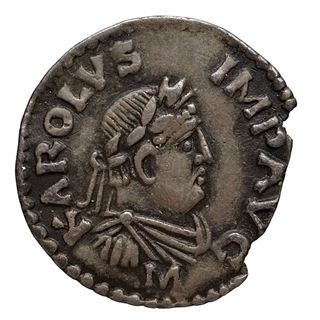
The valleys of Andorra, high in the eastern Pyrenees between the County of Foix to the north and Catalonia to the south, appear among the parishes of the diocese of Urgell in a document traditionally dated to 839, and a later legend credited Charlemagne with granting the Andorrans their freedom for help against the Moors. In the Carolingian period the valleys belonged to the counts of Urgell, who between the tenth and twelfth centuries ceded their rights there to the bishops of Urgell, seated at La Seu d'Urgell just south of the valleys. The bishops in turn granted the valleys as a fief to a local lineage, the lords of Caboet, whose rights passed by marriage to the viscounts of Castellbò and, in the early thirteenth century, to the counts of Foix. Bishops and counts then quarrelled for decades over jurisdiction, taxes and military service, at times by force. After years of conflict and arbitration, Bishop Pere d'Urtx and Count Roger-Bernard III of Foix signed the first Pareatge on 8 September 1278, agreeing to hold a joint and undivided lordship over Andorra. A second Pareatge of 1288 settled remaining questions. These agreements, which shared out tribute, justice and military obligations between the two lords, created the co-principality that still exists.
Socioeconomy

For most of its history Andorra was a poor mountain society of a few thousand people living in stone villages along the branches of the Valira river. Families farmed small terraced fields of rye, barley and later potatoes, cut hay for the winter and, above all, herded sheep and cattle on high summer pastures, moving flocks seasonally to the lowlands of Catalonia and southern France. Iron working in small water-powered forges flourished from the seventeenth to the nineteenth century, and tobacco had become an important crop by the eighteenth. The valleys' position between two states with high customs duties made smuggling a steady source of income. Society centred on the household (casa), whose heir inherited the property undivided, and on the parishes, which managed common pastures and woods. The people were Catholic, under the spiritual authority of the bishop of Urgell, and spoke Catalan, which remains the only official language. Small Romanesque churches such as Santa Coloma, with its round bell tower, and Sant Joan de Caselles survive from the eleventh and twelfth centuries. From the mid-twentieth century the economy changed completely: new roads, duty-free shopping, ski resorts and low taxes drew millions of visitors a year, banking grew, and the population rose from a few thousand in the 1940s to around 80,000 in the 2020s, a large share of them foreign nationals from Spain, Portugal and France.
Military
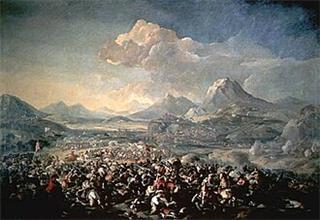
Andorra never had a standing army, and its survival depended less on arms than on the balance between its two lords and its poverty and remoteness. In the thirteenth century the conflict between the counts of Foix and the bishops of Urgell was fought partly by force, and the Pareatges defined the military service the Andorrans owed their lords, within set limits. Defence otherwise rested on a citizens' militia in which heads of household were expected to keep a firearm and turn out when called; the obligation survived in law into modern times, although the militia long ago became ceremonial. The valleys kept out of the wars that repeatedly crossed the Pyrenees, including the Reapers' War of 1640–1652, the War of the Spanish Succession and the Napoleonic wars, partly by their isolation and partly by respecting both co-princes. Neutrality was tested in the twentieth century. In 1933, during a dispute over voting rights, French gendarmes were sent into the valleys to restore order, and in 1934 the Russian adventurer Boris Skossyreff proclaimed himself King Boris I of Andorra before being arrested by the Spanish authorities within days. During the Spanish Civil War and the Second World War the mountain paths served as routes for refugees, escapers and smugglers. Andorra still has no army; France and Spain are responsible for its external defence, and internal security rests with its police force.
Governance & Law

For seven centuries Andorra's constitution was the Pareatge itself. The two co-princes, the bishop of Urgell and the count of Foix, held sovereignty jointly and undivided, each represented by a veguer who oversaw justice and order, while bailiffs (batlles) chosen from among the Andorrans judged lesser cases. Appeals went to the co-princes' own courts, the episcopal tribunal at La Seu d'Urgell and a French tribunal at Perpignan. In return for protection the valleys paid the co-princes a small tribute, the quèstia, which survives as a symbolic payment. Local life was run by the parishes, Canillo, Encamp, Ordino, La Massana, Andorra la Vella and Sant Julià de Lòria, with Escaldes-Engordany added as a seventh in 1978. In 1419 the co-princes allowed the creation of the Consell de la Terra, an assembly of parish representatives that developed into the Consell General, which from 1702 met in the Casa de la Vall in Andorra la Vella. The Nova Reforma of 1866 widened the electorate to all heads of household. The French rights descended from the counts of Foix to the kings of Navarre; when Henry III of Navarre became Henry IV of France, his edict of 1607 joined them to the French crown, and they later passed to the French heads of state, from emperors to the presidents of the Republic.
Global & Regional Impact
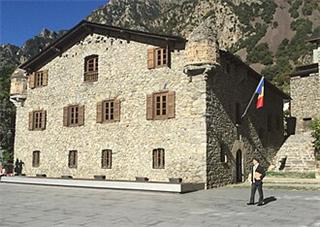
Andorra's influence on the wider world has been modest, but its history is unusual. It is the last survivor of the many feudal lordships of the Pyrenees, and its co-principality, in which a Catalan bishop and a French head of state share sovereignty, is a constitutional arrangement without parallel anywhere. Andorrans long cited the Pareatges of 1278 and 1288 as the guarantee of their liberties and of the self-government of their parishes, and the medieval texts remained in force until 1993. The country preserved Catalan as the language of public life through periods when it was suppressed or downgraded in Spain and France, and it is the only state in which Catalan is the sole official language. Its Romanesque churches, stone mountain houses and the Casa de la Vall preserve a landscape of traditional Pyrenean culture, and the Madriu-Perafita-Claror Valley was inscribed as a UNESCO World Heritage Site in 2004 as an example of high-mountain land use over centuries. Andorra also features in debates about microstates: its admission to the United Nations in 1993, in the same years as San Marino and Monaco, helped show that very small states could take full part in international organisations. In the twentieth century it became widely known as a destination for shopping, skiing and tax planning, and its later reforms show how a small society adapted to European integration.
Into the Present
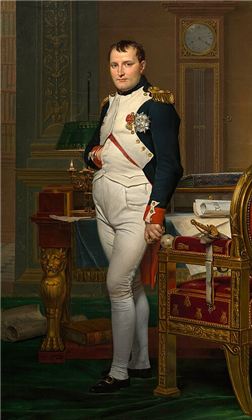
Andorra was never conquered or abolished, but its medieval order was transformed in the nineteenth and twentieth centuries. During the French Revolution the Republic refused in 1793 to accept the quèstia, rejecting the French co-sovereignty as a feudal relic, and for over a decade the bishop was the only co-prince until Napoleon restored the French rights in 1806 at the Andorrans' request. Pressure for reform grew with modernisation: the Nova Reforma of 1866, the crisis of 1933 that brought universal male suffrage, the vote for women in 1970, and the creation in 1981 of an executive council, whose first head, Òscar Ribas Reig, took office in 1982, gradually separated government from the co-princes. The decisive step was the constitution approved by referendum on 14 March 1993, which made Andorra a sovereign parliamentary co-principality: the co-princes became constitutional heads of state with limited powers, the Consell General became a full parliament, and a government answerable to it took over day-to-day rule. Andorra joined the United Nations on 28 July 1993 and the Council of Europe in 1994. It adopted the euro under a monetary agreement with the European Union signed in 2011, introduced corporate and personal income taxes in the 2010s and ended banking secrecy. Today it is a prosperous microstate of about 468 square kilometres, still ruled jointly by the bishop of Urgell and the president of France.
Andorra is the last surviving feudal lordship of the Pyrenees, a co-principality created by the Pareatges of 1278 and 1288 and still shared by the bishop of Urgell and the French head of state, which survived seven centuries through neutrality and remoteness and became a sovereign parliamentary microstate in 1993.
Test yourself
5 questions on this page, from its key events and facts.
The questions open here once the page has loaded.
References
- Bisson, T.N. (1986) The Medieval Crown of Aragon: A Short History. Oxford: Clarendon Press.
- Duursma, J.C. (1996) Fragmentation and the International Relations of Micro-States: Self-determination and Statehood. Cambridge: Cambridge University Press.
- Eccardt, T.M. (2004) Secrets of the Seven Smallest States of Europe: Andorra, Liechtenstein, Luxembourg, Malta, Monaco, San Marino, and Vatican City. New York: Hippocrene Books.
Connections
Open the full connections map →