Europe
Kingdom of Naples
At a glance
- The mainland half of the old Kingdom of Sicily, ruled separately from Naples after the Sicilian Vespers of 1282.
- Angevin, Aragonese, Spanish and Bourbon rulers made Naples one of Europe's largest cities and a centre of art and learning.
- Its feudal baronage and heavy taxes fuelled revolts; in 1816 it merged with Sicily into the Kingdom of the Two Sicilies.
Rise & Fall
- 1282The Sicilian Vespers leave Charles of Anjou with only the mainland
- 1309Robert the Wise begins a reign that makes Naples a cultural centre
- 1442Alfonso V of Aragon conquers Naples
- 1495Charles VIII of France enters Naples, opening the Italian Wars
- 1504The Treaty of Lyon ends the war, leaving Naples to Ferdinand II of Aragon
- 1647The revolt of Masaniello shakes Spanish rule
- 1734Charles of Bourbon restores an independent kingdom
- 1816Naples and Sicily are united as the Kingdom of the Two Sicilies
Foundation

The Kingdom of Naples emerged from the break-up of the Kingdom of Sicily, created by the Norman Roger II in 1130 and later ruled by the Hohenstaufen emperors. In 1265 Pope Clement IV invested Charles of Anjou, brother of Louis IX of France, with the kingdom; in February 1266 Charles defeated and killed King Manfred at the Battle of Benevento and in 1268 defeated the last Hohenstaufen heir, Conradin, at the Battle of Tagliacozzo, beheading him in Naples. Charles shifted the centre of government from Palermo to Naples, where he built the Castel Nuovo. Heavy taxation and the dominance of French officials provoked the Sicilian Vespers, the uprising that broke out in Palermo on Easter Monday, 30 March 1282, and massacred the French on the island. The Sicilians offered their crown to Peter III of Aragon, husband of Manfred's daughter Constance, and Charles was left with the mainland only. The War of the Sicilian Vespers lasted twenty years: Charles's son Charles II, captured at sea by the Aragonese admiral Roger of Lauria in 1284, became king on his father's death in 1285 while still a prisoner, and the Peace of Caltabellotta in 1302 confirmed the division. The Angevin kings kept the title 'King of Sicily', but their mainland realm was ruled from Naples and became known by its capital's name.
Socioeconomy
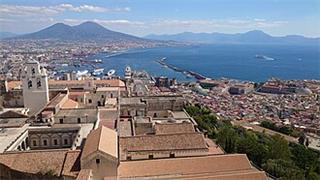
The kingdom was overwhelmingly agrarian, and its society was dominated by a powerful feudal baronage and a numerous clergy. Grain from Apulia, olive oil, wine, silk from Calabria and wool were its main products; the great seasonal migration of sheep between the Abruzzi mountains and the Apulian plain was organised by a royal customs office, the Dogana della mena delle pecore, founded under Alfonso V in 1447. Much of the long-distance trade was in the hands of Genoese, Florentine and Venetian merchants and bankers, who lent money to the crown and exported raw materials, while local manufacture remained modest. Naples itself grew enormously, drawing in nobles, lawyers, clergy and the rural poor; by around 1600 it probably had well over 250,000 inhabitants, making it one of the largest cities in Europe, until the plague of 1656 killed around half its population. The provinces, by contrast, were poor, burdened by feudal dues and troubled by banditry. The church was immensely rich, with hundreds of religious houses in the capital, and popular devotion centred on saints such as San Gennaro, whose blood is believed to liquefy. Cultural life flourished at court and in the capital, from Giotto and Petrarch under Robert the Wise to the humanists of Alfonso V, the painting of Caravaggio and Luca Giordano, and the Neapolitan school of opera in the eighteenth century.
Military
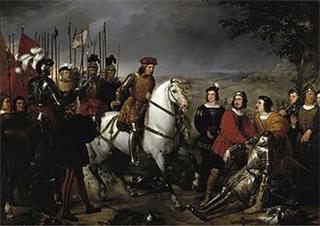
Angevin Naples spent much of the fourteenth century trying to recover Sicily through repeated expeditions that failed, and its kings led the Guelf cause in Italy: Robert the Wise was lord of Genoa from 1318 and the chief opponent of the emperor Henry VII. Ladislaus of Naples (r. 1386–1414) built one of the strongest armies in Italy with condottieri, occupied Rome in 1408 and threatened Florence before his sudden death. The Ottoman capture of Otranto in 1480, where many inhabitants were killed, exposed the vulnerability of the long coastline until the town was recovered in 1481. Naples then became a prize in the Italian Wars. Charles VIII of France entered the city in February 1495 almost unopposed but soon withdrew; Louis XII and Ferdinand II of Aragon agreed in 1500 to partition the kingdom, then fell out, and the Spanish commander Gonzalo Fernández de Córdoba, the 'Great Captain', won the Battle of Cerignola, one of the first battles decided largely by handguns, and the Battle of the Garigliano, both in 1503. Under Spain the kingdom supplied soldiers, money and galleys for the Habsburg wars, including ships at the Battle of Lepanto in 1571, and viceroys built chains of coastal watchtowers against Barbary corsairs. Charles of Bourbon won the kingdom at the Battle of Bitonto in 1734, but the army of his son Ferdinand IV collapsed against the French in 1798.
Governance & Law

The kingdom inherited from the Normans and Frederick II a centralised royal administration, with justiciars over the provinces, a royal treasury and a high court, but the Angevins granted extensive lands and jurisdiction to French and local barons, and royal authority depended heavily on these lords. Robert the Wise (r. 1309–1343), praised as a learned 'new Solomon', ruled through an able bureaucracy and close ties with the papacy at Avignon. The long reign of his granddaughter Joanna I (1343–1382), marked by the murder of her husband Andrew of Hungary in 1345, a Hungarian invasion and the Western Schism, ended with her deposition and death at the hands of her cousin Charles of Durazzo. Alfonso V of Aragon, who conquered Naples in 1442, reorganised finances and justice, creating the Sacro Regio Consiglio as supreme tribunal; his son Ferrante crushed the Conspiracy of the Barons of 1485–1486. Under Spanish rule from 1504 a viceroy governed with the Collateral Council, while a parliament of barons and towns voted taxes until it ceased to meet in the 1640s. Pedro de Toledo, viceroy from 1532 to 1553, strengthened royal justice and remodelled the capital, laying out the Via Toledo. The Bourbons from 1734, with ministers such as Bernardo Tanucci, tried to curb church privileges and baronial power, but feudalism was abolished only under French rule in 1806.
Global & Regional Impact

For over five centuries Naples was the largest state in Italy and its capital one of the great cities of Europe. Under Robert the Wise the Angevin court attracted Giotto, who worked there around 1328–1333, and Petrarch, who was examined by the king in 1341 before his coronation as poet laureate in Rome, while the young Giovanni Boccaccio spent formative years in the city. Alfonso V made Naples a centre of Renaissance humanism, patronising scholars such as Lorenzo Valla and Antonio Beccadelli, whose circle grew into the academy later named after Giovanni Pontano, and the triumphal arch of the Castel Nuovo is among the earliest Renaissance monuments of southern Italy. As a Spanish dominion the kingdom was a major source of revenue, men and ships for the Habsburgs and a centre of Baroque art, music and learning. The philosopher Giambattista Vico published his New Science in Naples in 1725, Pietro Giannone's Civil History of the Kingdom of Naples attacked the temporal power of the church, and Antonio Genovesi held one of Europe's first chairs of political economy from 1754. Charles of Bourbon founded the Teatro di San Carlo in 1737, began the palace of Caserta and sponsored the excavations of Herculaneum and Pompeii, which shaped European Neoclassicism. The kingdom's legacy of feudal landholding, weak provincial towns and fiscal pressure also lies behind the long-debated 'Southern Question' of united Italy.
Decline & Fall

The end of the kingdom came through revolution, French conquest and Bourbon restoration. Ferdinand IV, who succeeded in 1759 when his father Charles left to become king of Spain, and his wife Maria Carolina of Austria, sister of Marie Antoinette, turned against reformers after the French Revolution. In 1798 Ferdinand attacked the French in Rome, but his army was routed; the royal family fled to Palermo on Nelson's ships, and in January 1799 French troops and Neapolitan patriots proclaimed the Parthenopean Republic. Within months the peasant Army of the Holy Faith (Sanfedisti) led by Cardinal Fabrizio Ruffo retook Naples, and the restored king executed many of the republic's leaders, among them Eleonora Fonseca Pimentel. In 1806 Napoleon's armies drove Ferdinand back to Sicily, where he reigned under British protection, while the mainland became a French satellite under Joseph Bonaparte, who abolished feudalism, and from 1808 under Joachim Murat, who modernised the administration and law. After Murat's defeat at the Battle of Tolentino in 1815, the Congress of Vienna restored Ferdinand. By a law of 8 December 1816 he merged his two realms into the Kingdom of the Two Sicilies, taking the title Ferdinand I, and the separate Kingdom of Naples ceased to exist. The new state lasted until Garibaldi's Expedition of the Thousand in 1860 and its annexation to the Kingdom of Italy in 1861.
The Kingdom of Naples was for five centuries the largest state in Italy, ruled from one of Europe's greatest cities by Angevins, Aragonese, Spanish viceroys and Bourbons; a centre of humanism, Baroque culture and the Enlightenment, it also left the feudal and fiscal legacy that shaped the later history of southern Italy.
References
- Abulafia, D. (1997) The Western Mediterranean Kingdoms, 1200–1500: The Struggle for Dominion. London: Longman.
- Astarita, T. (2005) Between Salt Water and Holy Water: A History of Southern Italy. New York: W.W. Norton.
- Kelly, S. (2003) The New Solomon: Robert of Naples (1309–1343) and Fourteenth-Century Kingship. Leiden: Brill.
- Runciman, S. (1958) The Sicilian Vespers: A History of the Mediterranean World in the Later Thirteenth Century. Cambridge: Cambridge University Press.
- Ryder, A. (1976) The Kingdom of Naples under Alfonso the Magnanimous: The Making of a Modern State. Oxford: Clarendon Press.
Connections
Open the full connections map →