Central & East Asia
Yuan Dynasty
At a glance
- Kublai Khan proclaimed the Yuan Dynasty in 1271, making China the centre of the Mongol world and ruling it from Dadu (Beijing).
- It linked China to Persia and Europe across the Mongol network, and its rigid ethnic hierarchy put southern Chinese at the bottom.
- Floods, epidemics, runaway paper-money inflation and the Red Turban Rebellion brought it down; the Ming took Dadu in 1368.
Rise & Fall
- 1260Kublai's claim to be Great Khan sparks civil war with his brother Ariq Böke
- 1271Kublai Khan adopts the dynastic name Da Yuan
- 1273Xiangyang falls to Mongol counterweight trebuchets after a five-year siege
- 1274The first Mongol invasion of Japan is wrecked by storms
- 1279The last Song loyalist fleet is destroyed at Yamen, leaving the Yuan masters of all China
- 1344The Yellow River bursts its dykes, devastating the North China Plain
- 1351The Red Turban Rebellion breaks out across the Huai and Yangtze valleys
- 1368Zhu Yuanzhang proclaims the Ming and Toghon Temür flees Dadu
Foundation
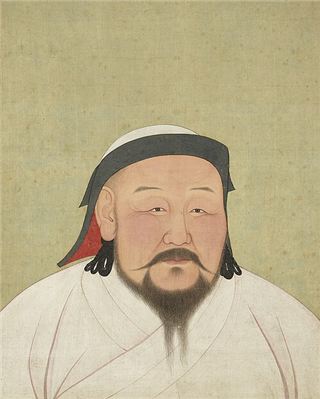
The proclamation of the Yuan dynasty came in 1271, when Kublai Khan, grandson of Genghis Khan and Great Khan of the Mongols, adopted the Chinese dynastic name Da Yuan ('Great Origin', a phrase drawn from the Book of Changes) and presented himself as emperor of China, formally placing the Chinese territories his family had conquered within the framework of Chinese imperial rule. The Yuan's foundation was the culmination of a Mongol conquest of China that began with Genghis Khan's campaigns against the Jurchen Jin Dynasty in the north from 1211, continued with the completion of the Mongol conquest of the Jin dynasty in 1234 and the Mongol conquest of Dali in 1253, and ended with the long war against the Southern Song (1235–1279). Kublai's adoption of a Chinese dynastic name and Chinese institutions marked a departure from earlier Mongol practice and provoked opposition from Mongol traditionalists who accused him of abandoning steppe ways, a tension that fed the Toluid Civil War with his younger brother Ariq Böke (1260–1264) and the long conflict with his kinsman Kaidu in Central Asia, which helped divide the Mongol world into rival khanates. Kublai built a new capital at Dadu (modern Beijing), known to the Mongols as Khanbaliq, a planned city on a magnificent scale, while keeping Shangdu (Xanadu) as his summer capital; Marco Polo, who by his own account served in China between 1275 and 1292, described both in terms of astonished admiration. The conquest of the Southern Song was completed in 1279 with the destruction of the last Song loyalist fleet at Yamen, after which the Yuan ruled all of China, governing one of the most populous states in the world, with perhaps 60 to 80 million subjects in China alone.
Socioeconomy

The Yuan economy combined the productive agricultural base of China, among the most advanced farming systems in the world, with the commercial networks of the Mongol world, creating conditions for exchange of unprecedented geographic scope. Marco Polo's celebrated description of China's commercial sophistication, with its paper money, canals, great cities and abundance of goods, reflects the genuine vitality of Yuan China, though it also reflects the wonder of a foreign merchant encountering a society far more commercially complex than any in contemporary Europe. The Yuan paper currency (chao) was one of the most ambitious monetary experiments of the medieval world: from 1260 the government issued notes initially backed by silver reserves and for long periods required their use as the principal legal tender, enabling transactions on a scale impossible with metal coinage alone. Successive governments, however, issued far more paper than their reserves could support, producing severe inflation in the dynasty's later decades that undermined commercial confidence and contributed materially to popular discontent. The Mongol conquest had disrupted agriculture across northern China through warfare, depopulation and the conversion of farmland to pasture, damage that took decades to repair. Government efforts to restore production through land reclamation, irrigation and the agricultural handbook Nongsang jiyao, issued by the Office for the Stimulation of Agriculture (often called the Board of Agriculture) in 1273, achieved partial success. The Grand Canal was extended northwards through Shandong by the Huitong Canal (1289) and linked to Dadu by the Tonghui Canal of the engineer Guo Shoujing (1293), allowing southern grain to reach the capital by water. Because the inland route remained difficult to maintain, much of the grain tribute was in fact shipped by sea along the coast, while the canal became a commercial axis along which goods of every kind moved in both directions.
Military

The Yuan military was built on the Mongol cavalry forces that had conquered China, supplemented by Chinese infantry, siege specialists and naval forces recruited or conscripted from the conquered population, including the large fleets taken over from the Song. Mongol effectiveness was demonstrated in the conquest itself: the siege of Xiangyang and Fancheng (1268–1273), which fell only after five years when Persian engineers sent from the Ilkhanate built counterweight trebuchets, heavy catapults able to batter the walls with heavy stones, exemplifies the persistence, logistical sophistication and technological adaptability of Mongol operations. The failed invasions of Japan (1274 and 1281) and Java (1292–1293), and costly campaigns in Vietnam and Burma, showed the limits of Mongol power in maritime and tropical environments: the Japanese expeditions were wrecked by storms, remembered in Japan as kamikaze or 'divine winds', while the Javanese expedition, after initial success, was outmanoeuvred by Raden Wijaya, founder of Majapahit, and forced to withdraw with significant losses. Within China the dynasty relied on a garrison system that stationed Mongol and Semu (Central and Western Asian) troops at strategic points, while Chinese soldiers served in separate units of lower status, and hereditary military households were registered to supply soldiers. This stratification mirrored the broader four-tiered ethnic hierarchy of Yuan government, Mongols first, Semu second, northern Chinese (Hanren) third and southern Chinese (Nanren) fourth, and produced both resentment and rigidity. By the 1350s the quality and morale of Yuan forces had declined sharply from the conquest-era peak, and the rebellions of the 1350s and 1360s showed that they could no longer suppress large-scale popular resistance; the court increasingly relied on local militias and regional strongmen, whose loyalty was uncertain.
Governance & Law

Yuan government was a remarkable experiment in multi-ethnic imperial administration, combining Mongol political traditions, Chinese bureaucratic institutions and the expertise of Central Asian, Persian, Tibetan and other non-Chinese specialists in Mongol service. Kublai's administration was centred on a Central Secretariat with six ministries beneath it, a Bureau of Military Affairs and a Censorate, with branch secretariats governing the provinces, the origin of China's modern provincial system. The civil service examinations, abandoned under Mongol rule, were not restored until 1315 under Emperor Renzong, and then with quotas that favoured Mongols and Semu, so that they supplied only a small share of officials. The four-class hierarchy, Mongols, Semu, Hanren and Nanren, shaped access to office, legal treatment and social status, embedding ethnic discrimination in imperial government. Semu specialists, including Central Asian Muslims skilled in finance, medicine and astronomy, held a share of office far beyond their numbers, reflecting the Mongol preference for trusted outsiders over potentially disloyal Chinese elites; the Muslim finance minister Ahmad Fanakati dominated the treasury until his assassination in 1282. Tibetan Buddhism received extraordinary patronage: Kublai named the Sakya lama Drogön Chögyal Phagpa as imperial preceptor and placed Tibet under a special office, the Xuanzheng Yuan, with the Sakya hierarchs as regional rulers. This laid foundations for later Tibetan Buddhist influence among the Mongols, although the mass conversion of Mongolia came only in the sixteenth century. The Phagspa script, devised by Phagpa at Kublai's request in 1269 as a universal script for the empire's languages, was an ambitious feat of linguistic engineering; it was used on official seals, documents, coins and passes but never displaced existing scripts in everyday use.
Global & Regional Impact

The Yuan Dynasty's historical impact operated through its place at the heart of the Mongol world, the most extensive linked network of trade, diplomacy and cultural diffusion the pre-modern world had created. The Pax Mongolica, which allowed travellers such as Marco Polo, the Moroccan Ibn Battuta and the Nestorian monk Rabban Sauma to cross Eurasia in relative safety, created conditions for commercial and cultural exchange that would not be matched until the age of European maritime expansion. Marco Polo's account of China, whether accurate in every detail or embellished, introduced European readers to the wealth, population and technological achievements of Chinese civilisation and fed the desire for direct access to Asian commerce; Columbus owned and annotated a copy. Through the Mongol network, Persian and Islamic astronomy, medicine and cuisine travelled east, with the astronomer Jamal al-Din bringing instruments and calendars to Kublai's court, while Chinese knowledge of printing, gunpowder weapons and medicine travelled west, notably to the Ilkhanate in Persia. The Black Death, which devastated Europe from 1347, very probably spread along the routes that connected the Inner Asian steppe, where plague was endemic among wild rodents, to the Black Sea and the Mediterranean. The Yuan relationship with the Sakya hierarchs of Tibet established a pattern of patron and preceptor between Inner Asian rulers and Tibetan lamas that later Mongol khans, who created the title of Dalai Lama, and the Qing emperors would revive, shaping Sino-Tibetan relations for centuries. The zaju drama and vernacular narrative forms that flourished in the Yuan, when Chinese literati, largely excluded from official careers, turned to popular literature, represent major contributions to Chinese literary culture, with playwrights such as Guan Hanqing and Wang Shifu, author of The Romance of the Western Chamber.
Decline & Fall
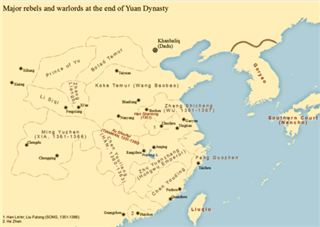
The Yuan Dynasty's decline accelerated in the 1340s and 1350s under the pressure of natural disasters, epidemics, fiscal collapse and the rebellions they provoked, producing one of the swiftest collapses of a major dynasty in Chinese history. Factional struggles at court had already weakened government, with eight emperors reigning between 1307 and 1333. In the Yellow River floods of 1344 the river burst its dykes and shifted its course, devastating agriculture across the North China Plain, creating vast numbers of refugees and disrupting the Grand Canal. The chief minister Toghto's great project to restore the river in 1351, which conscripted some 150,000 labourers, deepened popular resentment. Severe epidemics struck several provinces in the 1330s, 1340s and 1350s, causing heavy mortality and further undermining agriculture and tax revenues, though whether they were outbreaks of the same plague as Europe's Black Death remains debated. The Red Turban Rebellion, which broke out in 1351 under the millenarian banner of the White Lotus tradition, spread rapidly across the Huai and Yangtze valleys, producing a chaotic landscape of competing warlords whose origins ranged from salt smugglers to Buddhist monks to former Yuan soldiers. From this contest a single victor emerged: Zhu Yuanzhang, a former Buddhist monk of peasant origin, whose military and administrative ability enabled him to defeat his rivals Chen Youliang, at the great naval battle of Lake Poyang in 1363, and Zhang Shicheng, before proclaiming the Ming Dynasty in 1368. The last Yuan emperor, Toghon Temür, fled Dadu that year before Ming forces under Xu Da entered the city with little resistance, retreating to the Mongolian steppe. There his successors, known as the Northern Yuan, maintained a much diminished court, and later Mongol khans long continued to claim the Yuan imperial inheritance.
The Yuan Dynasty's most consequential legacy was its place at the heart of the Mongol world system that made the Pax Mongolica possible, fostering the transcontinental commercial and cultural exchanges that carried knowledge of printing and gunpowder westward and very probably the Black Death as well, and thereby helping, unintentionally, to set in motion transformations that shaped the modern world.
References
- Atwood, C.P. (2004) Encyclopedia of Mongolia and the Mongol Empire. New York: Facts on File.
- Dardess, J.W. (1973) Conquerors and Confucians: Aspects of Political Change in Late Yüan China. New York: Columbia University Press.
- Farquhar, D.M. (1990) The Government of China under Mongolian Rule: A Reference Guide. Stuttgart: Franz Steiner.
- Langlois, J.D. (ed.) (1981) China under Mongol Rule. Princeton: Princeton University Press.
- Mote, F.W. (1999) Imperial China, 900–1800. Cambridge, MA: Harvard University Press.
- Polo, M. (1958) The Travels. Translated by R. Latham. London: Penguin.
- Rossabi, M. (1988) Khubilai Khan: His Life and Times. Berkeley: University of California Press.
Connections
Open the full connections map →