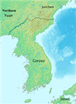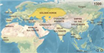
Central & East Asia
Mongol Empire
At a glance
- Genghis Khan united the steppe tribes in 1206 and built the largest contiguous land empire in history.
- Under the Pax Mongolica, protected trade routes linked China, the Middle East and Europe as never before.
- Succession wars split it into rival khanates after 1260; the Yuan fell to the Ming in 1368.
Rise & Fall
- 1206Temüjin is proclaimed Genghis Khan at a kurultai on the Mongolian steppe
- 1219–1221Genghis Khan destroys the Khwarazmian Empire in Central Asia
- 1223Subutai and Jebe defeat the Rus and Kipchaks at the Kalka River
- 1241Mongol armies defeat Polish and Hungarian forces at Legnica and Mohi
- 1258Hülegü sacks Baghdad, ending the Abbasid Caliphate
- 1260–1264The succession war between Kublai and Ariq Böke splits the empire into khanates
- 1294Kublai's death removes the last Great Khan widely recognised across the empire
- 1368The Ming drive the Yuan dynasty out of China
Foundation

The Mongol Empire was founded in the early 13th century on the steppes of Mongolia by Genghis Khan, born Temüjin around 1162. Emerging from a fragmented world of rival Mongol and Turkic tribes, among them the Tatars, Keraits, Merkits and Naimans, he unified the steppe through alliances, military skill and ruthless suppression of opponents, and was proclaimed Genghis Khan at a kurultai (assembly) in 1206. Tradition credits him with a body of law known as the Yassa, though its exact form is uncertain. The empire's rise was enabled by the steppe way of life, which produced highly mobile and disciplined mounted archers, and by the divisions among its settled neighbours: the Western Xia, the Jurchen Jin dynasty in northern China and the newly expanded but poorly integrated Khwarazmian Empire in Central Asia. Control of pastures and trade routes reinforced both economic and military capacity. By breaking up old tribal loyalties, reorganising his followers into new decimal units and promoting commanders for loyalty and ability, Genghis Khan established centralised authority over a flexible tribal hierarchy, enabling rapid and sustained conquest across Asia and into Europe.
Socioeconomy
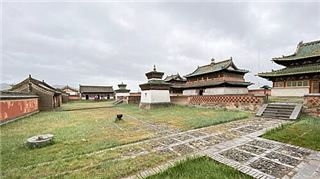
Mongol society was shaped by its pastoral nomadic economy, organised around extended families, herds and seasonal migration. Horses, camels, sheep, goats and cattle provided food, transport and military advantage, while trade supplied grain, silk, ceramics and metals that the steppe could not produce. Society was hierarchical, with the Borjigin royal clan and a warrior aristocracy at the top, common herders forming the backbone of the economy, and captives, including many skilled artisans, transferred from conquered lands. Conquered cities retained their administrative, craft and commercial functions, linking sedentary economies to the Mongol network, and the new capital at Karakorum, founded under Ögedei in the 1230s, drew merchants and craftsmen from across Eurasia. The Mongols imposed taxation and tribute in grain, textiles and precious metals, supported by censuses across the empire. Long-distance trade, encouraged through partnerships with merchant associations (ortogh) and protected by the Pax Mongolica, enabled relatively safe passage along routes connecting China, the Middle East and Europe, creating unprecedented economic interconnection in Eurasia.
Military
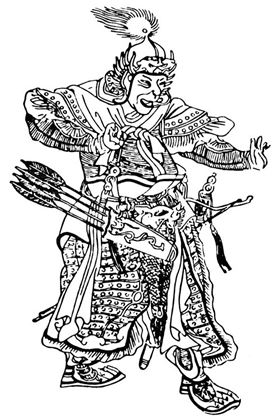
The Mongol military was highly organised, disciplined and mobile, its core composed of mounted archers drawn from the steppe tribes and augmented by units from conquered peoples. Armies were divided into decimal units (arban, zuun, mingghan, tumen) for command and control, ensuring flexibility and scalability. Tactics included feigned retreats, coordinated multi-pronged assaults and the extensive use of siege engines operated by Chinese and Persian engineers. Genghis Khan's campaign against the Khwarazmian Empire (1219–1221) demonstrated mastery of logistics, reconnaissance and psychological warfare, while generals such as Subutai and Jebe defeated the Rus and Kipchaks at the Kalka River in 1223, and Subutai later led the western campaign that devastated the Rus principalities and defeated Polish and Hungarian armies at Legnica and Mohi in 1241. Hülegü's campaign in the Middle East destroyed Baghdad in 1258. The army relied on promotion by merit, strict discipline and rapid communication through the yam relay system. Cavalry exploited speed, manoeuvrability and coordinated archery to overcome numerically superior opponents. Military power was the primary instrument of expansion, political consolidation and the enforcement of tribute across Eurasia.
Governance & Law
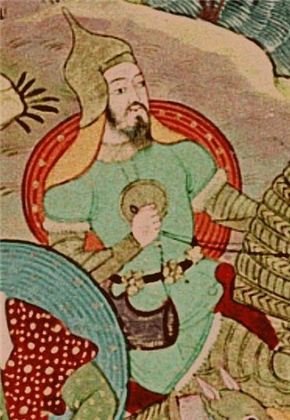
Government of the Mongol Empire was centred on the Great Khan, elected by a kurultai of the royal family, but relied on extensive delegation to princes, subordinate khans and regional administrators. The Yassa, traditionally attributed to Genghis Khan, provided a framework for military discipline and social order, and the adoption of the Uyghur script gave the Mongols their first written administration. Conquered peoples supplied bureaucrats such as the Khitan minister Yelü Chucai, engineers and tax collectors, while resident overseers known as darughachi supervised local rulers and revenue. Diplomatic correspondence and the yam relay network made government over vast distances possible. The Mongols generally tolerated diverse faiths, granting tax exemptions to clergy in return for prayers for the khan. After the succession war between Kublai and Ariq Böke (1260–1264), the Golden Horde, Ilkhanate, Chagatai Khanate and Yuan dynasty operated as largely independent states, though they continued to acknowledge a shared Chinggisid heritage. This combination of central legitimacy, delegated administration and pragmatic tolerance allowed the empire to hold together, for a time, across unprecedented geographic and ethnic diversity.
Global & Regional Impact

The Mongol Empire profoundly reshaped Eurasian history, enabling unprecedented cross-continental interaction in trade, culture and technology. By securing the overland routes under the Pax Mongolica, it allowed goods, ideas and people to travel between China, the Middle East and Europe, from merchants such as Marco Polo to envoys such as the Franciscan William of Rubruck, and fostered exchanges in astronomy, medicine, cartography and gunpowder technology. The same networks may also have helped carry the Black Death westwards in the 1340s. The Mongols shaped successor states by combining steppe traditions with sedentary administration, notably in Yuan China and the Ilkhanate of Persia, where Rashid al-Din compiled a pioneering world history. Population movements, including the transfer of skilled artisans and administrators, accelerated cultural integration. Mongol campaigns redrew political boundaries, destroying the Khwarazmian Empire, the Jin and Song dynasties and the Abbasid Caliphate, and subjecting the Rus principalities to more than two centuries of tributary rule. Mongol patronage of commerce and communication laid foundations for the wider networks of exchange of the Late Middle Ages.
Decline & Fall
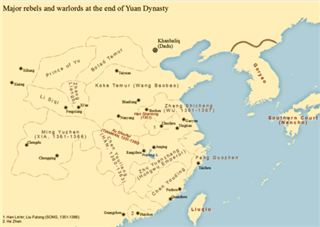
The unified Mongol Empire began to fragment in the mid-13th century, driven by overextension, succession disputes and the difficulty of governing vast territories. After the death of the Great Khan Möngke in 1259, the succession war between Kublai and Ariq Böke and conflicts between the Golden Horde and the Ilkhanate broke the empire into independent khanates pursuing separate policies. Kublai's death in 1294 removed the last Great Khan widely recognised across the empire. Further succession struggles, rebellions in China and Persia, and economic strains, including inflation of Yuan paper currency, famines and the ravages of plague, reduced the khanates' capacity to sustain armies and tribute networks. The Ilkhanate disintegrated after Abu Sa'id's death in 1335, and the Yuan dynasty was driven from China in 1368 by the Ming, founded by Zhu Yuanzhang, a leader who had risen in the Red Turban Rebellion. The Golden Horde fractured into rival khanates and lost its hold over Muscovy, symbolically ended by the Great Stand on the Ugra River in 1480. Although Mongol khans persisted in the steppe, the empire had long ceased to function as a single polity, its collapse revealing the limits of steppe-based rule over diverse and sedentary populations.
The Mongol Empire stands as the steppe power that, from Genghis Khan's unification of the tribes in 1206, joined China, the Middle East, and Europe in a single network of trade and exchange under the Pax Mongolica, and whose break-up into rival khanates showed the limits of steppe-based rule over vast settled populations.
References
- Grousset, R. (1970) The Empire of the Steppes: A History of Central Asia. Translated by N. Walford. New Brunswick: Rutgers University Press.
- Jackson, P. (2005) The Mongols and the West, 1221–1410. London: Pearson Longman.
- Juvaini, A.M. (1958) The History of the World Conqueror. Translated by J.A. Boyle. 2 vols. Manchester: Manchester University Press.
- Man, J. (2004) Genghis Khan: Life, Death and Resurrection. London: Bantam.
- Morgan, D. (1986) The Mongols. Oxford: Blackwell.
- Ratchnevsky, P. (1991) Genghis Khan: His Life and Legacy. Translated by T.N. Haining. Oxford: Blackwell.
- Weatherford, J. (2004) Genghis Khan and the Making of the Modern World. New York: Crown.
Connections
Open the full connections map →