Social ladder · 1764–1896 (from Osei Kwadwo's reforms to the exile of Prempeh I)
Social Hierarchy of the Ashanti Empire
From Asantehene to Enslaved
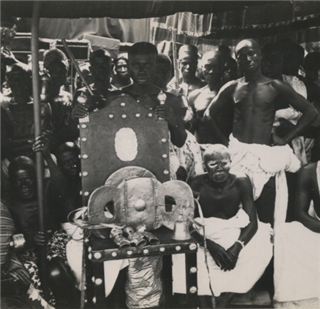
The Asante, an Akan people, ranked their people by lineage, by office and by freedom. At the top the Asantehene sat on the Golden Stool, believed to hold the spirit of the nation, and governed with councils of the chiefs of the member states. Every chief, from the village to the king, was chosen from a particular female line, swore fealty to the one above him and could be destooled for breaking his oaths, and a queen mother of his line had a say in choosing him. In Kumasi, the capital, a bureaucracy of appointed officials, chosen from Osei Kwadwo’s reign for their ability rather than their birth, ran the state’s ministries. Most people were free farmers, citizens of the metropolitan states, while conquered provinces paid tribute. War captives and slaves sent as tribute worked for Asante masters or were sold to the coast. Much of the evidence comes from European visitors, among them Thomas Bowdich, who reached Kumasi in 1817, and from Asante traditions.
Period 1764–1896 (from Osei Kwadwo's reforms to the exile of Prempeh I)People 3 millionRanks 9Profile Ashanti Empire
The ladder
By rank, the ladder is drawn as a pyramid. To scale, each bar is as wide as that rank’s share of the people. Shares marked est. are estimates where no count survives; their boxes and bars are dashed.

Ruler · One ruler
Asantehene (The king)
Sika dwa (the Golden Stool)
The Asantehene was the king of the Asante, and his throne was the sacred Golden Stool.
The Asantehene, king of all Asante, was enthroned on the Golden Stool, the Sika dwa, believed to house the spirit of the nation: the living, the dead and those yet to be born. The stool must never touch the ground, and only the king might handle it. He was also ruler of Kumasi. He alone could pass a sentence of death, every member state sent him tribute each year, and in war he was supreme commander, though in the 19th century the Ministry of War in Kumasi increasingly ran the fighting. He did not rule absolutely: he shared lawmaking and government with the bureaucracy, and by law he never ignored the decisions of the Asanteman council. Upon the stool he was sacred, the intermediary between the people and the ancestors.
Moving in or out. The senior woman of the royal lineage nominated the eligible men, the elders chose, and the assembled people could reject the choice; between reigns the Mamponghene ruled as regent. A king who broke his oaths could be destooled, as Kusi Obodom was after a failed invasion of Dahomey.
How many? One man, of the Oyoko royal line.
Nobility and officials · Fewer than 1 in 1,000 (est.)
Amanhene (Paramount chiefs)
omanhene
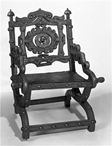
Paramount chiefs ruled the Asante states under the king and met in his great council.
The empire joined metropolitan states, whose people were Asante citizens, to provincial states, kingdoms it had absorbed. Each metropolitan state was headed by a paramount chief, the omanhene, who held executive, legislative and judicial power in his own state. The leaders of Nsuta, Mampong, Dwaben, Bekwai and Kokofu had met before the final break with Denkyira, and after the victory at Feyiase in 1701 the allied rulers recognised Kumasi as the centre of the union. The paramount chiefs, with other provincial chiefs, formed the Asanteman council, which advised the king and whose decisions bound him. In the Kotoko council the state chiefs and their ministers, with the king and the queen mother, formed the aristocratic party. The Mamponghene, the king’s deputy, ruled as regent between reigns.
Moving in or out. A paramount chief was elected from the female line that provided his state’s chiefs, as the Asantehene was, and swore fealty to the one above him; like the king, he could be destooled for breaking his oaths.
How many? Estimate: the heads of the metropolitan states, among them Nsuta, Mampong, Dwaben, Bekwai and Kokofu, with their households, among some 3 million people.
Picture: An Asante chief's chair (akonkromfi), 19th century (Brooklyn Museum) · Unknown author · CC BY 3.0 · Wikimedia Commons

Nobility and officials · c. 0.05–0.2% (est.)
Ohenemaa (Queen mothers)
Queen mothers helped choose the chiefs and kings, and judged quarrels between women.
Beside the chiefs stood the queen mothers. The queen, the ohenemaa, was the most powerful woman in Asante politics, for the chief represented her family and was her son or her sister’s son. She had to be consulted when a chief or the king was installed and played a major part in his nomination: for the Golden Stool itself the senior woman of the royal lineage nominated the eligible men. She settled disputes involving women, took part with the council of elders and chiefs in judging and lawmaking, and shared in decisions on war and on the distribution of land; the queen mother also sat on the Kotoko council. In 1900, after the king’s exile, Yaa Asantewaa, queen mother of Ejisu, led the War of the Golden Stool against the British.
Moving in or out. A queen mother was a senior woman of the female line that provided the chiefs, and she kept a voice in the choice of each of them.
How many? Estimate: one queen mother for each chief’s stool, from the Asantehene’s to those of the divisions, with their households.
Picture: The statue of Yaa Asantewaa, queen mother of Ejisu, at the Yaa Asantewaa Museum · Noahalorwu · CC BY-SA 4.0 · Wikimedia Commons
Nobility and officials · c. 0.05–0.2% (est.)
Ohene (Divisional chiefs)
Krontihene, Nifahene, Benkumhene, Adontenhene, Kyidomhene
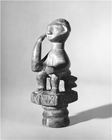
Divisional chiefs ruled groups of villages and gave advice to the paramount chiefs.
Below the paramount chiefs stood the divisional chiefs, the highest order in each state’s divisions, which grouped many villages together. An ohene was a man chosen from his mother’s family to represent it, and his main task was to advise his paramount chief. Their titles included the Krontihene, Nifahene, Benkumhene, Adontenhene and Kyidomhene; Amankwa Tia, who led Asante armies in the early 18th century, was the first Kontihene of Kumasi. Each chief swore fealty to the chief above him, and a chief who failed to punish wrongs risked the anger of the ancestors and his own removal. Dress marked their rank: prominent people wore silk, laws kept certain kente designs for the nobility, and some patterns were the king’s alone, worn only by his leave.
Moving in or out. An ohene was chosen from the female line that provided his division’s chiefs and, like any chief, could be destooled for breaking his oaths.
How many? Estimate: the chiefs of the divisions of every state, each division a group of villages, with their households.
Picture: Akan figure of a man seated on a stool, early 20th century (Brooklyn Museum) · Unknown author · CC BY 3.0 · Wikimedia Commons
Soldiers, merchants and craftsmen · c. 0.02–0.1% (est.)
Officials of Kumasi
Gyaasehene (head of the civil service)
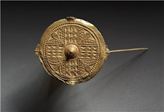
Skilled officials in Kumasi ran the king’s government, and some wrote down records.
The Asantehene governed through a bureaucracy in Kumasi with separate ministries, among them a foreign office, small but divided into departments for relations with the British, French, Dutch and Arabs, and in the 19th century a Ministry of War. Osei Kwadwo (r. 1764–1777) began appointing central officials for their ability rather than their birth. The civil service, headed by the Gyaasehene, drew men talented in trade, diplomacy and war, and the king appointed them all, including men from the Arabian Peninsula, Sudan and Europe. Although Asante had no writing of its own, the state recruited literate men: in 1817 Bowdich saw “Moorish secretaries” taking notes at a trial, and couriers carried despatch boxes. Ivor Wilks and Larry Yarak disagree over how much power these officials held beside the king.
Moving in or out. Office came by the Asantehene’s appointment and, from Osei Kwadwo’s reign, by ability rather than birth, so that even foreigners could serve.
How many? Estimate: the ministries of Kumasi, among them a foreign office described as small, with their clerks and couriers.
Picture: A gold disc pendant (akrafokonmu) of the Asante court, 1800s · museado · CC0 · Wikimedia Commons
Nobility and officials · c. 0.02–0.1% (est.)
Abirempon (Big men)
obirempon, mena (the elephant tail)
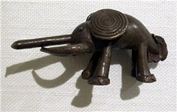
Rich traders who helped the kingdom were honoured as “big men” and given an elephant tail as a badge.
Successful entrepreneurs who gathered great wealth and many followers, or who distinguished themselves by heroic deeds, were honoured as abirempon (singular obirempon), “big men”. By the 18th and 19th centuries the title had become formal and political, given to those whose trade benefited the whole state, and the state marked them with the mena, an elephant tail, as their badge. An obirempon handled the administration and economic affairs of his region and sat as its supreme judge, with a fair amount of lawmaking power. The title was old: Ray Kea describes the early town of Asantemanso as the centre of abirempon who organised gold production, trade and political authority around it.
Moving in or out. The title was earned rather than inherited: trade that benefited the whole state, or deeds of valour, brought it by the state’s award.
How many? Estimate: a small number of rich traders and men of renown honoured by the state, with their households and followers.
Picture: An Asante gold weight in the shape of an elephant, about 1890–1910 (Brooklyn Museum) · Sailko · CC BY 3.0 · Wikimedia Commons
Soldiers, merchants and craftsmen · c. 0.1–0.5% (est.)
Guards, police and road wardens
ankobia (special police), nkwansrafo (road wardens)
Police with long hair guarded Kumasi, and road wardens checked travellers and collected tolls.
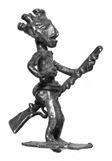
The metropolitan districts had several police forces. In Kumasi a uniformed police, known by their long hair, saw that no one entered or left the city without the government’s permission. The ankobia, a special police, were the king’s bodyguards and the empire’s special forces, gathered intelligence and put down rebellion. Along the roads the nkwansrafo, the road wardens, checked the movement of traders and strangers, scouted and collected tolls. In war, small cadres of regulars guided the levies and contingents called up from the provinces, and in the early 19th century the Asantehene used the annual tribute to set up a permanent standing army armed with rifles. Asante armies even had medical units.
Moving in or out. These forces served the Asantehene and his government directly; the sources say little about how their men were chosen.
How many? Estimate: the police of the capital, the king’s bodyguards and the road wardens, with the small cadres of regulars; the army’s potential strength of 80,000–200,000 was mostly levies called up when needed.
Picture: Asante gold weight of a hunter or warrior with a gun, 19th century (Brooklyn Museum) · Unknown author · CC BY 3.0 · Wikimedia Commons

Free commoners · About 84% (the rest, est.)
Amanfo (Free Asante)
odikro (village chief), abusua panyin (head of a lineage)
Most Asante were farmers who grew yams and plantains and lived in villages led by a chief.
Most people were free Asante, the amanfo, citizens of the metropolitan states, and most of them farmed. The family, extended and traced through the mother, was the basic political unit, led by the head of the lineage; each village had a chief, the odikro, who kept order, presided over the village council and stood between his people, the ancestors and the gods. Farmers burned their fields before the rains, worked them with iron hoes for two to four years and left them fallow, growing plantains, yams, maize, manioc and much else. Ordinary people wore cotton. Only the king could put an Asante to death, sentences were more often commuted than carried out, and under Osei Kwame Panyin (1777–1803) the sale of Asante citizens into slavery was banned.
Moving in or out. Trade that served the state could make a commoner an obirempon, and since Osei Kwadwo’s reign the king’s offices went by ability; a capital crime could bring death, though banishment or imprisonment was the more common penalty.
How many? Everyone not counted in the other ranks: the great majority, most of them farmers, in the metropolitan states and the conquered provinces. The other ranks are estimates, so this share is one too.
Picture: Akan kente cloth, 19th century (Metropolitan Museum of Art) · Unknown author · CC0 · Wikimedia Commons



Enslaved · c. 10–20% (est.)
Enslaved people
-
Enslaved people were owned by others and made to work without pay; most were captured in wars.
During the Atlantic slave trade Asante was the largest slave-owning and slave-trading state in the lands of present-day Ghana. Most of the enslaved were captives taken in war; others came as tribute, like the 500 slaves a year that conquered Dagomba paid from the early 1770s. Many were sold to the coast, but Ivor Wilks argues that slaves mattered more to Asante as labour on farms and in crafts than as exports. Their lives varied widely. Some acquired wealth, owned slaves of their own and married into their master’s family, and a slave who was badly mistreated could ask for a new master. Others were killed at funerals, for the Asante believed that slaves would follow their masters into the afterlife. Slaves were dressed in black cloth.
Moving in or out. Capture in war and tribute made people slaves; a master who married an enslaved woman could pass part of his property and status to their children. When Britain conquered Asante it let the chiefs keep their slaves, and the ban of 1908 was enforced only from the 1920s.
How many? Estimate: Asante was the largest slave-owning state in present-day Ghana, its wars brought captives and its provinces sent slaves as tribute (500 a year from Dagomba alone), and slaves did much of the work of its farms and crafts; a common share for West African kingdoms of the period.
Picture: A cell where captives were held for shipment at Elmina Castle on the Gold Coast · Kurt Dundy · CC BY-SA 3.0 · Wikimedia Commons

Born into history
Where would you have stood? Chance places you on the ladder, as birth placed most people: weighted by how many each rank held.
Moving up and down
Rank in Asante rested on lineage and office. The stools passed within the female lines that provided the chiefs, but no one inherited them outright: each holder was chosen by elders and could be rejected by the assembled people, and a king or chief who ruled badly could be destooled and lose his stool, regalia and powers, though he remained a member of his royal family. Below the stools the state opened careers to ability. Osei Kwadwo began appointing officials for their skill rather than their birth, foreigners served in the civil service, and traders whose business served the state were honoured as abirempon. Some Asante studied in Europe: in 1837 Kwasi Boachi, a son of Kwaku Dua I, and his cousin Kwame Poku were sent to the Netherlands for a European education. War moved people most of all. Conquest turned free people into captives, and the provinces paid tribute in gold, cattle, cloth and slaves; when the Aowin sacked Kumasi in 1717 they carried off thousands of Asante women and children. In 1896 the British exiled Prempeh I and dissolved the union, and they assured the chiefs that they could keep their slaves.
Women on the ladder
Asante families were matrilineal: a child belonged to the mother’s clan, a mother’s brother was the legal guardian of her children, and the chiefs represented their mothers’ lines, which gave the queen mothers their power to nominate kings and chiefs, to judge women’s disputes and to share in decisions on war and land. Women could initiate divorce, while a husband had legal rights over his wife, among them the right to cut off her nose for adultery. Only girls had public puberty rites. Menstruating women were held ritually unclean: they lived in special houses during their periods, swore no oaths and could be put to death for entering a stool house. Families with many children were respected and barren women scorned, and twin girls born into the royal family became potential wives of the king. Some men preferred to marry an enslaved woman or a pawn, because she had no lineage to stand up for her in a quarrel and her husband had full control of their children. In 1900 Yaa Asantewaa, queen mother of Ejisu, led the last armed resistance to British rule.
Compare with another society
Test yourself
5 questions on the ladder of the Ashanti Empire.
The questions open here once the page has loaded.
Sources and further reading
- Edgerton, R. B. (2010) The Fall of the Asante Empire: The Hundred-Year War for Africa's Gold Coast. New York: Simon & Schuster.
- McCaskie, T. C. (2003) State and Society in Pre-colonial Asante. Cambridge: Cambridge University Press.
- Perbi, A. A. (2004) A History of Indigenous Slavery in Ghana: From the 15th to the 19th Century. Accra: Sub-Saharan Publishers.
- Wilks, I. (1989) Asante in the Nineteenth Century: The Structure and Evolution of a Political Order. Cambridge: Cambridge University Press.
- Wilks, I. (1993) Forests of Gold: Essays on the Akan and the Kingdom of Asante. Athens: Ohio University Press.
The shares are of the whole population, children included. Where a scholar has counted or estimated a rank, its share follows that work, named on the rank; where no count survives, the share is an estimate, marked est. and drawn dashed, made from what the rank was and did, from related figures and from the same rank in comparable societies, and its note says what it rests on. Population: approximately, for the kingdom at its height, as general accounts give it, without a named estimate behind the figure.
Cite this page
- APA
- The Epoch Institute. (2026). Social Hierarchy of the Ashanti Empire. In Social Ladders. https://the-epoch-institute.org/societies/ashanti
- MLA
- “Social Hierarchy of the Ashanti Empire.” Social Ladders, The Epoch Institute, 2026, https://the-epoch-institute.org/societies/ashanti. Accessed .
- Chicago
- The Epoch Institute. “Social Hierarchy of the Ashanti Empire.” Social Ladders. 2026. https://the-epoch-institute.org/societies/ashanti.
- Harvard
- The Epoch Institute (2026) ‘Social Hierarchy of the Ashanti Empire’, Social Ladders. Available at: https://the-epoch-institute.org/societies/ashanti (Accessed: ).