Social ladder · 1727–1894 (from the conquest of Whydah to the French conquest)
Social Hierarchy of the Kingdom of Dahomey
From King to Enslaved
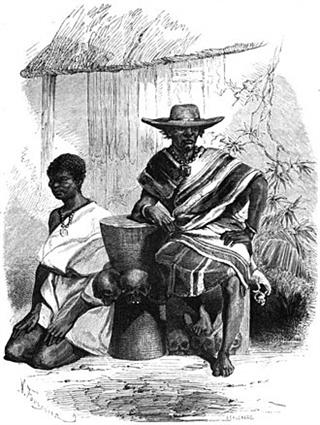
Dahomey, the kingdom of the Fon on the Abomey plateau, ranked its people around the king and his palaces at Abomey. The king, who claimed descent from the royal house of Allada, alone made the kingdom’s offerings to the spirits, received the gifts and tribute of every lineage at the Annual Customs and appointed the chiefs of its villages; each of his great officers had a woman counterpart. The kingdom was organised for constant war. A standing army of men, and a corps of women soldiers, took captives in wars and raids, and the kingdom sold them to European slave traders at Whydah, set them to work on royal plantations or killed them in the Annual Customs. Most free people were farmers who owed tribute and taxes. European visitors documented the kingdom extensively, but their accounts were often written for one side or the other of the debate over the slave trade, and recent historians stress the limits of the king’s power.
Period 1727–1894 (from the conquest of Whydah to the French conquest)People c. 200,000–400,000 (est.)Ranks 9Profile Kingdom of Dahomey
The ladder
By rank, the ladder is drawn as a pyramid. To scale, each bar is as wide as that rank’s share of the people. Shares marked est. are estimates where no count survives; their boxes and bars are dashed.
Ruler · One ruler
Ahosu (The king)
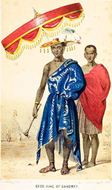
The king of Dahomey lived at Abomey, where each king built his own palace with pictures on its walls.
The king, the ahosu, was the sovereign of Dahomey, and all the kings claimed descent from the royal family of Allada. Houegbadja (c. 1645–1685) built the Royal Palaces of Abomey and made offerings to the spirits the king’s alone, and he, Akaba and Agaja laid down much of the succession and the administration. At the Annual Customs the king honoured his ancestors, received the tribute of every lineage, displayed it and gave much of it back, reviewed his troops and closed the debates of the Great Council by declaring its consensus. From Tegbesu’s reign (1740–1774) the slave trade gave him the largest part of his income. Each king built his own palace, its clay reliefs recording his deeds.
Moving in or out. Kingship passed through the male line, usually but not always to the eldest son, and the Great Council’s discussions largely decided the choice: Tegbesu, not the eldest, won a succession struggle with a brother in 1740, and Ghezo came to the throne in 1818 in place of his brother Adandozan.
How many? One man, with the royal family.

Nobility and officials · c. 0.02–0.1% (est.)
Great officers of the court
migan, mehu, yovogan, tokpo, agan, kpojito, chacha
The king’s chief ministers ran the courts, the palaces, farming and the army, and each had a woman partner.
The king’s court was led by great officers. The migan was the prime minister, the king’s chief counsellor, a leading judge and the head executioner. The mehu managed the palaces and the affairs of the royal family, economic matters and the lands south of Allada, and so the dealings with Europeans. Beside them stood the yovogan, the tokpo (minister of agriculture), the agan (general of the army) and the kpojito, the queen mother, and in the 19th century the chacha, the viceroy of Whydah, who took over the work of the king’s traders there with authority over the European traders. In war the migan commanded the right of the army and the mehu the left. Every office but the kpojito’s was held by a man, and each had a female counterpart.
Moving in or out. The kpojito owed her place to her son: Hwanjile, a wife of Agaja, became the first significant kpojito when her son Tegbesu was king. The chacha’s title went to Francisco Félix de Sousa, a former enslaved man turned slave trader, after Ghezo came to the throne.
How many? Estimate: some seven great offices, each with its female counterpart, and their households, among perhaps 200,000–400,000 people.
Nobility and officials · c. 0.5–1.5% (est.)
Chiefs and royal officials
tokpe (tax officials)
The king chose chiefs to run each village and officials to count the harvest and collect taxes.
Dahomey’s main political divisions were its villages, whose chiefs and officials the king appointed to act as his representatives and settle disputes. Tax officials, the tokpe, gathered figures on each village’s harvest, and the king set its tax by its production and population. Toll booths on the kingdom’s roads took yearly taxes on the goods people carried and on their occupations; their officials had armed guards and sometimes fined travellers for public nuisance before letting them pass. Courts presided over by officials the government recognised could sit anywhere, in the market or on the road, and take a payment from the litigants before judging. At the Annual Customs officials pressed petitions, debated in the Great Council, where low-ranking officials could publicly rebuke high-ranking ones, and spent their evenings building coalitions.
Moving in or out. Chiefs and officials held their posts by the king’s appointment, and at the Annual Customs they received gifts for their services.
How many? Estimate: a chief for each village and the tax and toll officials, with their households.
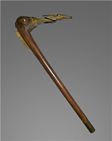
Picture: A récade, a sceptre of the kingdom of Dahomey (Muséum de Toulouse) · Didier Descouens · CC BY-SA 4.0 · Wikimedia Commons

Religious and learned · c. 0.5–2% (est.)
Vodun priests and priestesses
-
Priests and priestesses looked after the shrines of Dahomey’s many gods.
Dahomey’s religion joined older animist traditions to Vodun. The paired god Mawu-Lisa, with female and male natures, ruled the sky and the highest pantheon, and other gods lived in the earth and in thunder. Each god and each pantheon had its own priesthood and shrines; women made up a significant part of the priests, and the chief priest was always a descendant of Dakodonu, counted as the kingdom’s second king. The kings drew worship to themselves. Houegbadja made offerings to the spirits the king’s to give, and oral tradition holds that Hwanjile, Agaja’s wife and Tegbesu’s mother, brought Vodun to the kingdom, created two new gods and tied worship more closely to the king. Families could hold their own lineage ceremonies only after the royal Customs were over.
Moving in or out. The sources say little about how priests were made, except that the chief priest had to be of Dakodonu’s line.
How many? Estimate: a priesthood and shrines for each god, with many women among the priests.
Picture: The Temple of the Pythons at Ouidah, a Vodun shrine · Ji-Elle · CC BY-SA 4.0 · Wikimedia Commons
Soldiers, merchants and craftsmen · c. 2–5% (est.)
Soldiers
-
Dahomey’s soldiers trained from boyhood and were rewarded with cowrie shells.
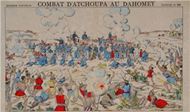
From at least the time of Agaja Dahomey kept a professional standing army, encamped wherever the king was: about 10,000 strong by one account, 15,000 by another, divided into right, left, centre and reserve and into companies and platoons. Boys were recruited at seven or eight as shield carriers for the regular soldiers and joined the ranks after years of apprenticeship. Each soldier was paid a bonus in cowrie shells for every enemy he killed or captured. They fought with European flintlock muskets, steel swords and cutlasses, were drilled constantly and fired on command, and by the late 19th century the kingdom had a large arsenal of breech-loading rifles. Abeokuta inflicted crushing defeats on them in the 19th century, and France defeated them in 1890 and 1892–1894.
Moving in or out. Boys entered at seven or eight as shield carriers and rose by service and by the captives they took; Ghezo also recruited soldiers from foreign captives.
How many? Estimate: a standing army of some 10,000–15,000 under Agaja; with the women a third of the army in the mid-19th century, the men numbered perhaps 2,000–12,000, among some 200,000–400,000 people.
Picture: The battle of Atchoukpa (1890), by Marcel Vagné, about 1900 · Marcel Vagné (1842-1901) · Public domain · Wikimedia Commons

Soldiers, merchants and craftsmen · c. 0.5–2% (est.)
Agojie (Women soldiers)
Mino, ahosi (king's wives)
Dahomey had an army of women soldiers who trained very hard and were respected in the kingdom.
The women soldiers were called Agojie or Mino (“our mothers”) and called themselves ahosi, the king’s wives; Europeans named them after the Amazons of Greek myth. Their origins are debated: a corps of elephant hunters, the gbeto, under Houegbadja; a female bodyguard; or women sent around 1729 to make the army look larger, who fought so bravely that they became a permanent corps. Many of the first were criminals pressed into service instead of death. Ghezo ordered every family to send him its daughters and chose the fittest. Legally married to the king, they could not bear children or live a married life. By the mid-19th century they numbered 1,000–6,000, about a third of the army, under women commanders; they were wealthy, held high status, could rise to command and took a prominent part in the Great Council.
Moving in or out. Women entered by capture, by the king’s levy of daughters, as a punishment or of their own will, and could rise to command; the corps was largely wiped out at Adegon in 1892 and disbanded in 1894.
How many? Estimate: visitors’ reports put the women soldiers at 1,000–6,000 in the mid-19th century, among a population that is itself an estimate.

Soldiers, merchants and craftsmen · c. 2–5% (est.)
Traders and craftsmen
akhigan (king's traders), akueho (cowrie huts)
Craftspeople in Dahomey made carvings, brass figures and colourful cloth pictures, and traders sold goods in busy markets.
Craftwork was dominated by a formal guild system, and blacksmiths, weavers and wood cutters paid taxes on their work. The kings paid artists well, and commoners as well as royals made important works: carvings, appliqué cloth, clay reliefs and small brass figures that the well-off wore or kept at home. Markets turned on a four-day cycle, a different market each day. At Whydah the king’s own traders, the akhigan, traded for him and collected customs, and private traders needed his licence. Wealthy citizens kept their cowries in fire- and theft-proof huts, the akueho, in their compounds, and held others’ deposits there. In the 19th century private traders were at first the sole owners of the large palm oil plantations, until the aristocracy joined them from the mid-century.
Moving in or out. Trade made fortunes, but at the king’s pleasure, since a private trader needed his licence to trade at Whydah; the palm oil plantations of the 19th century opened a new road to wealth.
How many? Estimate: the guild craftsmen, the licensed traders of Whydah and the markets, and the wealthy who kept cowrie stores, with their households.
Picture: Fon appliqué cloth with the emblems of the kings of Dahomey · IvanaMadzarevic · CC BY-SA 4.0 · Wikimedia Commons
Free commoners · About 72% (the rest, est.)
Free farmers
-
Most people in Dahomey were farmers who brought gifts to the king at a great yearly festival.
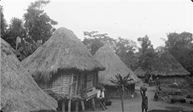
Most people were free farmers and their families: farming was done by most families, for local use until palm oil was exported. Every lineage owed gifts and tribute to the king at the Annual Customs, which most people were required to attend, and the king displayed the riches and gave much of them back. Villages were taxed on their harvests, and people paid tolls on the roads according to their goods and their trade. The Great Council at the Customs brought together a large part of the population, women as well as men. Under Adandozan Dahomeans themselves were sold into the slave trade; Ghezo ended that and sold only captured enemies, and he also abolished the death penalty for some lesser offences, such as adultery.
Moving in or out. A family’s sons could enter the army as boys and its daughters could be levied for the women’s corps; criminals could be pressed into the corps or killed at the Annual Customs.
How many? Everyone not counted in the other ranks: the great majority, most of them farming families, Fon on the Abomey plateau and other peoples in the conquered lands. The other ranks are estimates, so this share is one too.
Picture: A Fon village in Dahomey, about 1930 · Jean Duprez · Public domain · Wikimedia Commons



Enslaved · c. 10–25% (est.)
Enslaved people
-
Dahomey captured people in wars and sold many of them as slaves to European traders.
Dahomey’s growth went with the Atlantic slave trade. Its armies took men, women and children in wars and raids and sold them at Whydah to European traders for guns, gunpowder, cloth, cowries and alcohol; before the sale captives were made to march in circles round the “Tree of Forgetfulness”, so that they would forget their homes and their spirits would not return for revenge. Captives kept in Dahomey worked the royal plantations that fed the army and the court, and from the mid-19th century the palm oil plantations. Captives and criminals were killed at the Annual Customs, some 500 a year, figures that pro-slavery writers often exaggerated. The trade outlasted Britain’s treaty of 1852: in 1860 the Clotilda carried 110 captives from Whydah to Alabama, among them Oluale Kossola.
Moving in or out. Watson and Schellinger argue that slaves were once treated as members of their master’s family and could become free within a generation or two, but that the palm oil plantations made slavery harsher; Ghezo had the murders of slaves tried at the court in Abomey.
How many? Estimate: captives worked the royal plantations that fed the army and the court, and in the 19th century the palm oil plantations; in 1860 an American slaving captain was shown a warehouse holding 4,000 captives.
Picture: The Door of No Return at Ouidah, a memorial to the captives shipped from the port · Borisghost · CC0 · Wikimedia Commons

Born into history
Where would you have stood? Chance places you on the ladder, as birth placed most people: weighted by how many each rank held.
Moving up and down
Office in Dahomey came from the king, and war was the main road up and the main road down. Soldiers earned cowries for every captive, women soldiers could rise to command, wealth and high status, and officials received gifts at the Annual Customs and built coalitions there. A king’s mother could become one of the great officers, as Hwanjile did, and royal favour could raise a stranger: Francisco Félix de Sousa, once enslaved himself, became a major slave trader, the chacha of Whydah and holder of the monopoly on the export of slaves after Ghezo came to the throne. The throne itself was contested: Tegbesu won it in a struggle with a brother, and Ghezo replaced his brother Adandozan. At the bottom the 19th century hardened the line. On one view, slaves had once been able to win free status after a generation or two, but the palm oil plantations made their lives harsher, and the captives killed at the Customs or sold at Whydah had no way out. The kingdom fell to France in 1894, and in 1904 it became part of the colony of French Dahomey.
Women on the ladder
Women had a place in Dahomey’s government that set it apart: each great office held by a man had a female counterpart, the kpojito, the queen mother, ranked among the great officers, and women sat in the Great Council. Hwanjile, the first significant kpojito, is credited with reshaping the kingdom’s religion, and women made up a significant part of the priests. Tradition names Hangbe, a daughter of Houegbadja, as ruler from 1716 to 1718, though some sources doubt that she existed. The king’s wives, the ahosi, often numbered in the hundreds, and the women soldiers came from among them or were levied from the families of the kingdom; a woman could also be enrolled against her will if her husband or father complained of her behaviour. Prostitution was licensed by the king: from the 18th century the government placed prostitutes about the kingdom at a price set by decree and taxed them at the Customs. Enslaved women were sold with men and children, and in 1849 Ghezo gave a captive Yoruba girl, later named Sarah Forbes Bonetta, to the British naval officer Frederick Forbes as a “gift”.
Compare with another society
Test yourself
5 questions on the ladder of the Kingdom of Dahomey.
The questions open here once the page has loaded.
Sources and further reading
- Alpern, S. B. (1998) Amazons of Black Sparta: The Women Warriors of Dahomey. New York: New York University Press.
- Bay, E. G. (1998) Wives of the Leopard: Gender, Politics, and Culture in the Kingdom of Dahomey. Charlottesville: University of Virginia Press.
- Forbes, F. E. (1851) Dahomey and the Dahomans, Being the Journals of Two Missions to the King of Dahomey and the Residence at his Capital in the Years 1849 and 1850. London: Longman, Brown, Green, and Longmans.
- Law, R. (1993) "The 'Amazons' of Dahomey". Paideuma 39: 245–260.
- Law, R. (2004) Ouidah: The Social History of a West African Slaving 'Port', 1727–1892. Athens: Ohio University Press.
- Yoder, J. C. (1974) "Fly and Elephant Parties: Political Polarization in Dahomey, 1840–1870". Journal of African History 15 (3): 417–432.
The shares are of the whole population, children included. Where a scholar has counted or estimated a rank, its share follows that work, named on the rank; where no count survives, the share is an estimate, marked est. and drawn dashed, made from what the rank was and did, from related figures and from the same rank in comparable societies, and its note says what it rests on. Population: Estimate: the sources give no figure; a standing army of some 10,000–15,000 under Agaja, and in the mid-19th century 1,000–6,000 women soldiers making up about a third of the army, suggest a kingdom of a few hundred thousand people.
Cite this page
- APA
- The Epoch Institute. (2026). Social Hierarchy of the Kingdom of Dahomey. In Social Ladders. https://the-epoch-institute.org/societies/dahomey
- MLA
- “Social Hierarchy of the Kingdom of Dahomey.” Social Ladders, The Epoch Institute, 2026, https://the-epoch-institute.org/societies/dahomey. Accessed .
- Chicago
- The Epoch Institute. “Social Hierarchy of the Kingdom of Dahomey.” Social Ladders. 2026. https://the-epoch-institute.org/societies/dahomey.
- Harvard
- The Epoch Institute (2026) ‘Social Hierarchy of the Kingdom of Dahomey’, Social Ladders. Available at: https://the-epoch-institute.org/societies/dahomey (Accessed: ).