Social ladder · c. 1016–1113 (from the Pravda of Yaroslav to the code of Vladimir Monomakh, the 11th century)
Social Hierarchy of Kievan Rus'
From Grand Prince to Kholop
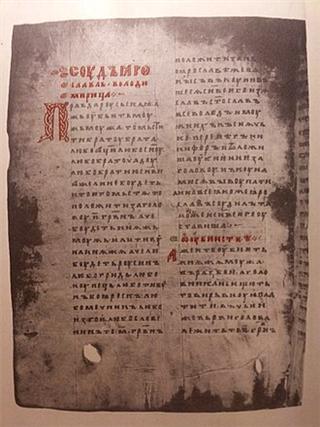
Kievan Rus’ was ruled by one family, the descendants of Rurik. The grand prince of Kiev held the lands around the city, and his formally subordinate relatives ruled the other cities and paid him tribute. Every prince kept a druzhina, a retinue of warriors whose senior members, the boyars, held the high offices and advised him. The law code of the 11th century, the Russkaya Pravda, ranked everyone else by what it allowed and what it charged: a community paid more for killing one of the prince’s men, the fine for killing a woman was half the usual one, a smerd’s killer paid no more than a kholop’s, and a kholop could be killed or sold by his master. The towns grew rich on trade with Byzantium, the Church came with Vladimir’s baptism, and most people farmed.
Period c. 1016–1113 (from the Pravda of Yaroslav to the code of Vladimir Monomakh, the 11th century)People c. 3–10 million (est.)Ranks 9Profile Kievan Rus'
The ladder
By rank, the ladder is drawn as a pyramid. To scale, each bar is as wide as that rank’s share of the people. Shares marked est. are estimates where no count survives; their boxes and bars are dashed.

Ruler · One ruler
The grand prince of Kiev
knyaz (prince), grand prince
The grand prince ruled from Kiev, gave the land its laws and collected tribute from the other princes.
The grand prince of Kiev controlled the lands around the city, while his formally subordinate relatives ruled the other cities and paid him tribute. He gave the land its law: Yaroslav the Wise (r. 1019–1054) wrote the first part of the Russkaya Pravda, and his sons and his grandson Vladimir Monomakh added to it. The prince’s court judged cases, and the fines of the Extensive Pravda went to the prince and his administration, with less compensation for the victims. In winter the ruler of Kiev went on rounds among the subject tribes, who paid tribute in money, furs or slaves. Rivalry within the family was constant, and princes killed their own kin to gain the throne.
Moving in or out. After Yaroslav’s death in 1054 no settled rule of succession took hold: the throne passed from elder to younger brother, from uncle to nephew and from father to son, and the princes fought over it. A defeat could cost a grand prince his city: after the Cumans beat the princes on the Alta River in 1068, Iziaslav fled to Poland to seek support and returned in a couple of years.
How many? One man, the senior prince of the Rurik dynasty on the throne of Kiev.

Nobility and officials · Fewer than 1 in 1,000 (est.)
Knyaz (Princes of the dynasty)
Rurikids
Princes of the same family ruled the other cities of Rus’ and hoped to move up, one day, to rule Kiev.
Rurik’s descendants shared power over the land. Junior members of the dynasty usually began as rulers of a minor district, moved on to richer principalities and then competed for the throne of Kiev. Yaroslav the Wise assigned his sons principalities in order of seniority: Kiev and Novgorod to the eldest, Iziaslav; Chernigov and Tmutarakan to Sviatoslav Yaroslavich; Pereyaslavl and Rostov-Suzdal to Vsevolod; Smolensk to Vyacheslav and Volhynia to Igor. The order did not hold. The princes of Polotsk contested the grand prince’s power by occupying Novgorod, and the branches of the family, the sons of Oleg in Chernigov, of Monomakh in Pereyaslavl and of Iziaslav in Turov–Volhynia, fought one another, until the princes met at Liubech in 1097 to seek an understanding.
Moving in or out. Princely rank came only by birth into the dynasty, and a prince’s place in the order of seniority decided which city he could hope for. A prince could also lose his lands: by 1130 Mstislav the Great had exiled all the descendants of Vseslav of Polotsk to the Byzantine Empire.
How many? Estimate: the princes of Rurik’s house and their families, a few dozen to a few hundred people; Yaroslav assigned principalities to five sons, and by the end of the 12th century the land had split into about twelve principalities.
Nobility and officials · c. 0.05–0.2% (est.)
Boyare (Boyars)
boyarin, duma (council)
Boyars were the prince’s chief warriors and advisers, and he rewarded them with land.
The boyars were the senior members of the prince’s druzhina and the highest nobility of Rus’, second only to the princes. They wielded power through their military support of the princes, and their power and prestige came to depend almost completely on service, on a family history of service and, to a lesser extent, on land. They held the highest offices, military, domestic and urban, and through a council (duma) they advised the grand prince; they received extensive grants of land and were the chief legislators of Kievan Rus’. In appearance they were very like knights. Their loyalty was to the prince in person, so a druzhina could, to a degree, choose whom to support.
Moving in or out. A boyar’s standing came from service to a prince and from his family’s record of service, rewarded with offices and land. Because the bond was personal it could break: when Boris refused the throne of Kiev that his father’s druzhina offered him in 1015, the druzhina dispersed, and his brother Sviatopolk’s agents murdered him.
How many? Estimate: the senior men of the princes’ retinues with their families; the articles give no count, but Ibrahim ibn Yaqub reckoned the whole retinue of Mieszko I of Poland in 961–62 at 3,000 paid men, and the boyars were only its senior part.
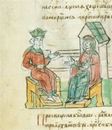
Picture: Olga of Kiev received at Constantinople, a miniature of the Radziwiłł Chronicle · Unknown author · Public domain · Wikimedia Commons
Soldiers, merchants and craftsmen · c. 0.3–1% (est.)
Mladshaia druzhina (The junior druzhina and the prince's servants)
otrok (soldier), tiun (privileged servant), mechnik (swordman), starosta (local official)
Young warriors guarded the prince, ate at his feasts and helped him collect tribute.
Below the boyars stood the rank and file of the druzhina, the “youths” of the junior retinue, and the prince’s servants. At its core the druzhina was the prince’s permanent bodyguard; more broadly it was his household, his court. A wise prince was expected to keep it close, feast with it, consult it and reward it. It had its own hierarchy and offices, and military and administrative work ran together: the “swordman” (mechnik) also had a part in gathering tribute. The law of Yaroslav’s sons made a community answer more heavily for killing the prince’s men on its land: his tiuns, privileged servants of princes and boyars; his starostas, low-ranking administrators; his otroks, low-ranking soldiers; and his other servants.
Moving in or out. A prince recruited where he could: free young warriors, Varangians hired for his wars, as Yaroslav brought them to Novgorod, and kholops, mainly house serfs, who filled the ranks of the princely servants, including the military.
How many? Estimate: the princes’ armed men, stewards and officials with their families; the articles give no count, but a Polish duke of the 960s paid a retinue of 3,000 men, and every prince of Rus’ kept one.
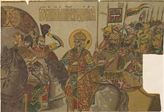
Picture: Grand Prince Vladimir with his druzhina, a lithograph by W. Prokhorov, 1884 · V. Prokhorov · Public domain · Wikimedia Commons

Religious and learned · c. 0.1–0.5% (est.)
The clergy
-
Priests and monks served the new Christian Church, and churchmen wrote down the history of Rus’.
Christianity had long been known in these lands, but the Church as an order of its own dates from Vladimir’s baptism in about 987 and the baptism of Kiev he ordered in August 988. It brought a liturgy written in Cyrillic and a body of translations from Greek, and with them some Greek philosophy, science and history. Yaroslav the Wise patronized the local clergy and monasticism, built the cathedrals of Saint Sophia in Kiev and Novgorod; his sons developed the Monastery of the Caves, the Kiev Pechersk Lavra. Churchmen kept the written record: Orthodox priests wrote the Primary Chronicle in the 12th century, and most copies of the Russkaya Pravda survive in kormchie books and other collections of monastic origin.
Moving in or out. Byzantine missionaries had come north in the 860s, and in 867 the Patriarch announced that the Rus’ had accepted a bishop; after 988 the princes patronized a local clergy and monks.
How many? Estimate: the priests, monks and bishops of a church established with Vladimir’s baptism in the late 10th century; the articles give no count.
Free commoners · c. 3–8% (est.)
Townspeople and merchants
-
Townspeople made glassware and traded furs, honey and wax down the rivers as far as Constantinople.
The towns lived by trade and crafts. Kiev was the main depot for trade with Byzantium and the Black Sea, and its trade grew rapidly in the 11th century; until the early or mid-12th century it held a monopoly on glassware, sold to towns from Suzdal to Beloozero, and its craftsmen borrowed the Byzantine technique of inlaid enamel. Furs, beeswax, honey and slaves went south down the Dnieper, and silk, spices, wine and fruit came back; treaties of 907 and 911 had given Rus’ merchants quarters and tax-free trade in Constantinople. Money-lending may already have been advanced. Literacy in Kiev, Novgorod and the other large towns was high, and Novgorod had wooden pavements and a sewage system.
Moving in or out. Trade made fortunes for merchants as for princes; debt could ruin a townsman, for a man sold for his debts became a kholop. After the Kiev riot of 1113 a new law limited the moneylenders’ interest.
How many? Estimate: the people of the towns, of which Mikhail Tikhomirov calculated there were about 300 on the eve of the Mongol invasion; Novgorod had 10,000–15,000 inhabitants in 1000 and Kiev 36,000–50,000 around 1200.
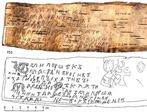
Picture: A birch-bark letter of the 12th century from Novgorod · Unknown author · Public domain · Wikimedia Commons
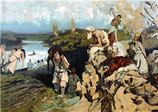
Free commoners · About 83% (the rest, est.)
Smerdy (Smerds)
smerd (plural smerdy)
Most people were farmers, called smerds, who grew grain and kept animals in village communities.
Most people of Rus’ were peasants: the Slavs were above all farmers, growing cereals and raising livestock. In the law they were smerds, a word from a root meaning “ordinary man” or “dependent man”. Free at first, the smerds gradually lost their freedom, in part or wholly, and their legal status differed from group to group. Unlike slaves they had their own property and paid fines for their offences, yet they never held full rights: a smerd’s killer paid the same fine as a kholop’s, and the prince inherited a dead smerd’s property. The Pravda forbade torturing a smerd under examination in court without the prince’s consent. Their villages formed communes (verv, hromada) within a volost.
Moving in or out. Debt pulled smerds down: a peasant who took a loan became a zakup until he repaid it, and one sold for his debts became a kholop.
How many? Everyone not counted in the other ranks: the peasants of the countryside, the great majority. The other ranks are estimates, so this share is one too.
Picture: Sergey Ivanov, Life of the East Slavs, 1909 · Sergey Ivanov · Public domain · Wikimedia Commons
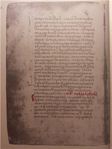
Serfs and dependants · c. 1–5% (est.)
Zakupy (Zakups)
zakup (the bonded man, and the loan that bound him)
A zakup was a farmer who had borrowed money and was not free again until the debt was paid.
A zakup was a peasant who had taken a feudal loan, also called a zakup, and lived in dependence until he paid it off, when he became free again. The Russkaya Pravda made new laws for them in the 11th to 13th centuries, and its Extensive Edition set out special rules for their status beside those for kholops. Debt also fed unrest: shortly after the uprising of 1113 in Kiev, Vladimir Monomakh enacted a new code, and a law against exorbitant interest limited what the moneylenders could do. A zakup’s bond stood between freedom and slavery, for a man could sell himself, or be sold for his debts, and so become a kholop.
Moving in or out. Paying off the loan made a zakup free again; failing to pay could make him a kholop.
How many? Estimate: peasants dependent on a creditor; the articles give no count, though the Extensive Pravda’s special rules for them suggest they were common.
Picture: The Russkaya Pravda in the Komissionny codex · B. D. Grekov · Public domain · Wikimedia Commons
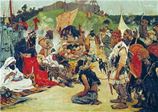


Enslaved · c. 5–10% (est.)
Kholopy (Kholops)
kholop (plural kholopy)
Kholops were enslaved people: their masters owned them and could sell them.
Kholops were the unfree of Rus’: in the 11th and 12th centuries the word covered several kinds of dependent people, and especially slaves. A master had unlimited power over a kholop: he could kill him, sell him or hand him over to settle a debt, though he answered for his kholop’s deeds, such as insulting a free man or stealing. People became kholops through capture, by selling themselves, by being sold for their debts, after committing crimes, or by marrying a kholop. Slaves were also a trade good: the Rus’ floated them down the Dnieper to Byzantium, and some subject tribes paid their tribute in slaves. Some, mainly house serfs, worked in trades, farming or administration.
Moving in or out. Capture, debt, crime or marriage made a free person a kholop. Some kholops, mainly house serfs, entered the princes’ service, among them their armed men.
How many? Estimate: the articles give no count; until the late 15th century kholops were the majority of the servants who worked the lords’ lands, and slaves were among the chief exports of Rus’.
Picture: Sergey Ivanov, Trade in the Land of the Eastern Slavs, 1909 · Sergey Ivanov · Public domain · Wikimedia Commons

Born into history
Where would you have stood? Chance places you on the ladder, as birth placed most people: weighted by how many each rank held.
Moving up and down
Rank in Kievan Rus’ rested above all on birth and service. Only Rurik’s descendants could be princes, and among them seniority and war decided who ruled which city. Service to a prince brought a boyar his offices and his grants of land, and the prince’s household took in free warriors, hired Varangians and even kholops, mainly house serfs. Trade made fortunes in the towns. The strongest current ran downward, through debt: a peasant who took a loan became a zakup, and a man who sold himself, or was sold for his debts, became a kholop. The law moved with unrest: the Pravda of Yaroslav’s sons laid down severe punishments for arson and for collective encroachment on rich people’s property, new provisions are believed to have been added after the revolts in Kiev, Novgorod and the Rostov-Suzdal land in 1068–1071, and Vladimir Monomakh’s code followed the Kiev uprising of 1113. Over the following centuries the smerds lost more of their freedom: in Novgorod and Pskov in the 14th and 15th centuries they were forbidden to seek a new master.
Women on the ladder
The Russkaya Pravda valued a woman’s life at half a man’s: if the victim of a killing was a woman, the fine was the poluvir’ye, half the usual vyra. Yet women had certain rights, among them to own and to inherit property. Princesses were the dynasty’s links to the rest of Europe. Olga had ruled Kiev as regent for her son Sviatoslav after 945 and converted to Christianity; Yaroslav the Wise married his sister and three daughters to the kings of Poland, France, Hungary and Norway, and his granddaughter Eupraxia, the daughter of Vsevolod, married the emperor Henry IV. At the bottom of society, marriage to a kholop made a free woman, or man, a kholop too.
Compare with another society
Test yourself
4 questions on the ladder of Kievan Rus'.
The questions open here once the page has loaded.
Sources and further reading
- Christian, D. (1999) A History of Russia, Mongolia and Central Asia. Blackwell.
- Cross, S. H. and Sherbowitz-Wetzor, O. P. (trs. and eds.) (1930) The Russian Primary Chronicle, Laurentian Text. Cambridge, Massachusetts: The Mediaeval Academy of America.
- Feldbrugge, F. J. M. (2009) Law in Medieval Russia. BRILL.
- Feldbrugge, F. J. M. (2017) A History of Russian Law: From Ancient Times to the Council Code (Ulozhenie) of Tsar Aleksei Mikhailovich of 1649. BRILL.
- Grekov, B. (ed.) (1940–1963) Pravda Russkaya. 3 vols. Moscow; Leningrad: publisher of the Academy of Sciences of the USSR.
- Kaiser, D. H. (tr. and ed.) (1992) The Laws of Rus' - Tenth to Fifteenth Centuries. Salt Lake City: Charles Schlacks Publisher.
The shares are of the whole population, children included. Where a scholar has counted or estimated a rank, its share follows that work, named on the rank; where no count survives, the share is an estimate, marked est. and drawn dashed, made from what the rank was and did, from related figures and from the same rank in comparable societies, and its note says what it rests on. Population: Estimate, kept wide: the articles give no count: Kievan Rus' was "sparsely populated compared to Western Europe" but the largest European state by area; Novgorod had 10,000–15,000 people in 1000, Kiev 36,000–50,000 around 1200, and some 300 towns stood on the eve of the Mongol invasion.
Cite this page
- APA
- The Epoch Institute. (2026). Social Hierarchy of Kievan Rus'. In Social Ladders. https://the-epoch-institute.org/societies/kievan-rus
- MLA
- “Social Hierarchy of Kievan Rus'.” Social Ladders, The Epoch Institute, 2026, https://the-epoch-institute.org/societies/kievan-rus. Accessed .
- Chicago
- The Epoch Institute. “Social Hierarchy of Kievan Rus'.” Social Ladders. 2026. https://the-epoch-institute.org/societies/kievan-rus.
- Harvard
- The Epoch Institute (2026) ‘Social Hierarchy of Kievan Rus'’, Social Ladders. Available at: https://the-epoch-institute.org/societies/kievan-rus (Accessed: ).