Europe
Kievan Rus'
At a glance
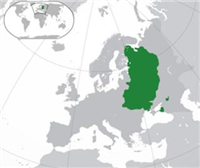
- A federation of East Slavic principalities ruled by the Rurikid dynasty from Kiev, on the river route from the Baltic to Byzantium.
- Vladimir the Great's conversion around 988 brought Orthodox Christianity, Cyrillic writing and Byzantine art to Rus'.
- Fragmented into rival principalities after 1132, it was destroyed by the Mongols, who sacked Kiev in 1240.
Rise & Fall
- 882Oleg of Novgorod takes Kiev and makes it his seat
- 911Oleg concludes a trade treaty with the Byzantine Empire
- c. 965Sviatoslav I destroys the Khazar Khaganate
- c. 988Vladimir the Great accepts Byzantine Christianity
- 1036Yaroslav the Wise becomes sole ruler and defeats the Pechenegs
- 1097The Council of Liubech confirms each prince's hereditary patrimony
- 1169Andrei Bogolyubsky of Vladimir-Suzdal sacks Kiev
- 1240Batu Khan's Mongol army storms and sacks Kiev
Foundation

Kievan Rus' took shape in the ninth and tenth centuries along the river routes linking the Baltic with the Black Sea and the Caspian. Scandinavian traders and warriors, known as Rus' or Varangians, moved down the Volkhov, Dnieper and Volga to exchange furs and slaves for Byzantine goods and Islamic silver, and a Rus' polity, sometimes called the Rus' Khaganate, existed in the north by the 830s. According to the Primary Chronicle, compiled in Kiev in the early twelfth century, the Slavic and Finnic tribes of the north invited the Varangian Rurik to rule them in 862, and in 882 his kinsman Oleg came south from Novgorod, killed the local rulers Askold and Dir and made Kiev his seat, uniting the two ends of the route from the Varangians to the Greeks. The chronicle's dates for this early period are schematic and partly legendary. Oleg and his successors Igor, Olga and Sviatoslav I extended tribute over East Slavic tribes such as the Polianians, Drevlians, Severians and Krivichians. Igor was killed by the Drevlians in 945 while collecting tribute, and his widow Olga took revenge and reorganised tribute collection. Sviatoslav I destroyed the Khazar Khaganate around 965, removing the main power of the steppe west of the Volga.
Socioeconomy
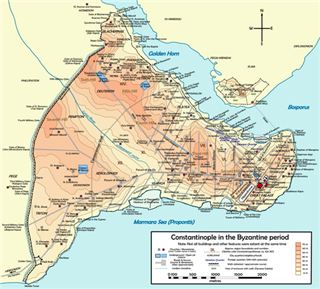
The population of Rus' was overwhelmingly East Slavic and rural, cultivating rye, wheat, barley and millet in clearings of the forest zone and on the richer soils of the forest-steppe, with Finnic and Baltic peoples in the north and west. Society was divided into princes and their retinues (druzhina), boyars who held land and office, free townspeople and peasants, dependent labourers and slaves. The wealth of the princes came from tribute in furs, honey, wax and captives, which they shipped to Constantinople under trade agreements such as the treaties of 911 and 944, while hoards of Islamic dirhams show the importance of the Volga trade with the Muslim world in the ninth and tenth centuries. Towns grew rapidly: Kiev, Novgorod, Chernigov, Smolensk, Polotsk and Vladimir became centres of crafts and commerce, and Kiev under Yaroslav the Wise was one of the largest cities in Europe. Excavations at Novgorod since 1951 have uncovered over a thousand birch-bark documents, showing that writing was used by merchants and ordinary townspeople. The conversion of 988 brought monasteries, among them the Kiev Monastery of the Caves, church dues and a new calendar of feasts, though pagan customs persisted in the countryside for generations, and the Church became an important landowner.
Military
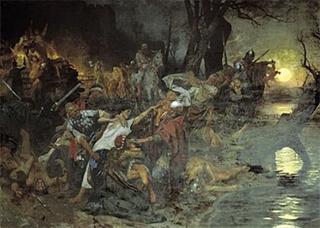
The armed strength of Rus' rested on the prince's druzhina, a mounted and well-armed retinue that also served as his council, supplemented by town militias, tribal levies and hired Scandinavian warriors. Early princes used river fleets of dugout boats to strike far afield. The chronicle records an attack by Oleg on Constantinople in 907, which Byzantine sources do not confirm, but his treaty of 911 is genuine; Igor's fleet was destroyed by Greek fire in 941. Sviatoslav I (r. c. 945–972) took the Khazar fortress of Sarkel and sacked Itil, invaded Danubian Bulgaria in 968 and was defeated by the Byzantine emperor John I Tzimiskes at Dorostolon in 971; on his way home he was killed by the Pechenegs at the Dnieper rapids. Vladimir the Great built lines of earthworks and forts south of Kiev against the Pechenegs and sent about 6,000 warriors to help Basil II in 988, the origin of the Byzantine Varangian Guard. Yaroslav the Wise defeated the Pechenegs decisively in 1036. From 1061 the Cumans, or Polovtsy, replaced them as the main steppe threat, routing the princes on the Alta River in 1068, until Vladimir Monomakh led joint campaigns deep into the steppe in 1103 and 1111. Feuds between princes, however, were a constant drain on military strength.
Governance & Law
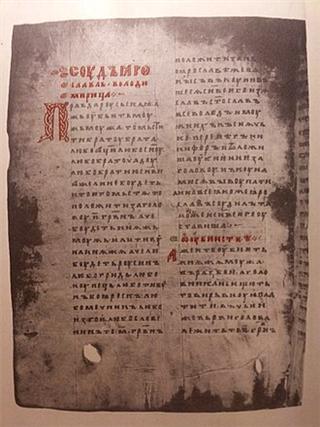
Kievan Rus' was less a unified state than a dynastic federation ruled by the descendants of Rurik. The grand prince in Kiev held seniority, and his sons and kinsmen governed other towns, moving up to more important seats as their elders died. This system of rotation produced repeated conflict: after Vladimir the Great's death in 1015 his son Sviatopolk had his brothers Boris and Gleb killed, and Yaroslav the Wise won Kiev only in 1019, sharing the realm with his brother Mstislav until 1036. Yaroslav's reign saw the first written law, the Russkaya Pravda, which restricted blood feud and increasingly replaced it with fines, and its later expanded versions set out rules on compensation, debt and inheritance. The Church was headed by a metropolitan of Kiev normally appointed from Constantinople, though Yaroslav installed the native Hilarion in 1051. Towns had assemblies (veche) that could summon or expel princes, above all in Novgorod. The Council of Liubech in 1097 tried to end the feuds by declaring that each prince should hold his father's patrimony, which in practice confirmed the division of the land into hereditary principalities. Vladimir Monomakh, invited to Kiev by its townspeople after a riot in 1113, and his son Mstislav the Great were the last princes to hold the federation together.
Global & Regional Impact
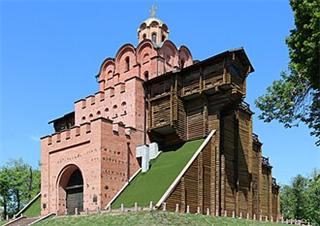
Kievan Rus' brought the East Slavs into the orbit of Byzantine Christianity. Princess Olga was baptised in the 950s, and around 988 Vladimir the Great accepted baptism, married Anna, sister of Emperor Basil II, and had the people of Kiev baptised in the Dnieper. With Orthodoxy came the Church Slavonic liturgy, writing in the Cyrillic alphabet, Byzantine architecture and icon painting. Yaroslav the Wise built the Cathedral of Saint Sophia in Kiev, with its mosaics and frescoes, and the Golden Gate, and a native literature followed: Hilarion's Sermon on Law and Grace, the Primary Chronicle, the Instruction of Vladimir Monomakh and the Tale of Igor's Campaign, which describes a failed raid against the Cumans in 1185. Yaroslav's children married into the royal houses of France, Norway, Hungary and Byzantium, a sign of the dynasty's standing in Europe; his daughter Anna of Kiev became queen of France as the wife of Henry I. The conversion of Rus' fixed the religious and cultural divide between Orthodox eastern Europe and the Latin West for centuries. Ukraine, Belarus and Russia all regard Rus' as the foundation of their history, and the question of its legacy, central to the national narratives of all three, remains politically charged today.
Decline & Fall
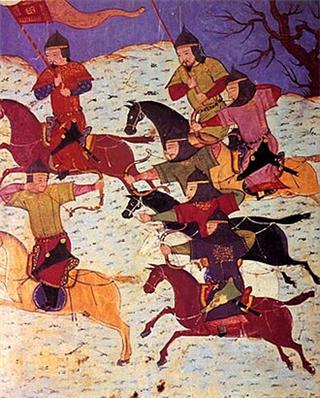
After the death of Mstislav the Great in 1132 the unity of Rus' dissolved. Kiev remained the senior city and a coveted prize, but it was contested by several branches of the dynasty and lost its primacy as other principalities grew stronger: Chernigov, Smolensk, Galicia and Volhynia in the south and west, Vladimir-Suzdal in the north-east, and the Novgorod Republic, which from 1136 chose and dismissed its own princes. In 1169 Andrei Bogolyubsky of Vladimir-Suzdal sacked Kiev and gave it to a junior relative rather than ruling there himself, a sign that the political centre had shifted. Kiev was sacked again in 1203 during wars between princes. The decline of the Dnieper trade route as Byzantium weakened, especially after the Fourth Crusade took Constantinople in 1204, further reduced the city's wealth. A first Mongol force crushed an army of Rus' princes and Cumans at the Battle of the Kalka River in 1223 but withdrew. In 1237 Batu Khan's armies returned, destroying Ryazan and Vladimir in 1237–1238 and Chernigov and Pereyaslavl in 1239, and in December 1240 they stormed Kiev. Most of the principalities became tributaries of the Golden Horde, and the lands of Rus' were later divided between Lithuania, Poland and the rising principality of Moscow.
Kievan Rus' was the first great state of the East Slavs, a federation of Rurikid principalities on the Dnieper trade route whose adoption of Byzantine Orthodoxy around 988 shaped the religion, writing and culture of eastern Europe, and from which Ukraine, Belarus and Russia all trace their origins.
References
- Cross, S.H. and Sherbowitz-Wetzor, O.P. (trans.) (1953) The Russian Primary Chronicle: Laurentian Text. Cambridge, MA: Mediaeval Academy of America.
- Fennell, J. (1983) The Crisis of Medieval Russia 1200–1304. London: Longman.
- Franklin, S. and Shepard, J. (1996) The Emergence of Rus 750–1200. London: Longman.
- Martin, J. (1995) Medieval Russia, 980–1584. Cambridge: Cambridge University Press.
- Plokhy, S. (2006) The Origins of the Slavic Nations: Premodern Identities in Russia, Ukraine, and Belarus. Cambridge: Cambridge University Press.
- Vernadsky, G. (1948) Kievan Russia. New Haven: Yale University Press.
Connections
Open the full connections map →