Europe
Duchy of Aquitaine
At a glance
- Founded by William the Pious in 893, the duchy was ruled from Poitiers by the counts of Poitou for nearly two centuries.
- Duke William IX is the earliest troubadour whose songs survive, and the ducal courts helped create courtly love poetry.
- Through Eleanor of Aquitaine it passed to the English crown, which held Gascony until the French victory at Castillon in 1453.
Rise & Fall
- 893William the Pious, count of Auvergne, takes the title of duke of Aquitaine
- 910William the Pious founds the abbey of Cluny
- 1137Eleanor of Aquitaine inherits the duchy and marries the future Louis VII of France
- 1152Eleanor marries Henry Plantagenet, joining Aquitaine to the Angevin lands
- 1259The Treaty of Paris confirms English rule of Gascony under French overlordship
- 1337Philip VI confiscates Gascony, opening the Hundred Years' War
- 1360The Treaty of Brétigny grants England an enlarged Aquitaine in full sovereignty
- 1453French victory at Castillon ends English rule; Guyenne joins France
Foundation
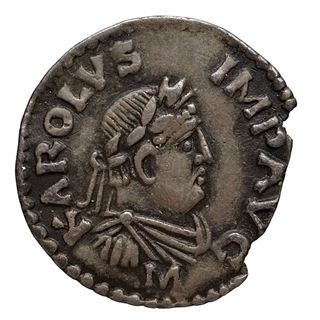
The Duchy of Aquitaine emerged from the break-up of Carolingian authority in south-western Gaul. Charlemagne had created a sub-kingdom of Aquitaine for his son Louis the Pious in 781, but by the late ninth century real power there had passed to great regional nobles. In 893 William the Pious, count of Auvergne, began to style himself duke of the Aquitanians, the first prince to hold the title in this new sense, and in 910 he founded the abbey of Cluny in Burgundy, whose monastic reform would spread across Latin Europe. After the death of his nephew Acfred in 927 the Auvergnat line died out, and the ducal title was disputed between the counts of Toulouse and the counts of Poitou. The Poitevin house, often called the Ramnulfids, prevailed in the mid-tenth century under William III Towhead and held the duchy for nearly two centuries, ruling from Poitiers. William V the Great, who ruled from the 990s until 1030, made the dukes among the most respected princes of the kingdom, and his son Guy-Geoffrey, who reigned as William VIII, acquired the Duchy of Gascony in the 1050s and 1060s, extending ducal lordship from the Loire to the Pyrenees. Aquitaine thus became the largest principality within the Kingdom of France, nominally subject to the king but in practice autonomous.
Socioeconomy

Aquitaine was a large and varied land, from the plains of Poitou and the Charente to the vineyards of the Bordelais, the forested Limousin, the uplands of Auvergne and the Gascon country towards the Pyrenees. Most people were peasants growing grain and vines under lay and ecclesiastical lords, and the region was dense with monasteries such as Saint-Martial of Limoges, Saint-Hilaire of Poitiers and Saint-Jean-d'Angély. Salt from the coastal marshes of Saintonge and wine shipped from La Rochelle and Bordeaux were exported to northern Europe. After 1152, and especially once Poitou was lost to the French crown, Gascon wine found a protected market in England; in the best years of the early fourteenth century Bordeaux shipped close to 100,000 tuns a year, and English cloth, grain and fish came back in return. Many new fortified towns, the bastides, such as Libourne and Monpazier, were founded by English and French lords in the thirteenth and fourteenth centuries to settle the countryside and secure revenues. The pilgrimage roads to Santiago de Compostela crossed the duchy, bringing pilgrims and wealth to great Romanesque churches such as Notre-Dame-la-Grande in Poitiers, while the Peace of God movement, launched at the Council of Charroux in 989, sought to protect clergy and peasants from aristocratic violence.
Military

The dukes commanded the service of their vassals, the counts and viscounts of Angoulême, Périgord, La Marche and Limoges and the lords of the castles that multiplied across the region from the late tenth century, but these vassals were often in revolt, and much ducal warfare was spent subduing them. Duke William IX led a large army on the Crusade of 1101, which was destroyed by the Seljuks in Anatolia. Under the Angevin kings the duchy was a theatre of constant rebellion: Richard the Lionheart, invested as duke in 1172, spent years besieging the castles of rebellious barons and was fatally wounded at the siege of Châlus-Chabrol in the Limousin in 1199. The French crown conquered Poitou between 1204 and 1224, when Louis VIII took La Rochelle, and Henry III's attempt to recover it failed at the Battle of Taillebourg in 1242. Gascony, defended by castles and fortified towns and supplied by sea from England, became a frontier of the Hundred Years' War. Edward the Black Prince marched from Bordeaux on the campaign that ended with his victory at the Battle of Poitiers in 1356, where King John II of France was captured. English rule ended after the Battle of Castillon in July 1453, where French artillery broke the English attack and the commander John Talbot, Earl of Shrewsbury, was killed.
Governance & Law

Ducal government in Aquitaine was always a matter of lordship over powerful men rather than of direct administration. The dukes held Poitou and later Gascony directly, ruled the rest through the homage of counts and viscounts, and depended on alliances with bishops and abbeys. The office was hereditary in the Poitevin house, and the dukes did homage to the kings of France, though in the tenth and eleventh centuries this was often nominal. William V the Great corresponded with rulers across Europe and was offered the crown of Italy for himself or his son around 1024–1025, an offer he eventually declined. When Eleanor, heiress of William X, married Louis VII in 1137 and Henry Plantagenet in 1152, the duchy passed into the hands of the kings of France and then of England, who governed through seneschals. After 1259 the English kings ruled Gascony as dukes of Aquitaine through a seneschal and the constable of Bordeaux, who kept the accounts, while the towns, Bordeaux and Bayonne above all, enjoyed wide privileges. Because the English king owed homage to the French king for the duchy, Gascon subjects could appeal against ducal officials to the Parlement of Paris, a legal lever the French crown used repeatedly. From 1362 to 1372 the Black Prince ruled an enlarged Principality of Aquitaine held in full sovereignty under the Treaty of Brétigny.
Global & Regional Impact
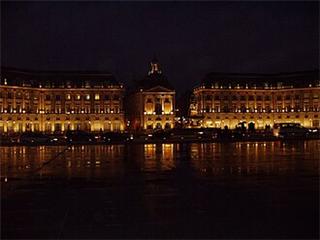
Aquitaine's most lasting contribution was cultural. Duke William IX (1071–1126) is the earliest troubadour whose songs survive, eleven poems in Occitan that range from the bawdy to the courtly, and the courts of his son William X and his granddaughter Eleanor of Aquitaine were associated with poets such as Marcabru and Cercamon. The lyric of fin'amor that the troubadours developed spread to northern France, Germany, Italy and Iberia and shaped European love poetry, from the trouvères and Minnesänger to Dante and Petrarch. Through Cluny, founded by William the Pious, the duchy contributed to the reform of Western monasticism, and through the councils of the Peace of God to the first organised efforts to limit aristocratic warfare. Eleanor herself, queen first of France and then of England and mother of Richard I and John, was one of the most powerful women of the medieval West. Politically, the duchy's union with the English crown made it a core of the Angevin Empire and later the principal cause of conflict between England and France: the confiscation of Gascony by Philip VI in 1337 opened the Hundred Years' War. Three centuries of English rule left close commercial ties between Bordeaux and Britain, which survive in the British taste for claret.
Decline & Fall
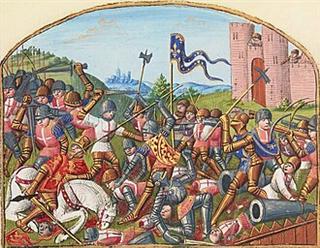
Aquitaine's decline as a great principality began with its absorption into larger dynastic empires. After Eleanor's death in 1204 King Philip II Augustus overran Normandy and Anjou, and the French crown took Poitou in stages, completing the conquest with the fall of La Rochelle in 1224. By the Treaty of Paris of 1259 Henry III of England gave up his claims to Normandy, Anjou and Poitou and did homage to Louis IX for a duchy reduced to Gascony, or Guyenne, with promises of lands in the Limousin, Périgord, Quercy and Agenais. The arrangement proved unstable: French kings confiscated the duchy in 1294 and 1324, and Philip VI's confiscation in 1337 started the Hundred Years' War. English victories restored a large Aquitaine under the Treaty of Brétigny in 1360, but the Black Prince's heavy hearth tax led Gascon lords, among them the count of Armagnac, to appeal to Charles V in 1368, and French armies reconquered most of the principality within a decade. By the late 1370s English rule was confined to a coastal strip around Bordeaux and Bayonne. After the Treaty of Arras of 1435 the French recovered steadily: Bordeaux surrendered in 1451, rose in 1452 to welcome John Talbot, and capitulated for good in October 1453 after Castillon, when Guyenne was annexed to the Kingdom of France.
The Duchy of Aquitaine matters as the largest principality of medieval France, the birthplace of troubadour poetry and the inheritance of Eleanor of Aquitaine, whose marriage to Henry Plantagenet in 1152 made it a core of the Angevin Empire and, through the Gascon question, a central cause of the Hundred Years' War.
References
- Gillingham, J. (1984) The Angevin Empire. London: Edward Arnold.
- Labarge, M.W. (1980) Gascony, England's First Colony, 1204–1453. London: Hamish Hamilton.
- Sumption, J. (1990) The Hundred Years War, Volume I: Trial by Battle. London: Faber and Faber.
- Turner, R.V. (2009) Eleanor of Aquitaine: Queen of France, Queen of England. New Haven: Yale University Press.
- Vale, M. (1990) The Angevin Legacy and the Hundred Years War, 1250–1340. Oxford: Basil Blackwell.
Connections
Open the full connections map →