Europe
Kingdom of France
At a glance
- Founded when Hugh Capet was elected king in 987, it was ruled by Capetians, Valois and Bourbons for more than 800 years.
- Its kings grew a small domain around Paris into Europe's most populous kingdom through war, marriage, inheritance and law.
- Louis XIV's Versailles made France the model of European monarchy, but unreformed debt led to the Revolution of 1789.
Rise & Fall
- 987Hugh Capet is elected and crowned king, founding the Capetian dynasty
- 1214Philip II Augustus defeats Otto IV and his allies at the Battle of Bouvines
- 1337The Hundred Years' War with England begins
- 1429Joan of Arc relieves Orléans and Charles VII is crowned at Reims
- 1598Henry IV's Edict of Nantes grants toleration to the Huguenots
- 1682Louis XIV moves the court and government to Versailles
- 1789The Estates-General meets and the Revolution begins
- 1792The monarchy is abolished and the First Republic proclaimed
Foundation

The Kingdom of France grew out of West Francia, the western share of the Carolingian Empire created by the Treaty of Verdun in 843. After the last Carolingian king, Louis V, died in a hunting accident in 987, the great nobles and bishops, led by Archbishop Adalbero of Reims, elected Hugh Capet, duke of the Franks, and he was crowned in July 987. The Carolingian claimant Charles of Lorraine resisted until he was captured in 991. Hugh's real power was modest: the royal domain was a narrow strip around Paris and Orléans, while the dukes of Normandy, Aquitaine and Burgundy and the counts of Flanders, Champagne and Toulouse owed only loose homage. The early Capetians survived by holding on to what they had. They had their eldest sons crowned in their own lifetime, a practice that lasted until Philip II, so that the succession never returned to election, and until 1316 every king was followed by a son. Louis VI the Fat (r. 1108–1137), advised by Abbot Suger of Saint-Denis, subdued the defiant castellans of the Île-de-France and made the domain safe to travel. The anointing at Reims, the cult of Saint-Denis and the kings' claimed power to heal scrofula by touch gave the dynasty a sacred standing that its armies could not yet match.
Socioeconomy
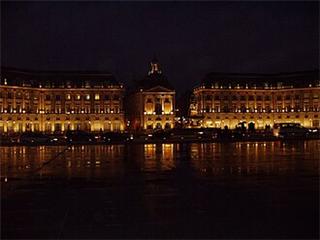
France was the most populous kingdom of Latin Europe: perhaps sixteen to twenty million people around 1300 within its borders of the time, roughly twenty million by 1700 and some twenty-eight million in 1789. The great majority were peasants growing grain, with wine in the Loire valley, Bordeaux and Burgundy, under seigneurs who collected dues and held rights of justice long after serfdom had largely disappeared. Society was described as three orders, clergy, nobility and the third estate, the last including both rich townspeople and the rural poor. In the twelfth and thirteenth centuries the fairs of Champagne linked Flemish cloth makers with Italian merchants, and Paris, with perhaps 200,000 inhabitants around 1300 on some estimates, was the largest city in Latin Christendom. The Black Death from 1348 and the wars that followed cut the population sharply before a long recovery after 1450. The Catholic Church was wealthy and powerful; the Protestant minority, the Huguenots, was tolerated from 1598 but lost that toleration in 1685, when many fled abroad. Under Jean-Baptiste Colbert the crown fostered royal manufactures such as the Gobelins tapestry works and backed projects such as the Canal du Midi, finished in 1681. In the eighteenth century Bordeaux and Nantes grew rich on Atlantic trade in sugar, coffee and enslaved Africans, centred on the colony of Saint-Domingue.
Military
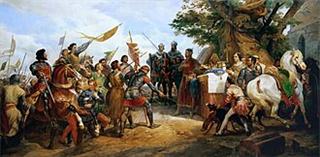
The early Capetians fought with small forces of household knights and vassals, but by the thirteenth century royal armies could defeat rivals outright. Philip II Augustus conquered Normandy from King John of England in 1202–1204 and at the Battle of Bouvines in 1214 routed Emperor Otto IV and his Flemish allies. The Hundred Years' War with England (1337–1453) began disastrously: English archers destroyed the French cavalry at the Battle of Crécy in 1346, King John II was captured at the Battle of Poitiers in 1356, and defeat at the Battle of Agincourt followed in 1415. Recovery came with Joan of Arc's relief of Orléans in 1429 and with Charles VII's reforms, which in 1445 created the compagnies d'ordonnance, the first permanent royal cavalry, and used artillery to win at Formigny in 1450 and Castillon in 1453. In the Italian Wars from 1494 French kings fought Spain and the Habsburgs, winning at the Battle of Marignano in 1515 but losing Francis I as a prisoner at the Battle of Pavia in 1525. Under Louis XIV the army grew to several hundred thousand men on paper, organised by the war ministers Michel Le Tellier and his son Louvois, while Vauban ringed the frontiers with bastioned forts. Colbert built a navy based at Brest, Toulon and Rochefort, but Britain usually held the seas.
Governance & Law

Royal government grew out of the king's household. Philip II created baillis and seneschals, salaried officials who ran justice and finance in the provinces, and kept written records of royal rights. Under Louis IX the king's court produced the Parlement of Paris, the supreme court of appeal, and a Chamber of Accounts followed in the early fourteenth century. Philip IV the Fair (r. 1285–1314) and his lawyers held that the king was emperor in his own kingdom, defied Pope Boniface VIII and summoned the first Estates-General in 1302. The Hundred Years' War gave the crown permanent taxes, above all the taille and the salt tax, the gabelle, levied without the estates' consent from the 1440s. Offices were sold and from 1604 became hereditary on payment of an annual fee, the paulette, creating a large, privileged class of officeholders. Cardinal Richelieu, chief minister of Louis XIII from 1624 to 1642, and Cardinal Mazarin after him extended the use of intendants, royal commissioners in the provinces, and Mazarin survived the revolt of the Fronde (1648–1653). Louis XIV then governed personally from 1661 with a small council and no chief minister, gathered the high nobility at Versailles, where the court settled in 1682, and never summoned the Estates-General, which did not meet between 1614 and 1789. In practice royal power remained limited by provincial estates, the parlements, privilege and custom.
Global & Regional Impact
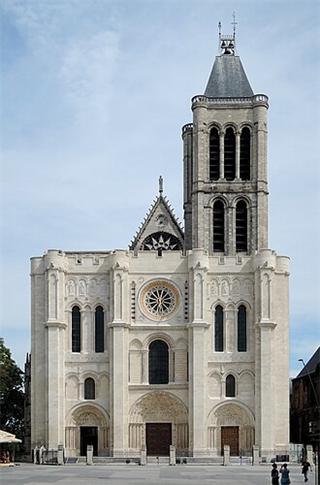
France set many of the patterns of European monarchy and culture. Gothic architecture began in the Île-de-France with Abbot Suger's rebuilding of the abbey church of Saint-Denis in the 1140s and spread from cathedrals such as Chartres, Reims and Amiens across Europe. The University of Paris made the city the centre of scholastic theology, where Thomas Aquinas taught in the thirteenth century, and Louis IX, canonised in 1297, became a model of Christian kingship. The Ordinance of Villers-Cotterêts of 1539 made French the language of law and administration. In the seventeenth century Descartes, Corneille, Molière and Racine, the Académie française founded in 1635 and the court of Versailles made French taste the standard of European elites, and French increasingly replaced Latin as the language of diplomacy. The Enlightenment of Montesquieu, Voltaire, Rousseau and Diderot's Encyclopédie was largely conducted in French. Overseas, the kingdom founded New France, with Quebec in 1608, Louisiana and sugar colonies in the Caribbean, leaving French-speaking communities from Canada to Haiti. The centralised state built by the kings, with its intendants, permanent army and capital-centred government, was inherited and strengthened by the Revolution and Napoleon, as Alexis de Tocqueville argued in The Old Regime and the Revolution (1856).
Decline & Fall

The monarchy's end was driven above all by debt and a failure of reform. The wars of Louis XIV left heavy debts, John Law's paper-money scheme collapsed in 1720, and the Seven Years' War cost France Canada and most of its position in India at the Treaty of Paris of 1763. Support for the American War of Independence (1778–1783) avenged that defeat but pushed the crown towards bankruptcy while the privileged orders and the parlements resisted new taxes. In 1787 the finance minister Calonne put a reform plan to an Assembly of Notables, which rejected it, and Louis XVI agreed to summon the Estates-General, which met at Versailles in May 1789. The third estate proclaimed itself the National Assembly in June, the fall of the Bastille on 14 July protected it from royal troops, and in August it abolished feudal privileges and issued the Declaration of the Rights of Man and of the Citizen. The king's attempted flight to Varennes in June 1791 destroyed trust in him, though the Constitution of 1791 kept him as a constitutional monarch. War with Austria from April 1792 and fear of betrayal led to the storming of the Tuileries on 10 August 1792; the National Convention abolished the monarchy on 21 September 1792, and Louis XVI was guillotined in January 1793.
The Kingdom of France turned a small royal domain around Paris into Europe's most populous and centralised monarchy, shaping European government, Gothic art, scholastic learning, court culture and the international standing of the French language, before debt and failed reform brought the Revolution that abolished it in 1792.
Test yourself
5 questions on this page, from its key events and facts.
The questions open here once the page has loaded.
References
- Baldwin, J.W. (1986) The Government of Philip Augustus: Foundations of French Royal Power in the Middle Ages. Berkeley: University of California Press.
- Collins, J.B. (1995) The State in Early Modern France. Cambridge: Cambridge University Press.
- Doyle, W. (1989) The Oxford History of the French Revolution. Oxford: Oxford University Press.
- Dunbabin, J. (1985) France in the Making, 843–1180. Oxford: Oxford University Press.
- Hallam, E.M. (1980) Capetian France, 987–1328. London: Longman.
- Potter, D. (1995) A History of France, 1460–1560: The Emergence of a Nation State. Basingstoke: Macmillan.
Connections
Open the full connections map →