Central & East Asia
Ghurid Sultanate
At a glance
- Shansabani chiefs from the mountains of Ghor rose from Ghaznavid vassals to rulers of an empire from Khurasan to Bengal.
- Mu'izz al-Din won the Second Battle of Tarain in 1192, and his slave generals went on to found the Delhi Sultanate.
- The Minaret of Jam, about 65 metres high, survives in a remote Afghan valley as a UNESCO World Heritage Site.
Rise & Fall
- 1011Mahmud of Ghazni invades Ghor and captures its chief, Muhammad ibn Suri
- c. 1150Ala al-Din Husayn burns Ghazni for seven days, earning the name 'World Burner'
- 1173Mu'izz al-Din takes Ghazni and makes it his base for campaigns in India
- 1186The Ghurids take Lahore, ending Ghaznavid rule
- 1192Mu'izz al-Din defeats Prithviraj Chauhan at the Second Battle of Tarain
- 1204The Khwarazmshah and the Qara Khitai defeat Mu'izz al-Din at Andkhud
- 1206Mu'izz al-Din is assassinated; Qutb al-Din Aybak takes power at Lahore
- 1215The Khwarazmian Empire takes Ghazni, ending Ghurid rule
Foundation

Ghor, a remote and mountainous region of central Afghanistan between Herat and Ghazni, was among the last parts of the eastern Iranian world to accept Islam, and its people lived in fortified villages under local chiefs. Little is known of its early history. Later Ghurid tradition, recorded by the historian Minhaj al-Siraj Juzjani in the thirteenth century, traced the ruling Shansabani family back to legendary Iranian kings and to an ancestor said to have converted at the hands of the caliph Ali; the starting date of 879 used here is conventional, since no reliable record of the dynasty survives from that time. The family becomes visible in 1011, when Mahmud of Ghazni invaded Ghor and captured its chief, Muhammad ibn Suri. For more than a century afterwards the Shansabanids were vassals of the Ghaznavids and, from the early twelfth century, of the Seljuk sultan Sanjar. The break came in the 1140s, when the Ghaznavid sultan Bahram Shah had the Ghurid prince Qutb al-Din Muhammad poisoned and later executed his brother Sayf al-Din Suri, who had briefly seized Ghazni. In revenge another brother, Ala al-Din Husayn, defeated Bahram Shah and in 1150 or 1151 sacked Ghazni, burning it for seven days, which earned him the name Jahan-suz, 'World Burner'.
Socioeconomy

Ghor itself was poor: a land of high valleys, pastures and forests where farming and stock raising supported a population of hardy highlanders, and whose main exports were reportedly slaves, armour and weapons made from local iron. The empire's wealth came from conquest. The Ghurids came to control the cities of Herat, Ghazni and Balkh, the trade routes between Khurasan and India and, from the 1190s, the rich farmland of the Punjab and the Ganges plain, whose treasuries and temples yielded enormous booty. Ghurid coinage reflects this mixed empire. In northern India Mu'izz al-Din issued coins in the local style, including gold coins bearing the image of the goddess Lakshmi and billon coins with a bull and a horseman, while in the west the sultans struck Islamic dinars and dirhams. Religion was a field of change. Many highlanders of Ghor had followed the Karramiyya, a pietist Sunni movement, but Ghiyath al-Din Muhammad later adopted the Shafi'i school while Mu'izz al-Din became a Hanafi, and the theologian Fakhr al-Din al-Razi was active at Ghurid courts. Buildings and works of art show a court culture that drew on Persian traditions and employed craftsmen from across the eastern Islamic lands, with Herat as its leading city.
Military
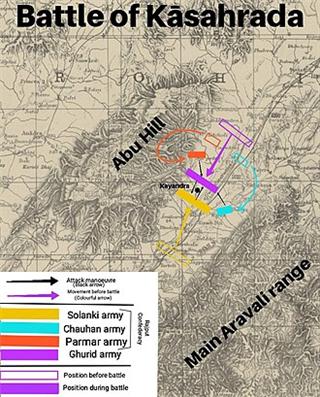
Ghurid armies combined the infantry of Ghor, known for fighting on foot behind large shields, with Turkic slave cavalry (ghulams), Khalaj, Afghan and other tribal contingents and, in India, captured war elephants. Mounted archers and the Turkic military slaves who commanded them formed the striking force. Under Ghiyath al-Din Muhammad (r. 1163–1203) the brothers fought on two fronts. In the west they took Herat around 1175 and contested Khurasan with the Khwarazmshahs, briefly occupying Nishapur after the death of the Khwarazmshah Tekish in 1200. In the east Mu'izz al-Din took Ghazni from the Ghuzz Turkmen in 1173 and from there advanced into India. He captured Multan in 1175 but was defeated by the Chaulukyas of Gujarat at Kasahrada in 1178, and he ended Ghaznavid rule in the Punjab by taking Lahore in 1186. In 1191 a Rajput coalition under Prithviraj Chauhan defeated him at the First Battle of Tarain, but the next year, at the Second Battle of Tarain, his mobile cavalry won a decisive victory. In 1194 he defeated the Gahadavala king Jayachandra at the Battle of Chandawar, and his commanders went on to raid as far as Bihar and Bengal. In 1204, however, a Khwarazmian army supported by the Qara Khitai crushed him at Andkhud.
Governance & Law
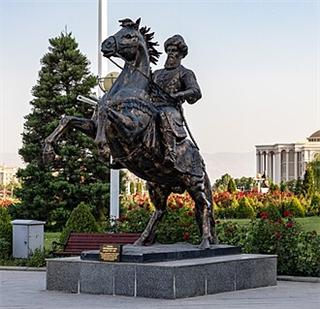
The Ghurid realm was a family enterprise rather than a centralised state. From 1163 the brothers Ghiyath al-Din Muhammad and Mu'izz al-Din Muhammad shared power in a partnership that held for forty years. Ghiyath al-Din, the senior sultan, ruled from Firozkoh in Ghor and from Herat and directed the western wars, while Mu'izz al-Din, governing from Ghazni from 1173, led the conquests in India, acknowledging his brother on his coins and in the Friday prayer. Another branch of the Shansabani family held Bamiyan and the upper Oxus lands as a semi-independent appanage. Below the dynasty, power rested with military commanders. In India Mu'izz al-Din relied on Turkic slave generals whom he had bought and trained, such as Qutb al-Din Aybak at Delhi and Lahore, Taj al-Din Yildiz at Kirman and Ghazni, and Nasir al-Din Qabacha at Multan and Uch, together with free commanders such as Muhammad Bakhtiyar Khalji in Bihar. Conquered Indian lands were divided into revenue assignments that supported the troops, and many local Hindu rulers were left in place as tributaries. The Ghurids adopted Persian administrative practice, Persian as the language of government and the titles of Islamic kingship, and cultivated recognition from the Abbasid caliph in Baghdad.
Global & Regional Impact

Although it was a great power for barely half a century, the Ghurid Sultanate changed the history of South Asia. Mu'izz al-Din's victories at Tarain and Chandawar broke the leading Rajput and Gahadavala kingdoms of the Ganges plain, and his commanders created the military and administrative framework from which the Delhi Sultanate emerged in 1206. Aybak, Iltutmish and other Turkic commanders of Ghurid origin ruled northern India for most of the thirteenth century, and the Muslim dynasties that dominated much of the subcontinent for the next five centuries trace their beginnings to the Ghurid conquest. The conquest also brought destruction: temples were demolished and their materials reused, as in the Quwwat al-Islam mosque begun at Delhi in the 1190s, and Bakhtiyar Khalji's raids in Bihar are traditionally associated with the sack of Buddhist monasteries such as Nalanda. The Ghurids were also major builders. The Minaret of Jam, about 65 metres high and decorated with brick patterns and the Qur'anic chapter of Maryam, was raised in the remote valley that probably held Firozkoh, most likely in the 1190s, and is now a UNESCO World Heritage Site. Ghiyath al-Din rebuilt the Friday Mosque of Herat, and Aybak began the Qutb Minar at Delhi, which Iltutmish completed.
Decline & Fall
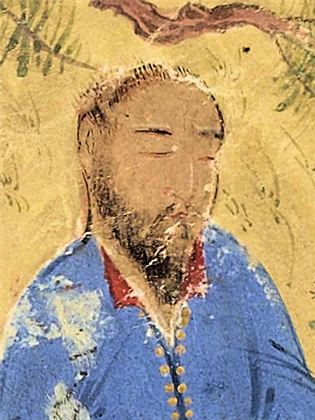
The Ghurid empire depended on the partnership of the two brothers and could not survive their deaths. Ghiyath al-Din died in 1203, leaving Mu'izz al-Din as sole sultan, and the disaster at Andkhud in 1204 against the Khwarazmshah Muhammad II and the Qara Khitai encouraged rebellion. After suppressing a rising of the Khokhars in the Punjab, Mu'izz al-Din was assassinated in March 1206 at Damyak in the Punjab, either by Isma'ili agents or by Khokhars; the sources disagree. He left no son, and the empire broke into rival domains. Ghiyath al-Din's son Ghiyath al-Din Mahmud took the throne at Firozkoh, the Bamiyan branch contested the inheritance, and the slave commanders made themselves masters of their provinces: Yildiz at Ghazni, Qabacha at Multan and Aybak at Lahore, where he founded what became the Delhi Sultanate. Ghiyath al-Din Mahmud, squeezed between rivals, was murdered in 1212. Meanwhile the Khwarazmshah Muhammad II expanded into Khurasan and Afghanistan, absorbed Ghor and took Ghazni by 1215, ending Ghurid rule; Yildiz fled to India, where Iltutmish defeated him in 1216. A few years later Ghor itself was devastated in the Mongol invasion of the early 1220s, and Firozkoh was destroyed so thoroughly that its site was long forgotten.
The Ghurid Sultanate rose from the mountains of central Afghanistan to rule from Khurasan to Bengal in the late twelfth century; its conquest of northern India under Mu'izz al-Din Muhammad laid the foundations of the Delhi Sultanate, and its monuments include the Minaret of Jam.
Test yourself
5 questions on this page, from its key events and facts.
The questions open here once the page has loaded.
References
- Bosworth, C.E. (1977) The Later Ghaznavids: Splendour and Decay. The Dynasty in Afghanistan and Northern India, 1040–1186. Edinburgh: Edinburgh University Press.
- Bosworth, C.E. (1996) The New Islamic Dynasties: A Chronological and Genealogical Manual. Edinburgh: Edinburgh University Press.
- Flood, F.B. (2009) Objects of Translation: Material Culture and Medieval 'Hindu-Muslim' Encounter. Princeton: Princeton University Press.
- Jackson, P. (1999) The Delhi Sultanate: A Political and Military History. Cambridge: Cambridge University Press.
- Wink, A. (1997) Al-Hind: The Making of the Indo-Islamic World, Volume 2: The Slave Kings and the Islamic Conquest, 11th–13th Centuries. Leiden: Brill.
Connections
Open the full connections map →