Americas
Powhatan Confederacy
At a glance
- A paramount chiefdom of some 30 Algonquian peoples in coastal Virginia, built by Wahunsenacah, whom the English called Powhatan.
- It met the founders of Jamestown in 1607 and nearly destroyed the colony in 1609–1610 and again in 1622.
- Defeated in 1646, its peoples became tributaries of Virginia; the Pamunkey and Mattaponi keep reservations confirmed in 1677.
Rise & Fall
- 1570Spanish Jesuits found the Ajacán mission, destroyed by local people the next year
- c. 1597Wahunsenacah kills the chief of the Kecoughtan and installs his son
- 1607The English found Jamestown; John Smith is brought before Wahunsenacah
- 1614Pocahontas marries John Rolfe, ending the First Anglo-Powhatan War
- 1622Opechancanough’s coordinated attacks kill some 347 colonists
- 1646Opechancanough is captured; the Treaty of 1646 makes the Powhatan tributaries
- 1677Cockacoeske signs the Treaty of Middle Plantation
Foundation

The Powhatan paramount chiefdom, often called the Powhatan Confederacy, grew among the Algonquian-speaking peoples of the coastal plain of present-day Virginia, a land they called Tsenacommacah. Its maker was Wahunsenacah, known to the English as Powhatan after his home town near the falls of the James River, where Richmond now stands. Probably born around 1550, he inherited six chiefdoms, the Powhatan, Arrohateck, Appamattuck, Pamunkey, Youghtanund and Mattaponi; when he did so is not recorded. Europeans had already touched the region. In 1570 Spanish Jesuits founded a mission at Ajacán, guided by Paquiquineo, a local man taken by Spaniards in 1561 and baptised Don Luis, who had spent years in Mexico and Spain; in early 1571 he and his kinsmen killed the missionaries. Some historians have identified Don Luis with Wahunsenacah’s kinsman Opechancanough, but the identification is unproven. Through a combination of force and diplomacy Wahunsenacah extended his rule over his neighbours. According to the English writer William Strachey he killed the chief of the Kecoughtan around 1597 and installed his young son Pochins in his place, and before 1607 he destroyed the Chesepians near the mouth of the Chesapeake Bay. By then he ruled some 30 peoples, perhaps 15,000 people, across the coastal plain from the Potomac to the James, governing from Werowocomoco on the York River.
Socioeconomy
The peoples of Tsenacommacah lived in towns of houses covered with bark or reed mats, set among fields along the rivers and estuaries of the Chesapeake. Women farmed maize, beans and squash and gathered wild plants; men hunted deer, often in communal drives using fire, fished with weirs and spears, and made dugout canoes by burning and scraping logs. The year moved between the towns, fishing camps and winter hunting grounds. Copper, pearls and shell beads marked rank and wealth, and copper, obtained through long-distance trade, was the most prized, which gave English copper great value in the first years of contact. Religion centred on Okeus, a powerful spirit honoured with offerings and images in temples kept by priests; English writers, who described him as a devil set against a kindly creator called Ahone, misunderstood much of it. The Powhatan language, an Eastern Algonquian tongue that had probably fallen silent by 1790, survives mainly in word lists made by John Smith and William Strachey, yet some of the first Native American words to enter English came from it. Archaeologists working at Werowocomoco since 2002 have found that it was settled by about 1270 and that two long curved ditches were dug there around 1400, marking a political and sacred centre long before Wahunsenacah’s time.
Military
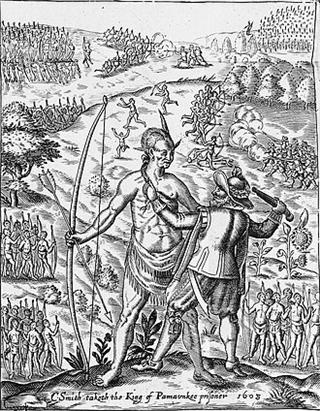
The warriors of Tsenacommacah fought with bows and arrows, wooden war clubs and shields, relying on ambush, surprise raids and rapid withdrawal rather than pitched battle; Wahunsenacah kept a guard of some fifty of his tallest men. The Siouan-speaking Monacan and Mannahoac above the fall line and the Massawomeck from the north were long-standing enemies. When the Virginia Company founded Jamestown in May 1607, Wahunsenacah first hoped to make the English his tributaries; in December 1607 a hunting party under Opechancanough captured John Smith and brought him to Werowocomoco. Relations broke down, and in the First Anglo-Powhatan War (1609–1614) his warriors ambushed a party under John Ratcliffe and besieged Jamestown through the winter of 1609–1610, the Starving Time, in which most of the fort’s colonists died. Reinforcements under Lord De La Warr in June 1610 turned the war: the English seized Kecoughtan and in August destroyed a Paspahegh town, killing the weroance’s wife and children. Opechancanough’s coordinated attacks of 22 March 1622 killed some 347 colonists, nearly a third of the English in Virginia, and those of 18 April 1644 about 400, but each time the colonists answered with years of raids on towns and crops, including the poisoning of Powhatan delegates at peace talks in 1623.
Governance & Law
Wahunsenacah ruled as mamanatowick, or paramount chief, over district chiefs called weroances; a woman ruler was a weroansqua. Many weroances were hereditary rulers who had submitted to him, while in conquered or strategic districts he installed sons and kinsmen, as at Kecoughtan and at his home town of Powhatan, where his son Parahunt ruled when the English arrived. Subject chiefs paid tribute in maize, deerskins, copper, pearls and shell beads and supplied warriors when called; much of it was kept in storehouses, from which the paramount chief could reward loyalty and feed allies. Priests sat in the paramount chief’s council and held great influence. Succession passed to a ruler’s brothers and then to the children of his sisters, so that after Wahunsenacah’s death in 1618 the title went to his brother Opitchapam, while a younger brother, Opechancanough, held the real power. Wahunsenacah moved his seat from Werowocomoco to Orapax, farther from the English, in 1609, and later to Matchut on the Pamunkey River. In 1608 Christopher Newport, following instructions from London, crowned him as a vassal of James I at Werowocomoco; he refused to kneel, and the ceremony meant very different things to the two sides. After 1646 the paramountcy was broken into tributary chiefdoms whose leaders the colony recognised and controlled.
Global & Regional Impact
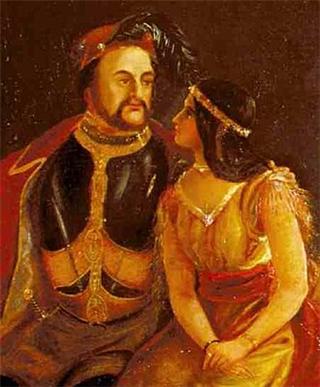
Tsenacommacah shaped the first permanent English colony in North America from its first days. Its maize, traded or seized, kept Jamestown alive in its early years, and its warriors nearly ended the colony in 1609–1610 and again in 1622, when the shock of the attacks helped to bring about the dissolution of the Virginia Company and royal rule in 1624. In the same years John Rolfe, who had begun growing a sweet tobacco from Caribbean seed, shipped his first crop to England in 1614, and the tobacco boom that followed drove the colonists’ hunger for land along the rivers. Wahunsenacah’s daughter Pocahontas, whose own names were Amonute and Matoaka, was captured in 1613, baptised Rebecca, married Rolfe and died at Gravesend in England in 1617. John Smith’s story that she saved him from execution in 1607, published only in 1624, is doubted by most historians, and her life became a founding legend of the United States retold far beyond the evidence. The Powhatan language gave English words such as raccoon, moccasin, tomahawk and persimmon. The Pamunkey, Mattaponi, Rappahannock, Nansemond and other tribes descended from the peoples of Tsenacommacah remain in Virginia; the Pamunkey gained federal recognition in 2016, and the Upper Mattaponi, Rappahannock and Nansemond, with the Chickahominy and Eastern Chickahominy, in 2018.
Decline & Fall

English expansion wore the paramount chiefdom down. After Wahunsenacah’s death tobacco plantations spread along the James, and Opechancanough, angered also by the English killing of the war leader Nemattanew, prepared a blow to drive them back. The attacks of 22 March 1622 opened the Second Anglo-Powhatan War, in which the English destroyed towns and crops; a two-day battle near a Pamunkey town in 1624 ended in stalemate, and peace was made in 1632. The aged Opechancanough struck again in 1644, but the colony had grown many times over. In 1646 Governor Sir William Berkeley captured him at his fort on the upper Pamunkey River, and a guard shot him at Jamestown. That October his successor Necotowance accepted a treaty that made the Powhatan peoples tributaries of the Crown, paying a yearly tribute and barred without a pass from the colonists’ lands between the York and Blackwater rivers. The Pamunkey weroance Totopotomoy was killed in 1656 fighting beside the colony’s militia at Bloody Run, and his widow Cockacoeske survived attacks by Nathaniel Bacon’s followers in 1676. In May 1677 she signed the Treaty of Middle Plantation, which recognised her authority over several scattered peoples, barred English settlement within three miles of an Indian town and set a yearly quitrent of three arrows. The Pamunkey and Mattaponi still hold reservations and present game to Virginia’s governor every year.
The Powhatan paramount chiefdom united some 30 Algonquian peoples of coastal Virginia under Wahunsenacah, met the founders of Jamestown on its own terms and twice nearly destroyed the colony, before English expansion broke it into tributary tribes whose descendants, among them the Pamunkey and Mattaponi, still hold reservations in Virginia.
Test yourself
5 questions on this page, from its key events and facts.
The questions open here once the page has loaded.
References
- Gallivan, M.D. (2016) The Powhatan Landscape: An Archaeological History of the Algonquian Chesapeake. Gainesville: University Press of Florida.
- Gleach, F.W. (1997) Powhatan’s World and Colonial Virginia: A Conflict of Cultures. Lincoln: University of Nebraska Press.
- Rountree, H.C. (1989) The Powhatan Indians of Virginia: Their Traditional Culture. Norman: University of Oklahoma Press.
- Rountree, H.C. (1990) Pocahontas’s People: The Powhatan Indians of Virginia through Four Centuries. Norman: University of Oklahoma Press.
- Rountree, H.C. (2005) Pocahontas, Powhatan, Opechancanough: Three Indian Lives Changed by Jamestown. Charlottesville: University of Virginia Press.
Connections
Open the full connections map →