Religion · Central & East Asia
Chinese folk religion
At a glance
- Chinese folk religion has no single church or creed: one takes part by belonging to a village, a lineage or a temple association with its gods and rituals, not by believing an official doctrine.
- Its common core is Tian, Heaven, the source of moral meaning; qi, the energy of which all things are made; the veneration of ancestors; and bao ying, moral reciprocity.
- Condemned as “feudal superstition” after 1911 and attacked most of all in the Cultural Revolution (1966–1976), it revived after 1978, with millions of temples rebuilt or built from scratch.
Timeline
- c. 1250 BCEDivination, a major component of folk religion, has developed in China by 1250–1150 BCE
- c. 1000 BCEThe Yijing and the Eight Trigrams are well established
- 531A cult of Ganesha, the Elephant-Head God, is attested, as influences from the Indian subcontinent arrive with the spread of Buddhism
- 960–1279Under the Song dynasty folk practices blend with Buddhist, Confucian and Taoist teachings into the popular religion that lasts to the present
- 1898Kang Youwei persuades the emperor to order temples that perform no state sacrifices turned into schools; the confiscations are soon reversed
- 1928The Nationalist government’s “Standards for retaining or abolishing gods and shrines” try to abolish the cults of all gods but great heroes and sages
- 1966–1976The Cultural Revolution makes the most serious and last systematic effort to destroy the ancient Chinese religion
- 1978After the adoption of the new constitution the religion revives rapidly, with millions of temples rebuilt or built from scratch
Spread through the centuries
Where it began, how it spread, and where it was a main faith (a bright glow) or held communities (a faint one), century by century to today. Press Play or move the slider, turn the globe, and tap a glow or a mark to read about it.
The map opens here once the page has loaded.
Origins
Chinese folk religion has no founder and no single beginning. At the start of Chinese civilisation the most honoured members of the family were the ancestors, thought to dwell between heaven and earth and to ask the gods to favour their families. Divination had developed in China by 1250–1150 BCE, and the Yijing and the Eight Trigrams were well established by 1000 BCE. The worship of Shangdi, the Primordial Deity, is rooted in the tradition of the Shang dynasty, which honoured ancestral gods and culture heroes; under the Zhou, who preferred gods of nature, Tian became a more abstract idea of God. In the Shang and Zhou shamans held a place in the political hierarchy, and the emperor was seen as the supreme shaman. Yin and yang and the five phases had developed by the third century BCE.
By the Han dynasty (202 BCE – 220 CE) the religion mostly consisted of shè, local communities at altars to a god of the earth or a deified virtuous person; some cults, such as that of Liu Zhang, a king in what is now Shandong, date from this period. At that time the term Shendao, “the Way of the Gods”, came to set the indigenous religion apart from imported Buddhism.
For much of the imperial period Chinese religion was the Three Teachings of Confucianism, Buddhism and Taoism; folk religion as practice distinct from them began primarily in the Song dynasty (960–1279), by which time it had blended with all three. Since the 1970s scholars such as Kristofer Schipper have seen a unified “ancient Chinese religion”; others study many local systems.
Beliefs & Practice
Chinese religion shares four core concepts: Tian, Heaven, both the physical heavens and the home of gods and ancestors, and the source of moral meaning, as in the Mandate of Heaven; qi, the breath or energy of which all things are made, gods included; the veneration of ancestors; and bao ying, moral reciprocity, by which every being is rewarded according to its deeds. Personal destiny, ming yun, is held to be both given and open to choice, and yuanfen, “fateful coincidence”, names good and bad chances. Yin and yang, the dark and the light, are the modes in which qi appears.
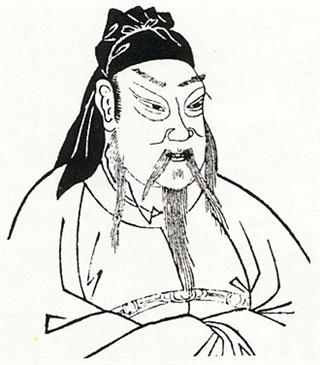
The religion is polytheistic. The shen, gods or spirits, are forces of growth: gods of nature, of stars, mountains and streams; household gods such as the Stove God; people who became gods, such as the warrior Guan Yu; and deified ancestors. Opposed to them are the gui, ghosts. Gods and immortals (xian) are not sharply divided, for gods can take human form and people can reach immortality. At the summit stand cosmic gods such as the Jade Deity and the Queen Mother of the West, and goddesses such as Bixia and Mazu, the Queen of Heaven, are widely worshipped.
A god’s worth is judged by its ling, its efficacy, shown above all in curing disease and granting children. Worshippers offer incense, oil, candles and money, make vows and do good deeds in a god’s name; ancestors are honoured before their tablets and nationally at the Qingming Festival. At death the po returns to the earth, while the hun receives the ancestral sacrifices.
Texts & Teachers
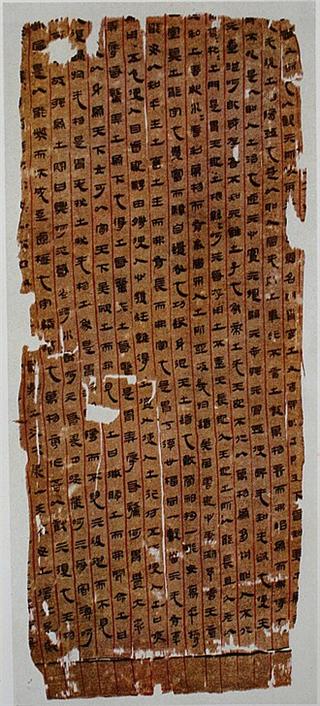
Chinese folk religion has no canon of its own but draws on a vast heritage of sacred books, in which cosmology, history, mythology, mysticism and philosophy are aspects of the same thing. A shift towards written transmission over oral tradition first becomes detectable in the 1st century CE, yet the spoken word kept its power: scriptures had to be recited and heard to be efficacious. The classics include the Confucian Four Books and Five Classics and the Classic of Filial Piety, the Mozi, the Huainanzi and the Xunzi; in the Han dynasty Dong Zhongshu compiled the “Interactions Between Heaven and Mankind”.
Taoism has its own literature, from the Daodejing, the Liezi and the Zhuangzi to the Taoist Canon, while the folk sects and vernacular literature produced the baojuan, “precious scrolls”, and morality books with ledgers of merit and demerit. Lists of gods and immortals appear in Ge Hong’s “Biographies of Deities and Immortals” and the Ming “Completed Record of Deities and Immortals”. The myths are told in the “Classic of Mountains and Seas”, the “Investiture of the Gods” and “Journey to the West”.
Ancient books found in recent decades, the Huangdi sijing in the 1970s and the Guodian texts, among them “The Great One Gives Birth to Water”, in the 1990s, have given rise to new interpretations of the religion and new directions in its renewal after Mao. Scholars have shaped how it is understood: Jan Jakob Maria de Groot coined “Chinese Universism”, and C. K. Yang described it as a “diffused religion”.
Spread
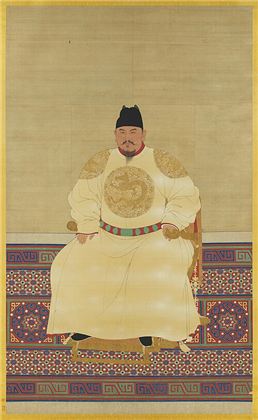
From the 3rd century, as Buddhism spread under the Northern Wei, strong influences from the Indian subcontinent entered the native religion: a cult of Ganesha is attested in 531, and processions of carts and floats bearing gods’ images, with music and chanting, came the same way. In the 14th century the Hongwu Emperor of the Ming used the name Shendao for the indigenous cults, which he strengthened and systematised, and imperial policy promoted some gods while suppressing others.
Practice differs between north and south. On the North China Plain villages of many surnames worship tutelary gods of nature in “communities of the gods”, with large temple gatherings and a pantheon of more ancient gods; folk sects and mother goddesses are strongest in the central plains and the northeast, where Han religion met Tungus and Manchu shamanism and fox gods head the pantheons. In the south and southeast lineages and their ancestral temples prevail, and Taoism dominates the rites along the coast. New temples join networks by “dividing the incense” of older ones. In the southwest the religions of the Zhuang, Yi, Yao, Tujia and Miao have been “Taoised”, and in Tibet, Inner Mongolia and western China the cult of Gesar has grown.
Emigrants carried the religion abroad. By 1899 there were 400 syncretic temples on the American West Coast alone. Among the Chinese of Southeast Asia, most of them from the southeastern provinces, Mazu is the most important deity. In Taiwan, where the 63rd Celestial Master fled in the 1940s, folk religion was very well preserved.
Community & Society
The prime criterion for taking part is not to believe a doctrine but to belong: to an association, a village or a kinship group, with its gods and rituals. No initiation, membership or conversion is required, and religion is embedded in family and civic life rather than in a separate church. Its local forms include deity and temple associations, lineage associations and pilgrimage associations, alongside secret societies and folk religious sects.
In the north the shénshè, the “society of a god”, organises the miaohui, temple gatherings on the gods’ birthdays or against droughts and epidemics, and many villages are named after their temples. In the south, kinship associations of one surname enshrine their deified ancestors in temples that show the lineage’s wealth and serve as centres of mutual help. Village rites are usually led by local people, often male heads of families; in late imperial China territorial temples were run by local notables, typically men, and women were excluded from certain rituals. Specialists are hired as needed: spirit mediums, fortune tellers, feng shui practitioners, Confucian “sages of rites”, Zhengyi Taoist priests who may marry and serve part-time, and ritual masters (fashi) outside official Taoism.
The “salvationist” sects, such as Yiguandao, the Luo teaching and the Tiandi teachings, look to charismatic founders and offer salvation through morality, cultivation and scripture. They were banned in early Republican and Communist China, and many remain illegal there, while in Taiwan virtually all have operated freely since the late 1980s.
Legacy
In the 19th and 20th centuries the religion was persecuted. Many temples were destroyed in the Taiping and Boxer rebellions; in 1898 Kang Youwei persuaded the emperor to turn temples into schools, and after the revolution of 1911 most temples were put to other uses or destroyed. Modernisers condemned “feudal superstition”, and the Nationalist government’s standards of 1928 tried to abolish all cults but those of great heroes and sages. After 1949 the Communist Party destroyed temples in anti-superstition campaigns and seized temple land, and the Cultural Revolution of 1966–1976 was the most serious and last systematic effort to destroy it.
After the 1978 constitution the religion revived rapidly, with millions of temples rebuilt or built from scratch, women often leading the fundraising, and overseas Chinese financing the worship of the Yellow Emperor. Under Xi Jinping the state has taken a more favourable view, letting temples register as folk belief activity sites. The government recognises five religions but treats folk religion as part of China’s cultural heritage.
Surveys suggest its reach: Yang and Hu counted 55.5% of China’s adults, 578 million people, practising folk religions, and the China Family Panel Studies found in 2012 that 81% of the population, a billion people, worship gods and ancestors in the traditional way, while 42.7% of Taiwan’s adults call themselves folk believers. Feng shui, acupuncture and traditional Chinese medicine reflect its view of the world.
In the Research Series
Chinese folk religion is the traditional religion of the Han Chinese: the worship of gods, immortals and ancestors, bound to villages, lineages and temples rather than to a church or creed. Rooted in ancient divination and ancestor cults, it blended with Confucianism, Buddhism and Taoism by the Song dynasty; persecuted in the 20th century, it has revived since 1978 among hundreds of millions in China, Taiwan and the diaspora.
Test yourself
5 questions on this page, from its key events and facts.
The questions open here once the page has loaded.