Religion · South & Southeast Asia
Hinduism
At a glance
- Hinduism has no single founder or creed: it grew from the Vedic religion of the north-west of India and absorbed many local traditions over three thousand years.
- Its central ideas, dharma, karma, rebirth and release (moksha), and its devotion to gods such as Vishnu, Shiva and the Goddess shaped the culture of South Asia and much of Southeast Asia.
- Reformed and renewed in the 19th and 20th centuries, it is the world’s third-largest religion, with about 1.2 billion followers and communities on every continent.
Timeline
- c. 1500–1200 BCEThe hymns of the Rigveda, the oldest Hindu scripture, are composed in north-west India
- c. 700–500 BCEThe earliest Upanishads explore the identity of the self (atman) and ultimate reality (Brahman)
- c. 400 BCE–400 CEThe Mahabharata, with the Bhagavad Gita, and the Ramayana take shape
- c. 320–550Under the Gupta Empire, temple building, the Puranas and devotion to Vishnu and Shiva flourish
- 8th centuryShankara teaches Advaita Vedanta, the non-dual reading of the Upanishads
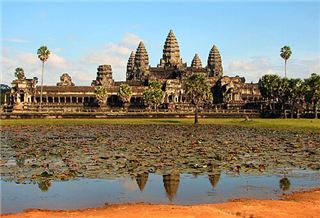
- early 12th centuryAngkor Wat is built as a temple to Vishnu under the Khmer king Suryavarman II
- 1893Swami Vivekananda introduces Hinduism to the World’s Parliament of Religions in Chicago
- 1950The constitution of the Republic of India abolishes untouchability
Spread through the centuries
Where it began, how it spread, and where it was a main faith (a bright glow) or held communities (a faint one), century by century to today. Press Play or move the slider, turn the globe, and tap a glow or a mark to read about it.
The map opens here once the page has loaded.
Origins

Hinduism has no founder and no single moment of origin. It is the name given, from the outside and only in modern times, to a vast family of traditions that grew up in the Indian subcontinent over more than three thousand years. The word “Hindu” comes from the Persian name for the people beyond the Indus river, the Sindhu; “Hinduism” as the name of a religion came into use in English in the early 19th century. Hindus themselves have often spoken of the sanatana dharma, the “eternal order”.
Its oldest recorded root is the religion of the Vedas, brought into the north-west of the subcontinent by speakers of Indo-Aryan languages in the second millennium BCE. The hymns of the Rigveda, composed in an early form of Sanskrit perhaps between 1500 and 1200 BCE, praise gods of nature and order such as Indra, Agni and Varuna and accompany sacrifices performed by priests around a sacred fire. For centuries they were transmitted by memory alone, with remarkable precision.
Over the following centuries Vedic religion changed. Ritual specialists, the Brahmins, developed elaborate sacrificial systems; then the Upanishads, composed from about the 8th century BCE, turned inward, asking about the nature of the self and of ultimate reality and teaching that the two are one. At the same time movements of wandering ascetics, from which Buddhism and Jainism also grew, challenged the authority of the Vedas and the value of sacrifice.
Between about 500 BCE and 500 CE the main features of classical Hinduism took shape. The great epics, the Mahabharata and the Ramayana, told the stories of gods and heroes; law books defined dharma, the duties of each class and stage of life; and devotion to personal gods, above all Vishnu and Shiva, grew alongside the older rites. Under the Gupta Empire of the 4th to 6th centuries, stone temples, sculpture and the Puranas, encyclopaedic collections of myth and ritual, gave this religion its classical form.
Hinduism also absorbed countless local traditions: village goddesses, the worship of trees, rivers and snakes, and the gods of peoples who came into the orbit of Sanskrit culture. Whether elements of it go back to the cities of the Indus Valley civilisation, as some scholars have suggested from its seals and figurines, remains uncertain.
Beliefs & Practice
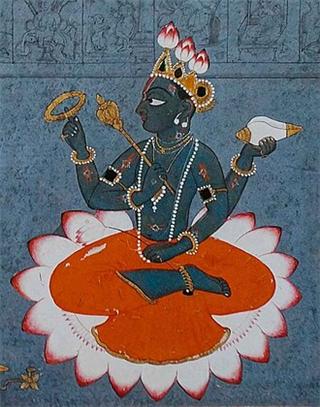
Hindu traditions differ greatly in their gods, practices and philosophies, but most share a set of ideas. Dharma is the order of the universe and the duty of each being within it. Karma is the law that actions bring their consequences, in this life or the next. Samsara is the cycle of birth, death and rebirth through which the soul passes according to its karma. Moksha is release from that cycle, the highest goal of life.
Classical texts describe four aims of human life: dharma, righteousness; artha, prosperity; kama, pleasure; and moksha, release. They also describe four stages of life for men of the higher classes: student, householder, forest dweller and renouncer. The paths to release are usually described as three: the way of action performed without attachment (karma yoga), the way of knowledge (jnana yoga) and the way of loving devotion to God (bhakti yoga), all of them taught in the Bhagavad Gita.
Most Hindus worship one or more personal gods, often understood as forms of a single ultimate reality. The major traditions are devoted to Vishnu, who descends to earth in incarnations (avatars) such as Rama and Krishna; to Shiva, the ascetic and the lord of creation and destruction; and to the Goddess, Devi, in forms such as Durga, Kali, Lakshmi and Parvati. Ganesha, the elephant-headed remover of obstacles, is honoured at the start of almost every undertaking.
Worship (puja) takes place at home shrines and in temples, where the image of the deity is treated as a living presence: bathed, dressed, offered food and lamps, and viewed by worshippers in the act of darshan, seeing and being seen by the god. Pilgrimage to sacred rivers and cities such as Varanasi on the Ganges, and festivals such as Diwali, the festival of lights, and Holi, the festival of colours, mark the year. Rites of passage, the samskaras, accompany birth, initiation, marriage and death; the dead are usually cremated.
Philosophers built sophisticated systems on these foundations. The school of Vedanta, based on the Upanishads, divided between Advaita, which holds that the self and Brahman are identical and the world of distinctions an illusion, and schools that keep a real distinction between the soul and a personal God.
Texts & Teachers

Hindu scriptures are traditionally divided into two classes. Shruti, “what is heard”, is revealed knowledge received by the ancient seers: the four Vedas, the Rigveda, Samaveda, Yajurveda and Atharvaveda, each with its Brahmanas, ritual commentaries; Aranyakas, forest treatises; and Upanishads, philosophical dialogues. Smriti, “what is remembered”, is the tradition built upon them: the epics, the Puranas, the law books and many other works.
The Mahabharata, at about 100,000 verses one of the longest poems in the world, tells of the war between two branches of a royal family. Within it stands the Bhagavad Gita, a dialogue on the battlefield between the warrior Arjuna and his charioteer Krishna, revealed as God, on duty, devotion and the nature of the self; it has become the best known of all Hindu texts. The Ramayana, ascribed to the poet Valmiki, tells of the exile of Prince Rama, the abduction of his wife Sita by the demon king Ravana and her rescue; retold in countless versions, among them the Ramcharitmanas of Tulsidas in the 16th century, it is performed across South and Southeast Asia.
The law books, of which the Manusmriti is the most famous, set out the duties of the classes and stages of life. The Puranas, compiled from the Gupta period onwards, gathered myths of creation, genealogies of gods and kings, and instructions for worship and pilgrimage.
Great teachers shaped the tradition. Shankara, in the 8th century, taught the non-dual Advaita Vedanta; Ramanuja, in the 11th and 12th centuries, taught a qualified non-dualism that made room for devotion to a personal God; Madhva, in the 13th, taught a dualism of God and souls. The Tamil poet-saints, the Alvars devoted to Vishnu and the Nayanars devoted to Shiva, composed hymns from the 6th to the 9th centuries that launched the bhakti movement, which later spread north through poets such as Mirabai and Tulsidas. In modern times Ramakrishna, Vivekananda and Mohandas Gandhi gave Hindu ideas new forms and a world audience.
Spread
Hinduism grew across the subcontinent as Sanskrit culture spread from the north into the south, east and the Himalayas, carried by Brahmins, ascetics, merchants and kings who sponsored temples and rites. Royal patronage made it the religion of most Indian kingdoms, from the Guptas to the Cholas of the south, whose great temple at Thanjavur was completed around 1010.
Through trade and the courts of Southeast Asia, Hindu gods, epics and ideas of kingship travelled across the Bay of Bengal. From the early centuries CE, kingdoms in Funan, Champa, Java and the Khmer lands adopted Sanskrit, Hindu rites and the worship of Shiva and Vishnu, often alongside Buddhism. Angkor Wat, built in the early 12th century for the Khmer king Suryavarman II, was dedicated to Vishnu, and the temples of Prambanan in Java to Shiva in the 9th century. Islam later became the main religion of Java, but Bali has remained Hindu to this day, and the Ramayana is still performed in dance and puppet theatre across the region.
From the end of the 12th century Muslim dynasties ruled much of northern India, first the Delhi Sultanate and from the 16th century the Mughal Empire. Hinduism remained the religion of most of the population, and the long encounter produced conflict and destruction of temples but also exchange: the bhakti poets and the Sufis shared ideas, and figures such as Kabir drew on both traditions.
In the 19th century, under British rule, reformers responded to Christian missionaries and Western criticism. Ram Mohan Roy founded the Brahmo Samaj in 1828 to promote a rational, monotheistic Hinduism; Dayananda Saraswati founded the Arya Samaj in 1875 to return to the Vedas; and Swami Vivekananda’s address to the World’s Parliament of Religions in Chicago in 1893 introduced Hindu philosophy to Western audiences.
Indentured labourers taken from India by the British in the 19th century founded Hindu communities in Mauritius, Fiji, Trinidad, Guyana and South Africa, and migration in the 20th century carried Hinduism to Britain, North America and the Gulf.
Community & Society

Hindu society has been organised for much of its history by the system of varna and jati. The law books describe four varnas, or classes: Brahmins, priests and teachers; Kshatriyas, rulers and warriors; Vaishyas, merchants and farmers; and Shudras, labourers and servants. In practice society was divided into thousands of jatis, hereditary groups linked to occupation and region that governed marriage, diet and social contact. Below them were communities treated as “untouchable”, subjected to severe discrimination. Caste has been criticised from within Hinduism, by bhakti poets who taught that devotion makes all equal and by modern reformers including Gandhi and B. R. Ambedkar, and the constitution of the Republic of India abolished untouchability in 1950, though caste remains a force in social and political life.
Temples have long been centres of community life and wealth. Medieval South Indian temples owned land, employed priests, musicians, dancers and craftsmen, lent money and fed pilgrims. Monasteries founded by Shankara and later teachers, and the orders of ascetics, the sadhus and sannyasins, preserved learning and teaching.
Much Hindu religious life takes place in the home: daily worship at the household shrine, the rites of the family’s life cycle, vegetarian diet in many communities, and the observance of fasts and festivals. Women have often been the keepers of household rites and devotional song, and some of the greatest bhakti poets, such as Mirabai and the Tamil saint Andal, were women; women also faced restrictions in the classical law books, and practices such as the burning of widows, sati, were opposed by reformers and banned under British rule in 1829.
Hinduism has no central authority. Teachers, gurus, temple traditions and regional customs carry it. In the 20th and 21st centuries it has also become a political identity: Hindu nationalism, which seeks to define India as a Hindu nation, has been a major force in Indian politics, while India’s constitution establishes a secular state.
Legacy
Hinduism is the world’s third-largest religion, with about 1.2 billion followers, the great majority of them in India, where it is the faith of about four in five people, and in Nepal. It is also one of the oldest living religious traditions, with scriptures in continuous recitation for three thousand years.
Its influence reaches far beyond its followers. The religions of Buddhism, Jainism and Sikhism grew in dialogue with it and share many of its ideas, such as karma and rebirth. The Sanskrit literature it produced, from the Vedas and the epics to drama and poetry, is one of the great literatures of the world, and its stories are told in the arts of all of South and Southeast Asia.
Hindu philosophy, from the Upanishads to Vedanta, influenced thinkers in Europe and America from the 19th century onwards, among them Arthur Schopenhauer and the American Transcendentalists. Practices of yoga and meditation, rooted in Hindu traditions and the Yoga Sutras of Patanjali, have spread worldwide in adapted forms, and Gandhi’s non-violent resistance, inspired in part by the Bhagavad Gita, shaped movements for civil rights across the world.
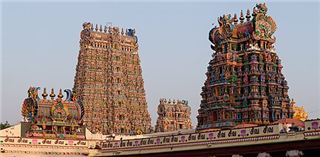
Hindu temple architecture produced some of the great monuments of Asia, from the temples of Khajuraho and the Meenakshi temple at Madurai to Angkor Wat and Prambanan. Classical music and dance traditions such as Bharatanatyam grew from temple performance. Its festivals, Diwali above all, are now celebrated in cities around the world.
Hinduism, which grew from the Vedic religion of ancient India and absorbed many local traditions, has no founder or single creed but shares the ideas of dharma, karma, rebirth and release and devotion to gods such as Vishnu, Shiva and the Goddess. Its scriptures, temples and philosophies shaped South and Southeast Asia, and today it is the world’s third-largest religion.
References
- Doniger, W. (2009) The Hindus: An Alternative History. New York: Penguin Press.
- Flood, G. (1996) An Introduction to Hinduism. Cambridge: Cambridge University Press.
- Klostermaier, K.K. (2007) A Survey of Hinduism. 3rd edn. Albany: State University of New York Press.
- Knott, K. (2016) Hinduism: A Very Short Introduction. 2nd edn. Oxford: Oxford University Press.
- Lipner, J. (2010) Hindus: Their Religious Beliefs and Practices. 2nd edn. London: Routledge.
- Michaels, A. (2004) Hinduism: Past and Present. Princeton: Princeton University Press.