
Religion · Americas
Mesoamerican religion
At a glance
- For three thousand years the peoples of Mesoamerica, from the Olmecs to the Maya and the Aztecs, shared a religion of gods of rain, maize, sun and wind, of sacred mountains and caves, and of time measured by interlocking calendars.
- Kings and priests offered the gods incense, their own blood and, at times, human lives in pyramid temples, to repay the gods who, in the myths, had sacrificed themselves to set the sun moving and to create humanity.
- Suppressed after the Spanish conquest, it survives in a handful of painted books, the Popol Vuh, the ruins of its temple cities and traditions, such as the 260-day calendar, still kept in Maya communities.
Timeline
- c. 1200 BCEThe Olmec centre of San Lorenzo flourishes on the Gulf Coast of Mexico, with the earliest monumental religious art of Mesoamerica
- c. 200The Pyramid of the Sun is completed at Teotihuacan, the city the Aztecs later believed to be the birthplace of the sun
- 292Stela 29 is raised at Tikal, the earliest known dated monument of the Maya lowlands
- 1325The Mexica found Tenochtitlan, by tradition where their god Huitzilopochtli had promised
- 1487The Great Temple of Tenochtitlan is rededicated with the sacrifice of many captives
- 1521The fall of Tenochtitlan to the Spanish and their allies ends the Aztec state religion
- 1562The friar Diego de Landa burns Maya books and images at Maní in Yucatán
- 1697The Spanish take Nojpetén, capital of the Itza, the last independent Maya kingdom
Spread through the centuries
Where it began, how it spread, and where it was a main faith (a bright glow) or held communities (a faint one), century by century to its last places. Press Play or move the slider, turn the globe, and tap a glow or a mark to read about it.
The map opens here once the page has loaded.
Origins

Mesoamerica, the region stretching from central Mexico to Honduras and El Salvador, was home to many peoples speaking different languages, but they shared a common civilisation: the cultivation of maize, beans and squash, cities with pyramid temples and plazas, a ritual ballgame, writing and books, interlocking calendars, and a common religious world view. That religion developed over three thousand years, with each people adding its own gods, myths and rituals.
The Olmecs, who flourished on the Gulf Coast of Mexico from about 1200 to 400 BCE at centres such as San Lorenzo and La Venta, created the first great religious art of the region: colossal stone heads, probably of rulers, jade figures, and images of supernatural beings combining human and jaguar features, as well as early forms of the maize god and the feathered serpent. Even earlier, around 1600 BCE, rubber balls were offered with other gifts in a sacred spring at El Manatí.
In the following centuries the Zapotecs of Oaxaca built Monte Albán, from about 500 BCE, and recorded early dates and names in writing. The great city of Teotihuacan, near present-day Mexico City, dominated central Mexico from the 1st to the 6th centuries CE; its Pyramid of the Sun, completed around 200 CE, the Pyramid of the Moon and the Temple of the Feathered Serpent, at whose foundation some two hundred people were sacrificed, made it a sacred city whose ruins the Aztecs later revered.
In the Maya lowlands of southern Mexico and Guatemala, Classic Maya kings, from the 3rd to the 9th centuries, ruled as holy lords who mediated between gods and people. Their carved stelae, the earliest dated example of which was raised at Tikal in 292, show them performing rituals of bloodletting, dancing in the guise of gods and marking the endings of periods of time.
Beliefs & Practice
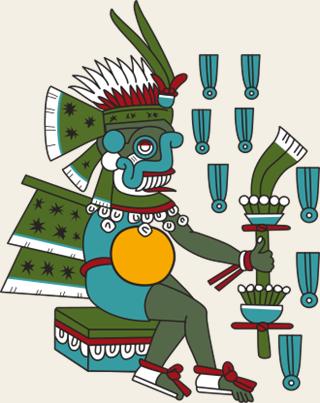
The Mesoamerican peoples worshipped many gods, who were not fixed personalities but forces with many aspects, which could merge, divide and change form. Among the most widespread were the rain and storm god, called Tlaloc by the Aztecs and Chaak by the Maya, who lived in mountains and brought the rain on which maize depended; the Feathered Serpent, Quetzalcoatl to the Aztecs and K’uk’ulkan to the Maya of Yucatán, a god of wind, priesthood and learning; the sun god; the young maize god, whose death and rebirth mirrored the planting and harvest of maize; and the gods of death and the underworld. The Aztecs also worshipped Tezcatlipoca, “Smoking Mirror”, the powerful god of night, fate and sorcery, and Huitzilopochtli, the sun and war god who was the patron of the Mexica.
The universe was imagined as layered, with heavens above and an underworld below, and divided into four directions around a centre, each with its own colour, gods and sacred tree. Mountains were sources of water and life, and caves were entrances to the underworld; pyramids were artificial sacred mountains, and the Aztec word for a city-state, altepetl, means “water-mountain”.
The myths taught that the world had been created and destroyed several times. According to the Aztec account, four earlier suns had ended in catastrophe; the present, fifth sun was born at Teotihuacan when a humble god threw himself into a fire and rose as the sun, and the other gods sacrificed themselves to set it moving. Quetzalcoatl created the present humanity from the bones of earlier people, brought back from the underworld, sprinkled with his own blood. The K’iche' Maya told in the Popol Vuh how the gods had made people of mud and then of wood before they succeeded, making the first true humans from maize dough.
Because the gods had given their lives and blood to create and sustain the world, humans owed them a debt of blood. Offerings of incense, rubber, food, jade and precious feathers were made to them, and nobles and priests drew their own blood with stingray spines and maguey thorns. Human sacrifice, of captives taken in war and others, was practised across Mesoamerica and reached its greatest scale under the Aztecs, whose priests offered the hearts of victims to the sun on the summit of the Great Temple. Its extent has long been debated: early Spanish figures are now regarded as exaggerated, but the skull racks excavated in Mexico City since 2015 confirm that it was carried out on a large scale.
Time itself was sacred. A ritual calendar of 260 days, made of twenty named days combined with the numbers one to thirteen, governed divination and the fate of every person born on a given day; it meshed with a solar year of 365 days to form a cycle of 52 years, at whose end the Aztecs extinguished all fires and kindled a new one, to ensure that the sun would rise again.
Texts & Teachers
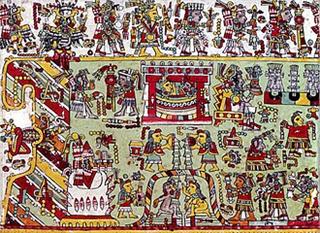
Mesoamerica was the only region of the Americas where full writing systems developed, and the Maya script, which combined signs for words and syllables, could record any sentence of the Maya languages. Largely deciphered in the second half of the 20th century, following the work of Yuri Knorozov and Tatiana Proskouriakoff, it now allows scholars to read the inscriptions in which Maya kings recorded their rituals, their accessions and their dealings with the gods.
The peoples of Mesoamerica wrote and painted books on long strips of bark paper or deerskin, coated with lime and folded like screens, which were kept by priests and used for divination, ritual and history. Almost all were destroyed by the Spanish. Only four Maya books survive: the Dresden Codex, with its tables of the movements of Venus and the eclipses, and the codices of Madrid, Paris and Mexico City. From central Mexico a small number of painted religious books survive, among them the Codex Borgia, a divinatory almanac of the 260-day calendar filled with images of the gods.
After the conquest, Indigenous scholars and Spanish friars recorded much of the old religion. The Franciscan Bernardino de Sahagún worked for decades with Nahua scholars to compile the Florentine Codex, completed in the 1570s, a twelve-book encyclopaedia of Aztec gods, rituals, beliefs and society, written in Nahuatl and Spanish and illustrated by Nahua artists; it remains the most important source for Aztec religion.
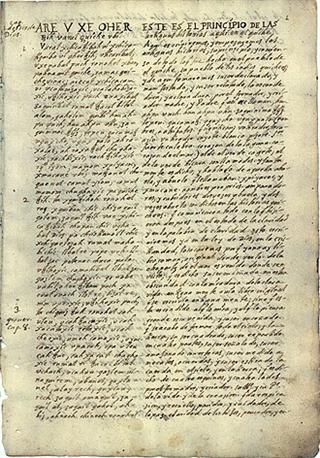
The greatest surviving work of Maya religious literature is the Popol Vuh, the “Book of the Council” of the K’iche' Maya of Guatemala, written in the K’iche' language in Latin letters by K’iche' nobles in the mid-16th century and preserved in a copy made by the friar Francisco Ximénez around 1701. It tells of the creation of the world, of the hero twins Hunahpu and Xbalanque, who defeat the lords of the underworld, Xibalba, in a ballgame and rise as the sun and moon, and of the making of humans from maize. The colonial books of Chilam Balam preserve the prophecies and calendars of the Maya of Yucatán.
Spread
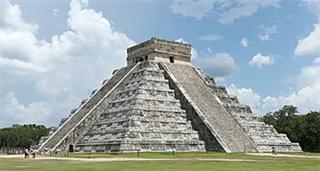
The religious ideas of Mesoamerica spread through trade, conquest and the prestige of great cities. Olmec symbols appear across the region in the early 1st millennium BCE; Teotihuacan’s influence reached the Maya cities, where in 378 its warriors installed a new dynasty at Tikal; after Teotihuacan’s fall, the cult of the Feathered Serpent flourished at Tula, the city of the Toltecs, and at Chichén Itzá in Yucatán, whose Sacred Cenote received offerings of jade, gold and human lives.
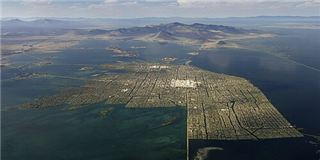
The Mexica, or Aztecs, arrived in the Valley of Mexico as newcomers and, by their tradition, founded Tenochtitlan in 1325 on an island in Lake Texcoco, where their god Huitzilopochtli had promised they would see an eagle on a cactus. As they built an empire in the 15th century, their Great Temple, with twin shrines to Huitzilopochtli and the rain god Tlaloc, was enlarged seven times; it was rededicated in 1487 with the sacrifice of a great number of captives, and the empire spread the worship of Huitzilopochtli while honouring the gods of conquered peoples.
The Spanish conquest brought the destruction of the public religion. After the fall of Tenochtitlan in 1521, the Great Temple was demolished and a cathedral built nearby; Franciscan, Dominican and Augustinian missionaries baptised millions, destroyed temples, images and books, and punished those who continued the old worship. In 1539 a noble of Texcoco, Don Carlos Ometochtzin, was burned for idolatry, and in 1562 Diego de Landa burned the books and images of the Maya at Maní. The last independent Maya kingdom, the Itza capital of Nojpetén in Guatemala, fell to the Spanish in 1697.
The old religion did not vanish entirely. Many communities blended their traditions with Catholicism, honouring saints in ways that recalled the old gods, keeping offerings for the dead and agricultural rituals, and turning to healers and diviners. In the highlands of Guatemala, Maya day-keepers still count the 260-day calendar, perform ceremonies at mountains and caves and guide their communities.
Community & Society
Religion and power were inseparable in Mesoamerica. Maya kings were holy lords who performed the most important rituals themselves, drawing blood from their bodies, dancing as gods and dedicating monuments; on famous carved lintels at Yaxchilan, Lady K’abal Xook draws a thorned rope through her tongue and then beholds a vision serpent. Aztec rulers were also high priests of the state cult, and their coronation required wars to take captives for sacrifice.
The Aztecs had a large professional priesthood. Two high priests served the shrines of Huitzilopochtli and Tlaloc, and priests and priestesses served every temple; male priests painted their bodies black and wore their hair long and matted with blood from their offerings. Noble boys were educated in priestly schools, the calmecac, which taught writing, the calendar, astronomy, songs and history.
The Aztec year was divided into eighteen periods of twenty days, each with its festival of offerings, dances, processions and sacrifices: in the festival of Toxcatl, a young man who had lived for a year as the image of the god Tezcatlipoca, honoured and richly dressed, was sacrificed. Shrines drew pilgrims from afar, such as Cholula, the sacred city of Quetzalcoatl with the largest pyramid in the world by volume, and the island of Cozumel, where women came to the goddess of childbirth, Ix Chel.
The ballgame, played with a heavy rubber ball in courts built within the sacred precincts of cities, was both a sport and a ritual re-enacting the movements of the heavenly bodies and the struggles of the myths; the Great Ballcourt of Chichén Itzá is the largest in Mesoamerica.
In daily life, families made offerings at household altars, consulted day-keepers on the naming of children, marriages and journeys, and turned to midwives and healers whose rituals invoked the gods of birth, rain and earth.
Legacy
Mesoamerican religion created some of the most remarkable sacred cities in the world: Teotihuacan, Monte Albán, Palenque, Tikal, Chichén Itzá and the Great Temple of Tenochtitlan, uncovered in the heart of Mexico City since the chance discovery of a great carved stone of the goddess Coyolxauhqui in 1978. Its priests’ observations of the sky, preserved in the Venus tables of the Dresden Codex, and the Maya calendar, with its sign for zero, are among the great achievements of ancient science.
The Popol Vuh is a classic of world literature, and the Florentine Codex an unrivalled record of a civilisation in its own words. The modern decipherment of Maya writing has allowed the voices of Maya kings to be heard again after more than a thousand years.
Mesoamerican traditions live on in the religious life of Mexico and Central America: in the Day of the Dead, with its offerings to returning ancestors, in the cult of saints and sacred places, and in the ceremonies of Maya day-keepers, whose spirituality Guatemala recognised in the peace accords of the 1990s. The gods and symbols of the old religion, the feathered serpent and the eagle on the cactus at the centre of the Mexican flag, are part of national identity.
The memory of human sacrifice, used by the conquerors to justify the destruction of Indigenous religion, has long dominated popular images of Mesoamerica. Modern scholarship has sought to understand it within a world view in which the gods themselves had died to create the world, and in which the survival of the sun depended on human devotion.
Mesoamerican religion, shared for three thousand years by the Olmecs, Zapotecs, Maya, Teotihuacanos and Aztecs, worshipped gods of rain, maize, the sun and the feathered serpent in pyramid temples, measured sacred time with the 260-day calendar and repaid the gods with offerings of blood. Suppressed after the Spanish conquest, it survives in painted books, the Popol Vuh, great ruined cities and living Maya traditions.
References
- Carrasco, D. (2014) Religions of Mesoamerica. 2nd edn. Long Grove: Waveland Press.
- Christenson, A.J. (trans.) (2003) Popol Vuh: The Sacred Book of the Maya. Winchester: O Books.
- Coe, M.D. (1992) Breaking the Maya Code. London: Thames & Hudson.
- López Austin, A. (1988) The Human Body and Ideology: Concepts of the Ancient Nahuas. Salt Lake City: University of Utah Press.
- Miller, M. and Taube, K. (1993) The Gods and Symbols of Ancient Mexico and the Maya. London: Thames & Hudson.
- Sahagún, B. de (1950–1982) Florentine Codex: General History of the Things of New Spain. Translated by A.J.O. Anderson and C.E. Dibble. Santa Fe: School of American Research.