Sub-Saharan Africa
Kilwa Sultanate
At a glance
- An island sultanate off southern Tanzania that grew rich as the middleman between the gold of the Zimbabwe plateau and the Indian Ocean.
- Its Great Mosque, the palace of Husuni Kubwa and its copper coinage made Kilwa a showpiece of medieval Swahili culture.
- Factional strife weakened it in the 15th century, and the Portuguese sack of 1505 ended its power on the coast.
Rise & Fall
- c. 957Traditional date for the founding of the dynasty by Ali ibn al-Hasan of Shiraz
- c. 1277The Mahdali dynasty, of Yemeni origin, seizes power in Kilwa
- c. 1310Al-Hasan ibn Sulaiman becomes sultan and begins the palace of Husuni Kubwa
- c. 1331Ibn Battuta visits Kilwa and praises the generosity of its sultan
- 1502Vasco da Gama forces Emir Ibrahim to pay tribute to Portugal
- 1505Francisco de Almeida sacks Kilwa and builds Fort Santiago
- 1512The Portuguese withdraw their garrison from Kilwa
- 1981The ruins of Kilwa Kisiwani and Songo Mnara become a UNESCO World Heritage Site
Foundation
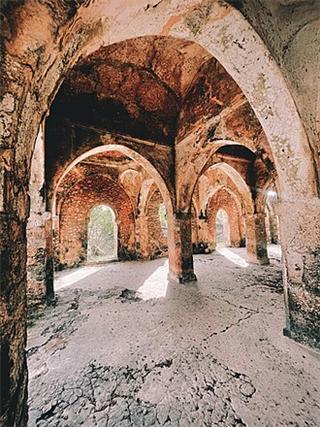
Kilwa Kisiwani is a small island off the southern coast of present-day Tanzania, about 300 kilometres south of Dar es Salaam, with a sheltered harbour well placed for ships sailing on the monsoon winds. Excavation and radiocarbon dating show that people settled there in the 9th century, building a town of earth-and-timber houses whose inhabitants fished, farmed and traded along the coast. The ruling dynasty’s own account of its origins survives in the Kilwa Chronicle, written down in the 16th century in an Arabic version and in a Portuguese version preserved by the historian João de Barros. It tells how Ali ibn al-Hasan, a son of a ruler of Shiraz in Persia by an Abyssinian mother, was driven out by his brothers, sailed south with his household and bought the island from a local king for a quantity of cloth. Historians conventionally date this founding to about 957, but the story is a dynastic tradition rather than a record, and archaeologists still debate when Ali ibn al-Hasan, in whose name copper coins were struck, actually reigned. A study of ancient DNA published in 2023 found that by about 1000 men of largely Persian ancestry were having children with African women along the Swahili coast, including at Kilwa, which lends some support to the Chronicle’s tradition of Persian settlers.
Socioeconomy
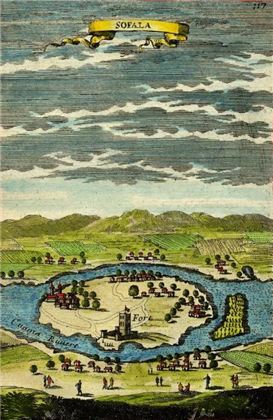
Kilwa lived by trade. Its merchants were middlemen between the African interior and the Indian Ocean: gold from the Zimbabwe plateau, shipped through the port of Sofala, and ivory from the mainland were exchanged for Indian cotton cloth and glass beads, Persian glazed earthenware, Chinese porcelain, silver, carnelian and perfumes, carried by ships that sailed with the monsoon to Arabia and India. Enslaved Africans, taken in raids on the mainland, were also among the goods traded. From about the 11th century Kilwa’s rulers struck their own copper coins, which circulated widely along the coast. The townspeople were Swahili-speaking Sunni Muslims of the Shafi’i school, and Ibn Battuta, who visited around 1331, noted that most of them were Africans. Society was sharply ranked. The ruling family and wealthy merchant households lived in houses of coral stone and lime mortar, and the grandest buildings had Chinese porcelain bowls set into their domes and plaster, while most people lived in houses of earth and thatch. Food came partly from the island’s fields and coconut palms and partly from grain and cattle bought on the mainland. Nearby islands shared in this prosperity: on Songo Mnara a walled stone town with several mosques, a palace and dozens of stone houses grew up in the 14th and 15th centuries.
Military

Kilwa had no large standing army, and its power rested more on wealth, alliances and control of harbours than on force. Its sultans did lead armed expeditions onto the mainland: Ibn Battuta wrote that the people of Kilwa were constantly campaigning against their non-Muslim neighbours, and that Sultan al-Hasan ibn Sulaiman gave a fifth of the booty to pious causes. The Kilwa Chronicle records wars with mainland peoples, in one of which a sultan was killed in the mid-14th century, as well as coups in which rival factions seized the town. The walled enclosure of Husuni Ndogo, with towers at its corners, may have served as a fort, though its purpose is uncertain. Kilwa’s sewn ships were built for trade rather than war, and the town could not resist Portuguese fleets armed with cannon. In 1502 Vasco da Gama, commanding the fourth Portuguese fleet sent to India, forced Emir Ibrahim to agree to pay tribute under threat of attack. On 24 July 1505 Francisco de Almeida landed about 500 men in two columns; the defenders fought from the rooftops with arrows and stones, but the Emir escaped to the mainland and the town was sacked. Almeida then built a fort, Fort Santiago, and left a garrison to hold Kilwa for Portugal.
Governance & Law
The sultan of Kilwa stood at the head of the state, but his power depended on the town’s leading families. According to the Kilwa Chronicle, the throne passed within the ruling house, often between brothers, and the people of Kilwa more than once deposed a ruler they rejected. Tradition attributes the first dynasty to the Shirazi founders; in the late 13th century power passed by force to the Mahdali, a family of Yemeni origin, under al-Hasan ibn Talut. The Mahdali sultans presented themselves as pious Muslim rulers. Al-Hasan ibn Sulaiman, who reigned from about 1310 to 1333, was acclaimed while on pilgrimage to Mecca, bore the name Abu al-Mawahib, ‘father of gifts’, and had his name inscribed on his new palace, while coins carrying the sultans’ names proclaimed their authority. The chief ministers were the vizier and the emir, and in the 15th century these officials became kingmakers: according to the Chronicle, from about 1478 Emir Muhammad Kiwabi set up and removed sultans for nearly two decades. Kilwa’s authority over the other towns of the southern coast, such as Mafia and Sofala, was loose, exercised through governors or allied local rulers rather than a central bureaucracy, and it fell apart after Emir Ibrahim murdered Sultan al-Fudail around 1499 and seized power.
Global & Regional Impact

Kilwa’s demand for gold tied the Swahili coast to the states of the southern African interior. Gold mined on the Zimbabwe plateau reached the Indian Ocean through Sofala and Kilwa, a copper coin minted at Kilwa has been found at Great Zimbabwe, and the wealth of this trade helped to sustain both the coastal towns and the stone-built capitals inland. Kilwa’s buildings set standards for Swahili architecture. The Great Mosque of Kilwa, whose oldest part dates from the 11th or 12th century, was enlarged in the 13th or early 14th century with a domed extension; it is the oldest standing mosque on the East African coast, and its great dome remained the largest in East Africa until the 19th century. The palace of Husuni Kubwa, built for al-Hasan ibn Sulaiman between about 1310 and 1333, had more than a hundred rooms and an octagonal bathing pool. The Kilwa Chronicle is the oldest surviving history told by people of the Swahili coast, and traditions of Shirazi origins like those it records were told in many coastal towns. Portuguese accounts made Kilwa’s name known in Europe, and John Milton’s Paradise Lost (1667) lists ‘Quiloa’ beside Mombasa, Malindi and Sofala. Since 1981 the ruins of Kilwa Kisiwani and nearby Songo Mnara have been a UNESCO World Heritage Site.
Decline & Fall
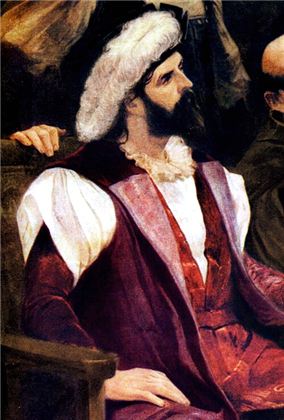
Kilwa’s fortunes faltered after the death of al-Hasan ibn Sulaiman around 1333. Husuni Kubwa was left unfinished and abandoned, and the Chronicle records a rapid turnover of sultans in the decade after 1356. The 15th century brought a recovery, when Sultan Sulaiman ibn Muhammad was remembered for rebuilding the Great Mosque, but also growing factional strife, as viziers and emirs made and unmade rulers. By 1500 the usurpation of Emir Ibrahim had loosened Kilwa’s hold on its dependencies, and Sofala’s ruler dealt with the Portuguese on his own account. After Pedro Álvares Cabral’s visit in 1500 and Vasco da Gama’s demand for tribute in 1502, Francisco de Almeida took the town in July 1505 and installed a client sultan. The client sultan was murdered in 1506, rival claimants fought in the streets and many inhabitants fled, while from a fort built at Sofala in 1505 the Portuguese tried to take over the gold trade. In 1512 King Manuel I of Portugal had the garrison withdrawn, and Kilwa remained only a nominal vassal. Its sultans ruled on over a much reduced town: raiders whom the Portuguese called Zimba sacked it in the late 1580s, it came under Omani authority in the 18th century, and by the mid-19th century the island town had been abandoned in favour of Kilwa Kivinje on the mainland.
The Kilwa Sultanate was the leading power of the southern Swahili coast from the 13th to the 15th century, linking the gold of the Zimbabwe plateau to the Indian Ocean, and its mosques, palace, coinage and Chronicle mark a high point of medieval Swahili civilisation until the Portuguese sack of 1505 broke its power.
References
- Chittick, H.N. (1974) Kilwa: An Islamic Trading City on the East African Coast. 2 vols. Nairobi: British Institute in Eastern Africa.
- Freeman-Grenville, G.S.P. (1962) The East African Coast: Select Documents from the First to the Earlier Nineteenth Century. Oxford: Clarendon Press.
- Horton, M. and Middleton, J. (2000) The Swahili: The Social Landscape of a Mercantile Society. Oxford: Blackwell.
- Ibn Battuta (1962) The Travels of Ibn Battuta, A.D. 1325–1354, vol. II. Trans. H.A.R. Gibb. Cambridge: Cambridge University Press for the Hakluyt Society.
- Pearson, M.N. (1998) Port Cities and Intruders: The Swahili Coast, India, and Portugal in the Early Modern Era. Baltimore: Johns Hopkins University Press.
- Wynne-Jones, S. (2016) A Material Culture: Consumption and Materiality on the Coast of Precolonial East Africa. Oxford: Oxford University Press.
Connections
Open the full connections map →