Europe
Hellenic Republic
At a glance
- Turkey's invasion of Cyprus on 20 July 1974, after a Greek-backed coup there, brought down the junta; Konstantinos Karamanlis returned, the first multiparty elections since 1964 were held, and a 1975 referendum rejected the monarchy.
- Greece became the tenth member of the European Communities in 1981, adopted the euro in January 2001 and hosted the 2004 Summer Olympic Games in Athens; New Democracy and PASOK alternated in power for four decades.
- The debt crisis from 2010 brought bailouts of 110 billion and 130 billion euros, a 25% fall in GDP between 2009 and 2015 and the emigration of 350,000 to 450,000 people before the bailouts ended in 2018.
Rise & Fall
- 1974Turkey invades Cyprus on 20 July after a Greek-backed coup; the junta collapses, Konstantinos Karamanlis returns and the first multiparty elections since 1964 are held.
- 1975A democratic and republican constitution is promulgated after a referendum chooses not to restore the monarchy.
- 1981Greece becomes the tenth member of the European Communities; Andreas Papandreou's PASOK comes to power.
- 2001The euro replaces the drachma in January.
- 2004Athens hosts the Summer Olympic Games.
- 2010A 110 billion euro rescue package from the eurozone and the IMF averts default; harsh austerity follows.
- 2018The bailouts end; Alexis Tsipras and Zoran Zaev sign the Prespa Agreement, settling the Macedonia naming dispute.
- 2019Kyriakos Mitsotakis of New Democracy becomes prime minister; re-elected in June 2023 with 158 seats.
Foundation
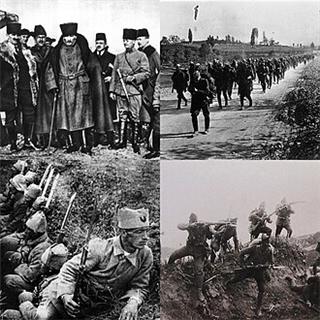
The Third Hellenic Republic was born of the failure of a dictatorship. Greece had become a modern nation state in 1830 after its war of independence, doubled its territory in the Balkan Wars, lost the Greco-Turkish War of 1919–1922 and absorbed over 1.5 million refugees from Asia Minor. A republic of 1924 fell to a royalist coup in 1935, and Ioannis Metaxas's 4th of August Regime of 1936 opened an authoritarian era that lasted, through occupation and the civil war that ended in 1949, until 1974. In 1967 a group of colonels under Georgios Papadopoulos seized power; civil rights were suspended and torture was rampant. The brutal suppression of the Athens Polytechnic uprising in 1973 brought a counter-coup under Brigadier Dimitrios Ioannidis.
On 20 July 1974 Turkey invaded Cyprus in answer to a Greek-backed Cypriot coup. The crisis broke the regime and democracy was restored in the Metapolitefsi. Konstantinos Karamanlis, the dominant politician of the post-war years, was invited back from self-exile, and the first multiparty elections since 1964 were held on the first anniversary of the Polytechnic uprising. A referendum chose not to restore the monarchy, and a democratic and republican constitution was promulgated in 1975. The new republic governed a mountainous peninsula at the southern end of the Balkans with the longest coastline in the Mediterranean, up to 227 inhabited islands and some ten million people, its capital Athens and its co-capital Thessaloniki.
Socioeconomy
Greece entered the republic on the record growth of 1950 to 1973, and membership of the European Communities from 1981 brought sustained growth through industrial investment, infrastructure, European funds, tourism, shipping and a fast-growing service sector. Andreas Papandreou's social reforms of the 1980s recognised civil marriage, abolished the dowry and widened education and health care, but his economic policies left stagflation and chronic deficits. Today the economy is advanced and high-income, the 15th largest in the European Union, with services at 85% of output, industry 12% and agriculture 3%. Manufacturing shrank sharply after 1980; the main exports in 2025 were refined petroleum, food, manufactured goods and chemicals.
Two sectors stand out. Tourism contributed 21% of GDP in 2018 and drew 33 million visitors in 2023, making Greece the ninth most visited country. Shipping, 5% of GDP and 160,000 jobs, rests on the world's largest merchant fleet, 18% of global capacity; it was built from surplus American ships after the war and nearly doubled in the 1960s under Aristotle Onassis and Stavros Niarchos. Greece is the Union's largest producer of cotton and pistachios and second in olives. The population, 10.6 million in 2022, is ageing fast: fertility is 1.4, a quarter are over 65, 350,000 to 450,000 young people emigrated after 2010 and a fall to 7.5 million by 2050 is projected. Unemployment stood at 13% in 2021, youth unemployment at 33%.
Military
The Hellenic Armed Forces, overseen by the Hellenic National Defence General Staff under the Ministry of National Defence, comprise the Hellenic Army, the Hellenic Navy and the Hellenic Air Force, with the Hellenic Coast Guard under the Ministry of Shipping. Personnel total 364,050, of whom 142,700 are active and 221,350 reserves; military service is compulsory, generally for one year between the ages of 19 and 45, and men in strategically sensitive areas may serve part-time in the National Guard. Greece spends over seven billion dollars a year on defence, 2.3% of GDP, the second-highest share in NATO after the United States, though its part in alliance missions is small.
The republic has fought no war, but the Cyprus crisis that made it has never closed. Greece rejoined NATO in 1980; the Turkish occupation of Northern Cyprus and Turkish challenges to Greek sovereignty over the Aegean Sea and its airspace remain the two issues the Foreign Ministry names as of particular importance, with a long-standing conflict over natural resources in the eastern Mediterranean, since Turkey does not recognise a continental shelf and exclusive economic zone around the Greek islands. Under the junta the army had ruled directly; under Papandreou controversial foreign policy decisions fuelled the rise of terrorism in Greece.
Governance & Law

The constitution of 1975 established Greece as a parliamentary republic. Its 120 articles separate executive, legislative and judicial powers and guarantee civil liberties and social rights, reinforced in 2001; it has been amended four times. The 300-member unicameral Parliament is elected every four years by semi-proportional representation with a majority bonus, which usually yields single-party governments; the voting age is 17, and women have voted since 1952. The President, elected by Parliament for five years, promulgates laws and formally appoints the prime minister, but the amendment of 1986 made the office largely ceremonial, and the prime minister, the leader who commands a vote of confidence, holds real power.
After 1974 politics was dominated by Karamanlis's liberal-conservative New Democracy and Andreas Papandreou's social-democratic PASOK, which alternated in power until the debt crisis of 2009 broke them; in May 2012 the left-wing SYRIZA overtook PASOK, and in 2015 Alexis Tsipras became the first prime minister from outside the two old parties. New Democracy returned under Kyriakos Mitsotakis in 2019 and won 158 seats in June 2023. Since the Kallikratis reform of 2011 Greece has 13 regions and 332 municipalities. Three supreme courts, the Supreme Civil and Criminal Court, the Council of State and the Court of Audit, head an independent judiciary. In February 2024 Greece became the first Orthodox Christian country to recognise same-sex marriage.
Global & Regional Impact

The republic tied Greece to Europe. It signed accession to the European Communities in 1979, completed entry to the single market in 1982, joined the Economic and Monetary Union in June 2000 and adopted the euro in January 2001, and is a founding member of the OECD, the Black Sea Economic Cooperation and the United Nations. Greece has the largest economy in the Balkans and is an important regional investor: the second foreign investor in Albania and the largest in North Macedonia. The Prespa Agreement of 2018 between Tsipras and Zoran Zaev settled the naming dispute that had strained relations with North Macedonia and eased its path to NATO and the Union. Its position between Europe, Asia, the Middle East and Africa gives Greece a regional policy for stability in the Balkans and the Mediterranean and the standing of a middle power.
Greece describes special relationships with Cyprus, Italy, France, Armenia, Australia, Israel, the United States and the United Kingdom, belongs to the Council of Europe, the Union for the Mediterranean, NATO and the Francophonie, and joined the Three Seas Initiative in 2023. Its 21 UNESCO World Heritage Sites rank 17th in the world, and the Athens Olympics of 2004 brought the Games back to their birthplace. The Hellenic National Space Committee has been a member of the European Space Agency since 2005, and in 2024 Greece became the first EU country to ban bottom trawling in its marine protected areas.
Into the Present
The republic's gravest trial was the debt crisis. In 2009, as the Great Recession cut GDP by 2.5%, deficits were revealed to have reached 10% and 15% of GDP in 2008 and 2009, with borrowing kept off the books; debt rose to 127% of GDP and, as a eurozone member, Greece could not devalue. A 110 billion euro rescue from the eurozone and the IMF in May 2010 and a second bailout of 130 billion euros with a debt haircut in 2012 came with harsh austerity. GDP fell 25% between 2009 and 2015 and the debt ratio climbed to about 170%; in 2013 the IMF admitted it had underestimated the effects of tax rises and cuts. A budget surplus came in 2013 and growth in 2014, PASOK and New Democracy collapsed at the 2012 elections, Tsipras took office in 2015 amid social strife, and the bailouts ended in 2018.
Since then the state has recovered its footing. The economy was forecast to grow nearly 3% in 2024, approaching its 2009 size and far outpacing the eurozone's 0.8%; Greece repaid its IMF loans two years early in 2022 and in March 2026 was to repay a further seven billion euros of its first bailout ahead of schedule. Renewables supplied 46% of electricity in 2022 against 11% in 2011, and the Thessaloniki Metro opened in 2024. The republic still faces the Aegean and Cyprus disputes with Turkey, youth unemployment, a falling and ageing population and a fertility rate among the lowest in the world, but it remains a stable parliamentary democracy with Mitsotakis in a second term.
The Third Hellenic Republic rose from the junta's collapse in the Cyprus crisis of 1974 and the constitution of 1975. It took Greece into the European Communities in 1981 and the euro in 2001, lived through the debt crisis and bailouts of 2010 to 2018, and today governs a high-income country whose shipping fleet is the world's largest and whose islands draw 33 million visitors a year.
Test yourself
5 questions on this page, from its key events and facts.
The questions open here once the page has loaded.
References
- Richard Clogg, A Concise History of Greece (Cambridge University Press, 1992)
- Thomas W. Gallant, Modern Greece: From the War of Independence to the Present (Bloomsbury, 2016)
Connections
Open the full connections map →