South & Southeast Asia
Lan Xang
At a glance
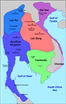
- The first kingdom to unite the Lao lands along the middle Mekong, founded by Fa Ngum in 1353.
- A Buddhist mandala state of semi-autonomous principalities, ruled from Luang Prabang and from 1560 from Vientiane.
- A succession crisis after Sourigna Vongsa's death split it into the kingdoms of Luang Phrabang and Vientiane in 1707.
Rise & Fall
- 1353Fa Ngum is crowned king of Lan Xang
- 1479A Vietnamese army sent by Lê Thánh Tông sacks the capital
- 1560Setthathirath moves the capital to Vientiane
- 1566The great stupa of That Luang is built in Vientiane
- 1574Lan Xang becomes a vassal of Burma
- 1641The Dutch merchant Gerrit van Wuysthoff visits Vientiane
- 1707Lan Xang divides into the kingdoms of Luang Phrabang and Vientiane
Foundation

Lan Xang, the 'Kingdom of a Million Elephants', was created in the mid-fourteenth century by Fa Ngum, a prince of the ruling house of Muang Sua, the Lao principality centred on the confluence of the Mekong and Khan rivers. According to the Lao chronicles, Fa Ngum's family was exiled and he grew up at the Khmer court at Angkor, where he married a Khmer princess. With an army raised with Khmer support he advanced up the Mekong, subduing local rulers along the way, and in 1353 he took Muang Sua, then called Xieng Dong Xieng Thong, and was crowned king. Further campaigns brought the Vientiane plain, parts of the Khorat plateau and upland principalities such as Muang Phuan under his authority, creating for the first time a single Lao kingdom stretching along the middle Mekong. Lao tradition credits Fa Ngum and his Khmer queen with bringing Theravada Buddhism and Cambodian monks to the court, together with the gold Buddha image known as the Phra Bang, although the image probably reached the capital later. Fa Ngum's harsh rule alienated the nobility, who deposed him around 1373. His son Oun Heuan, remembered as Samsenthai, consolidated the kingdom during a long and peaceful reign that lasted until 1416.
Socioeconomy
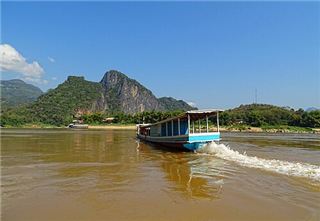
Lan Xang was a land of river valleys and forested mountains. Its lowland population, mostly Lao, grew glutinous rice in irrigated fields along the Mekong and its tributaries, while the uplands were home to Mon-Khmer-speaking and other peoples who practised shifting cultivation and paid tribute in forest products. The kingdom's name is said to derive from the numerous elephants used in war, transport and royal ceremony. Samsenthai's own name is traditionally explained by a census that counted 300,000 Tai men available for service, a figure that indicates the importance of manpower rather than a reliable count. Lan Xang was landlocked, and its exports travelled by river and overland trails to Ayutthaya, Cambodia, Vietnam and Yunnan: gold, benzoin, lac, ivory, musk and other forest goods. These products drew a Dutch East India Company mission under Gerrit van Wuysthoff to Vientiane in 1641. Theravada Buddhism became the foundation of court and village life. Monasteries were centres of education and literacy in the Lao script, preserving religious texts, chronicles and literature on palm leaves, and King Photisarath ordered the suppression of spirit cults in favour of Buddhist practice in 1527. Spirit beliefs nevertheless persisted alongside Buddhism in rural life.
Military
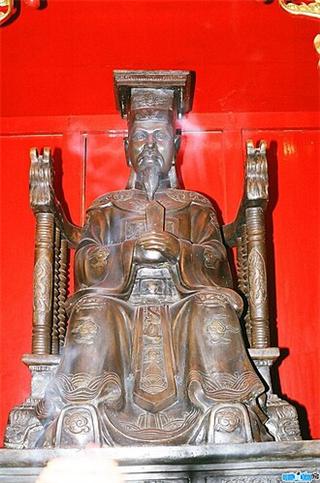
The kings of Lan Xang raised armies by calling up the manpower of the muang, the principalities that made up the kingdom, with war elephants and infantry forming the core of their forces. Mountains, forests and the Mekong gave natural protection, but the kingdom lay between stronger neighbours and fought repeated wars for survival. In 1479 a large Vietnamese army sent by Lê Thánh Tông invaded and sacked the capital, though Lao forces later recovered it and the invaders withdrew. In the sixteenth century the main threat was Burma. When the Toungoo king Bayinnaung conquered Lan Na and Ayutthaya, Setthathirath (r. 1548–1571) allied with Ayutthaya, an alliance commemorated in the stupa of Phra That Si Song Rak, and moved his capital to Vientiane, further from the Burmese advance. Bayinnaung took Vientiane in 1565, but Setthathirath withdrew into the forests and waged a guerrilla war that forced the Burmese to leave. After Setthathirath disappeared on a campaign in the south around 1571, Burmese armies returned, and from 1574 Lan Xang was a Burmese vassal until Nokeo Koumane restored its independence in the early 1590s. The seventeenth century brought greater security, and Sourigna Vongsa kept largely peaceful relations with Vietnam and Ayutthaya.
Governance & Law
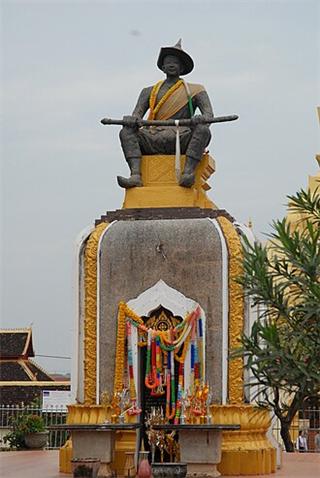
Lan Xang was a mandala state: the king ruled the capital and its core directly, while the surrounding muang were governed by their own lords, often members of local ruling families, who owed tribute, manpower and loyalty. The more distant principalities, such as Muang Phuan on the Xieng Khouang plateau, had considerable autonomy, and their allegiance could shift to Vietnam or Ayutthaya when the centre was weak. The king was supported by an uparat, or viceroy, often his designated successor, and by a council of high nobles who could play a decisive role in successions, as when they deposed Fa Ngum. Royal legitimacy rested on descent from the legendary ancestor Khun Borom, on patronage of Buddhism and on possession of sacred images such as the Phra Bang and, from Setthathirath's reign, the Emerald Buddha, which he brought from Lan Na after briefly ruling there. Kings built and endowed monasteries, and the sangha in turn supported royal authority. Setthathirath moved the capital to Vientiane in 1560, building the Haw Phra Kaew to house the Emerald Buddha and the great stupa of That Luang, while the old capital received the name Luang Prabang after the Phra Bang. Sourigna Vongsa (r. 1638–c. 1695) ruled through a strong court and is remembered for strict justice.
Global & Regional Impact

Lan Xang was the first state to unite the Lao lands and remains the foundation of Lao national identity. Its Buddhist culture shaped the religious life of the middle Mekong for centuries: Wat Xieng Thong in Luang Prabang, begun under Setthathirath around 1560, is the finest example of the Luang Prabang style of temple architecture, and That Luang in Vientiane, built in 1566, became a national symbol that appears today on the emblem of Laos. Lan Xang's literature in the Lao script, including Buddhist texts, chronicles and the epic Sinxay, traditionally dated to the reign of Sourigna Vongsa, formed a literary tradition shared with the Lao-speaking population of northeastern Thailand. The kingdom's reach over the Khorat plateau helps explain why Lao is still widely spoken in the Isan region of Thailand. Its sacred images also played a part in later history: the Emerald Buddha, taken from Vientiane by Siamese forces in 1779, became the palladium of the Chakri kings in Bangkok, while the Phra Bang still gives Luang Prabang its name. Reports by van Wuysthoff and the Jesuit Giovanni Maria Leria, who lived in Vientiane in the 1640s, are among the earliest European accounts of Laos. Modern Laos honours Fa Ngum as its founding king, and his statue stands in Vientiane.
Decline & Fall

Lan Xang reached its last peak under Sourigna Vongsa, whose long reign brought peace and prosperity, but his death left no undisputed heir. According to Lao tradition, he had executed his only son for adultery, and his grandsons were still young. After his death around 1694 or 1695, a high official seized the throne and a period of rapid usurpations followed. Sai Ong Hue, a nephew of Sourigna Vongsa raised in exile in Vietnam, took Vientiane with Vietnamese support around 1700, while Sourigna Vongsa's grandsons Kingkitsarat and Inthasom gathered support in the north. In 1707 Kingkitsarat established himself as king at Luang Prabang, and the kingdom was formally divided into the Kingdom of Luang Phrabang and the Kingdom of Vientiane. In 1713 the southern provinces broke away to form the Kingdom of Champasak. The three Lao successor kingdoms were weaker than Lan Xang and fell under Siamese overlordship in the late eighteenth century, when Vientiane was taken in 1779. After the failed rising of Chao Anouvong of Vientiane in 1826–1828, the Siamese sacked his capital. In the 1890s France took the lands east of the Mekong, creating the core of the modern Lao state, which claims Lan Xang as its ancestor.
Lan Xang matters as the first kingdom to unite the Lao peoples of the middle Mekong: for over three centuries it combined a Theravada Buddhist monarchy with a loose mandala of principalities, resisted Vietnam and Burma, and left the temples, sacred images and identity on which modern Laos is built.
Test yourself
5 questions on this page, from its key events and facts.
The questions open here once the page has loaded.
References
- Stuart-Fox, M. (1998) The Lao Kingdom of Lān Xāng: Rise and Decline. Bangkok: White Lotus.
- Stuart-Fox, M. (1997) A History of Laos. Cambridge: Cambridge University Press.
- Evans, G. (2002) A Short History of Laos: The Land in Between. Crows Nest: Allen & Unwin.
- Simms, P. and Simms, S. (1999) The Kingdoms of Laos: Six Hundred Years of History. Richmond: Curzon Press.
- Lieberman, V. (2003) Strange Parallels: Southeast Asia in Global Context, c. 800–1830. Volume 1: Integration on the Mainland. Cambridge: Cambridge University Press.
Connections
Open the full connections map →