At a glance
- A Tai kingdom founded in 1228 by Sukaphaa that ruled the Brahmaputra valley of Assam for six centuries.
- The paik system made every free adult man owe labour or military service, supporting roads, embankments and armies.
- The Ahoms resisted the Mughal Empire, winning at Saraighat in 1671, before rebellion and Burmese invasions ended the state.
Rise & Fall
- 1228Sukaphaa crosses the Patkai hills into the upper Brahmaputra valley
- 1523Suhungmung annexes the Chutia kingdom
- 1639Treaty of Asurar Ali fixes a frontier with the Mughal Empire
- 1662Mir Jumla's Mughal army occupies the Ahom capital Garhgaon
- 1671Lachit Borphukan defeats the Mughals at the Battle of Saraighat
- 1769The Moamoria rebellion breaks out
- 1817Burmese armies invade Assam
- 1826Treaty of Yandabo: Burma renounces Assam, which passes to the East India Company
Foundation

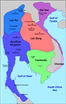
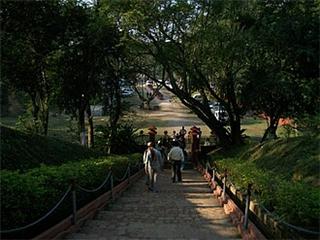
The Ahom kingdom was founded by Sukaphaa, a Tai prince from the Shan country of Mong Mao in what is now northern Myanmar and south-western China. According to the Ahom chronicles he left his homeland with a band of followers, crossed the Patkai hills and reached the upper Brahmaputra valley in 1228. For more than two decades the newcomers moved between temporary settlements before Sukaphaa fixed his seat at Charaideo, traditionally around 1253. The local Moran and Borahi peoples were absorbed through conquest, intermarriage and the grant of land, a pattern of assimilation that the Ahoms repeated as they grew. The early kingdom was small, confined to the land between the Dikhou and Dihing rivers, and its neighbours were stronger: the Chutia kingdom to the north-east and the Kachari kingdom to the south-west. Over the following three centuries Sukaphaa's successors pushed westwards along the river, opening new land to wet-rice cultivation, which the Tai settlers brought with them and which allowed far denser populations than the shifting agriculture of the hills. The decisive expansion came under Suhungmung (r. 1497–1539), who annexed the Chutia kingdom in 1523, drove the Kacharis from their capital at Dimapur and turned a regional chiefdom into the dominant power of the Brahmaputra valley.
Socioeconomy
The Ahom economy rested on wet-rice agriculture in the fertile floodplain of the Brahmaputra, supported by embankments, roads and irrigation channels built by state labour. Its foundation was the paik system: every free adult man was registered as a paik and grouped with others in a unit called a got, whose members took turns serving the state for part of the year as soldiers, builders or workers while the others farmed their plots. In return each paik received a grant of rice land. Under King Pratap Singha (r. 1603–1641) the official Momai Tamuli Borbarua reorganised the paiks into professional guilds called khels, which supplied the state with boatmen, archers, potters, goldwashers and other specialists. The economy used little coinage until the mid-seventeenth century, when octagonal silver and gold coins were struck in the king's name. Trade with Tibet, Bhutan, the hill peoples and Bengal brought salt, horses and cloth, though the kings kept it under tight control. Society was gradually transformed as the Tai elite intermarried with Assamese-speaking communities. Hinduism spread at court from the sixteenth century, while the Neo-Vaishnavite monasteries (satras) inspired by Srimanta Sankardev won wide popular followings. Ahom priests, the Deodhais and Bailungs, kept older Tai rites alive, including the burial of royalty in mounds called maidams at Charaideo.
Military

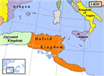
The paik system made the Ahom kingdom a society organised for war: in an emergency a large share of the male population could be mobilised quickly, and the same officers who supervised labour commanded troops. Armies fought mainly as infantry armed with bows, swords, spears and, from the sixteenth century, matchlocks and cannon, and they made skilful use of earthen ramparts, stockades and the dense forests and rivers of the valley. A fleet of war boats on the Brahmaputra was equally important. Suhungmung defeated an invasion from the Bengal Sultanate in the early 1530s. From 1615 the Ahoms fought a long series of wars with the Mughal Empire over Kamrup in the lower valley; the Treaty of Asurar Ali in 1639 fixed a frontier between them. In 1662 the Mughal governor of Bengal, Mir Jumla, invaded, occupied the capital Garhgaon and forced Jayadhwaj Singha to accept the harsh Treaty of Ghilajharighat in 1663, but disease and monsoon floods ruined the Mughal army. The Ahoms retook Guwahati in 1667, and in 1671 the general Lachit Borphukan defeated a Mughal force under Raja Ram Singh I of Amber at the Battle of Saraighat, fought largely on the river. Gadadhar Singha finally expelled the Mughals from Guwahati in 1682, fixing the western frontier at the Manas River.
Governance & Law
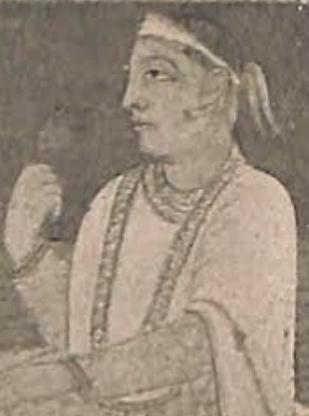
The king, styled Swargadeo, "lord of heaven", had to be a descendant of Sukaphaa without physical blemish, and he ruled with a council of great ministers. The oldest offices were the Burhagohain and the Borgohain, hereditary in particular Ahom noble families, to which Suhungmung added the Borpatrogohain. Pratap Singha created two further offices: the Borbarua, who handled revenue and justice in Upper Assam, and the Borphukan, viceroy of the lower valley with his seat at Guwahati after its recovery. Below them a hierarchy of officers commanded fixed numbers of paiks: the Bora 20, the Saikia 100 and the Hazarika 1,000, with the Rajkhowa and the Phukan above them. This structure combined civil administration, labour service and military command in one chain. Regular censuses of the paiks were made, and the state kept chronicles called buranjis, written first in the Tai Ahom language and later in Assamese, which record campaigns, embassies and court affairs year by year. The court moved from Charaideo to Garhgaon in the sixteenth century and later to Rangpur, where kings built the brick palaces of the Talatal Ghar and Kareng Ghar and the Rang Ghar pavilion. Succession disputes were frequent, and in the 1670s and 1680s ministers made and unmade several kings before Gadadhar Singha restored royal authority.
Global & Regional Impact
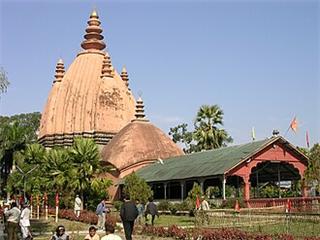
The Ahom kingdom is the central state in the history of Assam, and its six centuries of rule shaped the region's identity more than any other polity. Its resistance to the Mughal Empire was unusual on the subcontinent: while most of northern India and Bengal came under Mughal control, the Ahoms held the Brahmaputra valley, and the victory at Saraighat remains a point of pride in modern Assam, where Lachit Divas is celebrated each November. The kingdom also illustrates how a small group of Tai migrants could build a lasting state by assimilating local peoples; over time the Ahoms adopted Assamese, which became the language of administration and literature, and Hindu religious practice, while preserving Tai rituals, titles and the royal burial mounds. The buranjis form one of the richest bodies of historical writing in pre-colonial India and are a main source for the region's history. Ahom kings patronised temples and tanks around Sivasagar, including the Sivadol, and the moidams at Charaideo were inscribed as a UNESCO World Heritage Site in 2024. Ahom place names, institutions and memories of the paik system remained part of Assamese life long after 1826, and the Tai Ahom community continues to claim descent from the founders of the kingdom.
Decline & Fall
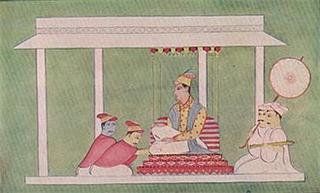
The kingdom reached its height under Rudra Singha (r. 1696–1714) and his successors, but strains grew within it during the eighteenth century. Royal patronage of Shaktism alienated many Vaishnavite satras, and the persecution of the Moamaria monastery and its largely lower-caste and tribal followers set off the Moamoria rebellion in 1769. In two great waves the rebels seized the capital, and King Gaurinath Singha fled to Guwahati; at his request the British East India Company sent Captain Thomas Welsh with a small force in 1792, which restored him before being recalled in 1794. The paik system was disrupted, large areas were depopulated and the minister Purnananda Burhagohain governed with difficulty. Court factionalism then opened the door to Burma: the dismissed Borphukan Badan Chandra sought help from the Konbaung kings, and Burmese armies entered Assam in 1817, returning in 1819 and 1821, when they made the valley a province of Burma. Their occupation was remembered for its violence and caused heavy loss of population. The British, at war with Burma from 1824, expelled the Burmese army, and by the Treaty of Yandabo in 1826 Burma renounced its claims to Assam. The Company briefly installed Purandar Singha as a tributary ruler of Upper Assam in 1833 but annexed his territory in 1838, ending Ahom rule.
The Ahom kingdom ruled the Brahmaputra valley for six centuries, turning a band of Tai migrants into the dominant power of Assam through the paik labour system, resisting the Mughal Empire at Saraighat and leaving the chronicles, monuments and identity on which modern Assam was built.
References
- Gait, E.A. (1906) A History of Assam. Calcutta: Thacker, Spink & Co.
- Gogoi, P. (1968) The Tai and the Tai Kingdoms. Gauhati: Gauhati University.
- Baruah, S.L. (1985) A Comprehensive History of Assam. New Delhi: Munshiram Manoharlal.
- Guha, A. (1991) Medieval and Early Colonial Assam: Society, Polity, Economy. Calcutta: K.P. Bagchi.
Connections
Open the full connections map →