South & Southeast Asia
Chenla
At a glance
- Chenla is a Chinese label: most historians now hold that it was never a unitary kingdom but a series of loose and temporary confederations of Khmer principalities, Michael Vickery's 'Dângrêk Chieftains'.
- Isanavarman I, whose embassy reached the Sui court in 616–17 and whose capital was Isanapura (Sambor Prei Kuk), absorbed the territories of Funan and called himself King of Kings ruling 'Suvarnabhumi as far as the sea'.
- After 707 the Tang histories divide Chenla into Land and Water Chenla; Water Chenla fell to the Javanese around 790, while from Land Chenla Jayavarman II proclaimed the Khmer Empire in 802.
Rise & Fall
- 598On 13 April Narasimhagupta, vassal of Bhavavarman I, erects a figure of Vishnu at Isanapura; the same year Bhavavarman builds a temple at the centre of his kingdom of Bhavapura.
- 616–617Isanavarman I sends the first Chenla embassy to the Sui court; the Sui annals of 636 are the oldest Chinese text to name Chenla.
- 627–649Chenla subdues Funan; the New Book of Tang credits Isanavarman with annexing its territory at the beginning of the Zhenguan era.
- 657On 14 June Jayavarman I, son of Candravarman, issues his earliest inscriptions; his reign of about thirty years is the last over a united Chenla.
- 707After the end of the Shenlong era the Tang histories record Chenla divided into Land Chenla (Wendan) and Water Chenla.
- 713On 5 April Queen Jayadevi, ruling at Angkor, complains of 'bad times' in her Western Baray inscription as the kingdom breaks into principalities.
- c. 790The last king of Water Chenla is killed and his realm absorbed into the Javanese monarchy; Jayavarman II and Indrayudha defeat a Cham army and found Hariharalaya.
- 802Jayavarman II proclaims the Khmer Empire, ending the pre-Angkor period.
Foundation
Chenla, or Zhenla, is the name the Chinese gave to an entity that sent tribute to their emperors; neither it nor Funan is known in Old Khmer, and Michael Vickery holds the original meanings of both unknown. The History of the Sui records a state called Chenla, a vassal of Funan, which sent an embassy to China in 616 or 617 and whose ruler Citrasena Mahendravarman conquered Funan after Chenla had gained its independence. Its aristocracy, whom Vickery calls the "Dângrêk Chieftains", came from local principalities north and south of the Dângrêk Mountains and left the oldest stone inscriptions of the region. The Sanskrit inscription of Vãl Kantél in Stung Treng names a ruler Vīravarman, who had adopted divine kingship and the cult of Harihara.
Chenla was recognised as a separate entity at the end of the 6th century under Bhavavarman I, who "conquered his throne at the tip of his sword" and in 598 built a temple at the centre of his kingdom of Bhavapura, probably near Thala Barivat. The inscriptions make Bhavavarman and Citrasena brothers by the same mother, Citrasena the son of Vīravarman; together they attacked Funan, which Chenla subdued around 627–649. Older scholarship, following George Cœdès and the Chinese annals, placed Chenla's origin at Champasak in Laos, with Vat Phou at Mount Phu Kao, Lingaparvata, as its spiritual centre; Claude Jacques and Vickery doubt the identification, since many Cambodian hills fit the vague description.
Socioeconomy

Chenla's wealth came from wet-rice agriculture and the mobilisation of manpower rather than subsistence farming, and an extensive irrigation system produced the rice surpluses that formed the bulk of its trade. By the early 7th century Cambodian society was shifting from the trading orientation of Funan to an agrarian one: the trading centres near the coast were collapsing while inland agrarian centres rose. Productive land was donated to temples, where slaves worked the fields and earned the temples revenue.
Status rested on language. Sanskrit, the language of the gods, was valued above Khmer, and the division between those who worked the fields and those who did worthier tasks followed command of it; the educated could become officials or royal servants, while the majority without Sanskrit names spent their lives producing a surplus for the temples and the ancestral gods. Outside the towns farmers bore Khmer names and paid tribute to regional landowners with the Khmer title poñ, who built temples to Hindu and local deities alike; wealth and power there passed through the female line, and women played central roles in ritual, specialised in crafts and held rank as high officials. Many commoners cleaned, cooked and built temples without pay, and Judith Jacob identified fourteen categories of slaves who could be bought, sold and given away, bound by debt or inherited bondage.
Military

Leadership was at first won by merit in battle and the ability to attract a following, and the Hindu idea of the consecrated military leader, the varman or protector king, became the ideological basis of supremacy. Bhavavarman I conquered his throne at the tip of his sword and ruled the eastern part of his father's realm; his brother Citrasena, Mahendravarman, is credited by the epigraphy with the conquest of Funan, and the New Book of Tang attributes the effective annexation of Funan's territory to Isanavarman at the start of the Zhenguan era (627–649). Under Jayavarman I, whose inscriptions reach from Vat Phou to the Gulf of Siam, Chenla conquered principalities in northwestern Cambodia.
In the 8th century the principalities fought abroad and were attacked at home. Land Chenla aided Mai Thúc Loan's rebellion against the Chinese in 722–723, and in 754 a son of the king of Wendan joined a Chinese army against Nanzhao. Water Chenla, on the Mekong Delta, had the river's wealth but was more exposed; late in the century it faced war from Javanese pirates who took the delta and then Chenla itself, and it came to depend on the Shailendra dynasty of Java and Srivijaya. Its last king seems to have been killed and his realm absorbed into the Javanese monarchy around 790. The Sdok Kak Thom inscription of 1053 records that Jayavarman II and his son Indrayudha defeated a Cham army in 790 before moving north of the Tonlé Sap to found Hariharalaya.
Governance & Law

Chenla's kings took the Sanskrit name of a patron deity or avatar with the suffix -varman, "protected by", following the code of the Kshatriya caste in the Laws of Manu. Isanavarman I, whose first embassy reached the Sui court in 616–17, founded Isanapura, the site of Sambor Prei Kuk north of the Tonlé Sap, and left inscriptions there dated 13 September 627 and at Khau Noy in Thailand on 7 May 637; one calls him "the King of Kings, who rules over Suvarnabhumi as far as the sea". He ceased to reign around 637 and was followed by Bhavavarman II, attested in 644 and 655, Candravarman, and Candravarman's son Jayavarman I, whose earliest inscriptions date from 14 June 657 and whose reign of about thirty years, the last over a united Chenla, ended perhaps after 690.
Chenla's existence as a single state is doubted. Vickery argues that ancient authors bundled many small principalities under one name, which would explain the sharp rise in inscriptions in the 7th century. After Jayavarman I the kingdom broke into principalities; his daughter Queen Jayadevi ruled at Angkor and lamented "bad times" on 5 April 713, and the Tang histories say that after 6 February 707 Chenla split into Land Chenla, also called Wendan or Polou, and Water Chenla. Royal religion was Hindu, the brick sanctuaries of Isanapura centred on lingas, with Harihara, Brahma, Indra and Lakshmi also worshipped and Buddhism tolerated beside them.
Global & Regional Impact
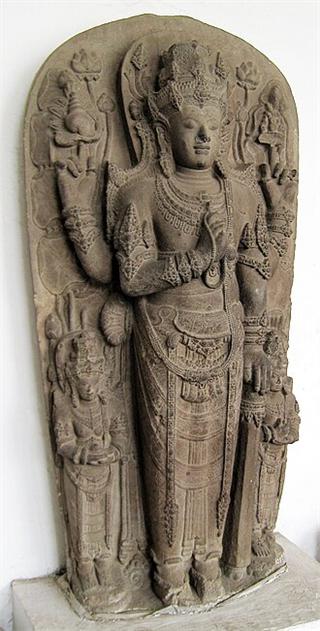
Chenla carried the Indianised statecraft of Funan inland and handed it to Angkor. Its kings underwent a process of Indianisation to consolidate and magnify their rule, adopting the devaraja idea of the god-king, Sanskrit as the language of the gods and the script of the Pallavas and Chalukyas. Its temples, in brick and stone with a statue of a Hindu god or the Buddha at the centre, the finer ones in sandstone from the Kulen Mountains, followed the Gupta style of northern and central India; by the close of the 7th century the region was dotted with temples and shrines. Harihara, the combined Vishnu and Shiva, was a favourite image.
The temple foundations, with their own lands, people and taxes, both strengthened and drained the kings, and may also have drawn foreign traders. Most of the population kept to local goddesses, gods and ancestors in their villages, attending the public Hindu and Buddhist cults only on occasion, and some local deities were probably absorbed into the Hindu pantheon; the kings kept this liberal religious policy until the Khmer Empire was founded. Jayavarman II's own links lay with Vyādhapura in the south, from which, Angkor-period inscriptions record, he took people to settle Battambang. The name outlived the polity: Zhou Daguan still used it in the 13th century, it stands on the Mao Kun map, and after Cambodia overran Champa in 1195–1200 the Chinese renamed the country Zhanla, "Defeated Chams".
Decline & Fall
The number of inscriptions fell sharply in the 8th century. Some scholars argue that Chenla fell in the 700s through internal division and Shailendra attacks from Java. After Jayavarman I's death, his last inscription dated 681/82, turmoil came upon the kingdom and at the start of the 8th century it broke into many principalities; after 707 the Chinese knew two Chenlas, Land and Water. Water Chenla, open to the sea and the Mekong, fell to Javanese attack: by the late 8th century it depended on the Shailendras and Srivijaya, and around 790 its last king seems to have been killed and the polity incorporated into the Javanese monarchy.
Land Chenla kept its integrity under Jayavarman II, who defeated a Cham army in 790 with his son Indrayudha, founded Hariharalaya north of the Tonlé Sap and proclaimed the Khmer Empire in 802, the year at which historiography ends the pre-Angkor period. Vickery identifies him with the Jayavarman of inscriptions dated 20 April 770 near Kompong Cham and 781 near Śambhupura, a king from the south with particularly close links to Vyādhapura. Many historians reject a classical decline altogether, arguing that there was no Chenla to begin with, only a region subject to prolonged contested rule and turbulent successions, unable to establish a lasting centre of gravity; Vickery insists that until 802 there was no single great state in Cambodia but a number of smaller ones.
Chenla is the Chinese name for the Khmer principalities of pre-Angkorian Cambodia, which under Bhavavarman I, Mahendravarman and Isanavarman broke from Funan and absorbed it in the 7th century, split into Land and Water Chenla after 707, and dissolved into the Khmer Empire that Jayavarman II proclaimed in 802.
Test yourself
5 questions on this page, from its key events and facts.
The questions open here once the page has loaded.
References
- Michael Vickery, Society, Economics, and Politics in Pre-Angkor Cambodia: The 7th–8th Centuries (Toyo Bunko, 1998)
- George Cœdès, The Indianized States of Southeast Asia, trans. Susan Brown Cowing (East-West Center Press, 1968)
- Zhou Daguan, A Record of Cambodia: The Land and Its People, trans. Peter Harris (Silkworm Books, 2007)
Connections
Open the full connections map →