Central & East Asia
Shang dynasty
At a glance
- The first Chinese dynasty known from its own writing, ruling the middle Yellow River plain from c. 1600 to 1046 BCE.
- Its kings divined with inscribed oracle bones, the oldest substantial body of Chinese writing.
- Its bronze ritual vessels, chariots and royal tombs at Anyang make it one of the great Bronze Age civilisations.
Rise & Fall
- c. 1600 BCETang of Shang overthrows Jie of the Xia, according to tradition
- c. 1600–1400 BCEThe walled city at Zhengzhou flourishes in the Erligang period
- c. 1300 BCEPan Geng moves the capital to Yin near Anyang
- c. 1250 BCEWu Ding begins his long reign; the earliest oracle-bone inscriptions
- c. 1200 BCEChariots appear at Anyang; Fu Hao is buried in her tomb
- 1046 BCEKing Wu of Zhou defeats Di Xin at the Battle of Muye
Foundation

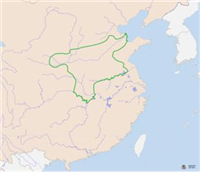
According to traditional histories compiled more than a millennium later, above all the Shiji of Sima Qian, the Shang dynasty was founded when Tang of Shang, a lord of the eastern plain, overthrew Jie, the tyrannical last ruler of the Xia. The date of about 1600 BCE is a modern reconstruction, adopted by the Xia–Shang–Zhou Chronology Project of 1996–2000; no contemporary record survives for the early Shang, and the existence of the Xia as a state is still debated. Archaeologically, the early Shang is usually identified with the Erligang culture, whose walled city at Zhengzhou, enclosed by rammed-earth walls about seven kilometres long, and the walled town at Yanshi date from roughly 1600–1400 BCE. Erligang bronzes and outposts spread as far as Panlongcheng on the Yangtze. Tradition records frequent moves of the royal capital, and a large walled city at Huanbei, identified in 1999 just north of Anyang, may represent one stage of them. King Pan Geng is credited with moving the capital to Yin, near modern Anyang in Henan, around 1300 BCE, and the inscriptions found there, which begin in the reign of Wu Ding in the thirteenth century BCE, make the late Shang the first period of Chinese history documented by its own writing.
Socioeconomy
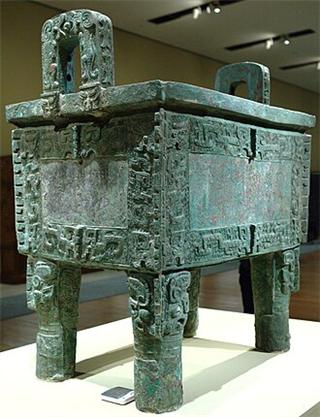
Shang society was steeply ranked. At the top stood the king and the royal lineage, surrounded by noble lineages, diviners, scribes and officials; below them were farmers, artisans organised in specialised lineages, and large numbers of dependent labourers and captives. Agriculture on the loess soils of the Yellow River plain produced millet, some wheat and rice, and the court kept herds of cattle, sheep and pigs, many of them destined for sacrifice. Religion pervaded political life. The king offered regular sacrifices to his royal ancestors according to a ritual calendar, and above them stood Di, a high god who commanded rain, wind and harvests but received no regular offerings of his own. At Yin, workshops cast the great bronze ritual vessels used in ancestral feasts with piece-mould techniques that required many coordinated workers; the largest known, the Houmuwu ding, weighs more than 800 kilograms. Bone workshops, jade carving, pottery and silk weaving also flourished. Cowrie shells from the southern seas served as prestige goods and royal gifts, while copper, tin, turtle shells and other materials were brought from distant regions. Human sacrifice was practised on a large scale: oracle-bone texts record the killing of thousands of captives, many of them Qiang, and royal tombs contain hundreds of victims.
Military

The Shang king was the supreme war leader, and the oracle-bone inscriptions record frequent campaigns against neighbouring peoples known as fang, such as the Tufang, the Guifang and the Qiang. Armies were raised from royal and noble lineages and allied lords, and inscriptions mention forces of three thousand men; how far there was a standing army is uncertain. Infantry fought with the bronze dagger-axe (ge), spears, composite bows and shields, and elite warriors wore bronze helmets. Horse-drawn chariots appear suddenly at Anyang around 1200 BCE, probably introduced from the northern steppe, and were buried with their horses and drivers in elite tombs; they seem to have served mainly as command vehicles and status symbols rather than as a decisive battle arm. Wu Ding, whose long reign is the best documented of the dynasty, campaigned widely, and one of his consorts, Fu Hao, led armies in the field: her intact tomb, discovered in 1976, contained more than 400 bronze objects, over 700 jades and weapons bearing her name. Massive rammed-earth walls protected the early Shang cities at Zhengzhou and Yanshi, although no outer wall has been found at the late capital of Yin. Late in the dynasty Di Yi and Di Xin campaigned against the Renfang or Yi peoples in the east, wars that may have weakened them before the Zhou attack.
Governance & Law

Government centred on the person of the king, who combined political, military and religious authority. He was the chief intermediary with the royal ancestors, and the divinations performed in his name, by cracking heated ox scapulae and turtle plastrons and inscribing the question and sometimes the result, covered sacrifices, harvests, weather, hunts, childbirth, illness and war. Around 150,000 inscribed fragments have been found, mostly at Anyang, and they record the names and order of the kings: tradition lists about thirty rulers in seventeen generations, and the inscriptions largely confirm the Shiji list. Succession often passed between brothers before descending to the next generation, and each king received a temple name containing one of the ten day-signs of the ritual week, as in Wu Ding or Di Xin. The royal domain around the capital was administered through officials with titles such as yin and shi and through royal relatives. Beyond it lay a patchwork of lords and allied or hostile fang polities whose loyalty depended on royal visits, hunts, gifts and warfare, so that the Shang state was more a network of alliances radiating from the capital than a territorial state with fixed borders. Scribes and diviners formed a literate elite, and the script already had several thousand characters.
Global & Regional Impact
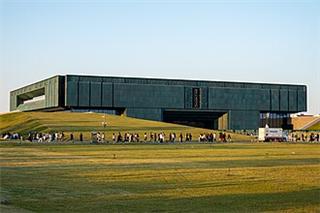
The Shang laid foundations for much of later Chinese civilisation. Their script, recorded on oracle bones and bronzes, is the direct ancestor of Chinese characters, which have been used continuously ever since, and many basic institutions, from ancestor worship and the ritual use of bronze vessels to the ten-day week and the sixty-day cycle for counting days, carried over into the Zhou period and beyond. Shang bronze casting, in technical skill and scale, ranks among the highest achievements of the world's Bronze Age, and the taotie mask motif on its vessels shaped Chinese decorative art for centuries. The Zhou conquerors absorbed Shang scribes, craftsmen and ritual specialists and justified their own rule by contrasting the virtue of their founders with the alleged depravity of the last Shang king, the origin of the theory of the Mandate of Heaven. Descendants of the Shang royal house ruled the State of Song through the Zhou period, and Confucius was traditionally said to descend from them. In modern times the Shang became a test of the reliability of the Chinese historical tradition: the recognition of oracle-bone writing, traditionally credited to the scholar Wang Yirong in 1899, and the excavations at Yinxu by the Academia Sinica from 1928 confirmed many traditional king names. Contemporary cultures such as Sanxingdui in Sichuan show that the Shang were one of several Bronze Age centres in China.
Decline & Fall

The end of the Shang came from the west. The Zhou, a people of the Wei River valley who had been Shang allies and subordinates, grew powerful under King Wen and built alliances with other western peoples. According to tradition the last Shang king, Di Xin, known to later writers as King Zhou of Shang, was a cruel and debauched tyrant devoted to his consort Daji; these stories were largely shaped by Zhou propaganda, and the oracle bones of his reign show a conventional ritual routine and long campaigns in the east. In 1046 BCE, the date favoured by the Xia–Shang–Zhou Chronology Project (other scholars prefer 1045 or 1027 BCE), King Wu of Zhou and his allies defeated the Shang army at the Battle of Muye. Zhou texts claim that much of the Shang force deserted or turned on its masters, and Di Xin is said to have burned himself to death in his palace. The Zhou at first left his son Wu Geng in charge of the Shang heartland under the supervision of King Wu's brothers, but after Wu's death Wu Geng joined the Rebellion of the Three Guards and was killed in the Duke of Zhou's campaign. The Shang ancestral sacrifices were then entrusted to Weizi Qi as ruler of the State of Song, and many Shang subjects were resettled near the new eastern capital at Luoyi.
The Shang dynasty is the earliest Chinese dynasty attested by its own written records, and its oracle-bone inscriptions, monumental bronzes and royal tombs at Anyang document the origins of the Chinese script, kingship and ancestral religion that the Zhou and every later dynasty inherited.
Test yourself
3 questions on this page, from its key events and facts.
The questions open here once the page has loaded.
References
- Chang, K.C. (1980) Shang Civilization. New Haven: Yale University Press.
- Keightley, D.N. (1978) Sources of Shang History: The Oracle-Bone Inscriptions of Bronze Age China. Berkeley: University of California Press.
- Keightley, D.N. (2000) The Ancestral Landscape: Time, Space, and Community in Late Shang China (ca. 1200–1045 B.C.). Berkeley: Institute of East Asian Studies, University of California.
- Loewe, M. and Shaughnessy, E.L. (eds) (1999) The Cambridge History of Ancient China: From the Origins of Civilization to 221 B.C. Cambridge: Cambridge University Press.
- Thorp, R.L. (2006) China in the Early Bronze Age: Shang Civilization. Philadelphia: University of Pennsylvania Press.
Connections
Open the full connections map →