Ancient Near East
Hittite Empire
At a glance
- A Bronze Age power ruled from Hattusa in central Anatolia that rivalled Egypt for control of Syria and the Levant.
- Its vassal treaties and its peace with Ramesses II are among the earliest milestones of international law and diplomacy.
- It vanished in the Bronze Age Collapse when Hattusa was abandoned and burned c. 1180 BCE; Neo-Hittite city-states carried on its legacy.
Rise & Fall
- c. 1650 BCEHattusili I founds the Old Kingdom with Hattusa as his capital
- c. 1595 BCEMursili I raids Babylon, ending the First Babylonian Dynasty
- c. 1525 BCEThe Edict of Telipinu recounts decades of palace murders and coups
- c. 1344 BCESuppiluliuma I takes the throne and goes on to dismantle the Mitanni kingdom
- 1274 BCEMuwatalli II fights Ramesses II at Kadesh, perhaps the largest chariot battle of antiquity
- c. 1259 BCEHattusili III and Ramesses II conclude the Treaty of Kadesh
- c. 1180 BCEHattusa is abandoned and burned under Suppiluliuma II
Foundation

The Hittites established themselves on the Anatolian plateau during the early second millennium BCE, absorbing the indigenous Hattian population whose religious traditions and royal titles they largely inherited. The Old Kingdom emerged around 1650 BCE under Hattusili I, who made Hattusa his capital, a naturally defensible site among the rocky highlands of north-central Anatolia, and campaigned southward into Syria. His successor Mursili I carried out the dynasty's most audacious early venture, raiding Babylon around 1595 BCE and ending the First Babylonian Dynasty in a campaign of extraordinary operational reach that nonetheless produced no permanent territorial gain. A subsequent period of palace murders and coups, recounted in the Edict of Telipinu around 1525 BCE, revealed the structural fragility of early Hittite kingship. The New Hittite Kingdom reached full imperial maturity under Suppiluliuma I (c. 1344–1322 BCE), who transformed the Hittites into a genuine great power competing directly with Egypt and Mitanni for control of the Levantine corridor. His dismantling of the Mitanni kingdom and installation of Hittite-aligned rulers across Syria, including his own sons at Carchemish and Aleppo, established the imperial framework that defined the empire at its height.
Socioeconomy
The Hittite economy rested on the agriculture of the Anatolian plateau, supplemented by herding and the exploitation of substantial metal deposits, particularly copper and silver. The Hittites occupied a strategically vital position astride the routes connecting Mesopotamia to the Aegean, and merchants operating under Hittite protection took part in the long-distance tin and copper trade that supplied the ancient world's bronze industry. Land was formally held by the palace and the temples and distributed to warriors, officials and cultivators in return for military service or labour obligations, an arrangement documented in detailed land-grant texts. The state stored and redistributed grain through royal magazines, providing a buffer against the harvest failures to which the plateau was prone. Tribute from vassal states in Syria and western Anatolia supplemented agricultural revenues significantly, making the empire's fiscal health directly dependent on its peripheral vassal network. The loss of Syrian vassals to Egyptian or Assyrian competition therefore meant not merely territorial contraction but immediate fiscal damage.
Military
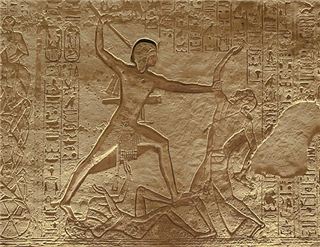
The Hittite military was built around the chariot as its primary offensive arm, deploying heavier three-man vehicles carrying a driver, a shield-bearer and a spearman, in contrast to the lighter two-man Egyptian designs. This configuration prioritised shock and close combat over mobile archery. The Battle of Kadesh in 1274 BCE, fought against Ramesses II on the Orontes River under Muwatalli II, is often described as the largest chariot engagement of antiquity, with perhaps five thousand chariots involved on both sides. Neither side achieved decisive victory, though both claimed triumph, and Kadesh itself remained in Hittite hands. Hittite infantry combined levies and professional palace troops with vassal contingents, providing numerical depth but variable reliability. Suppiluliuma I's Syrian campaigns demonstrated sophisticated operational capacity, combining direct military action with diplomatic subversion to detach enemy vassals before engaging their principals. The Hittites conducted systematic siege warfare, with battering rams and siege works described in the Old Hittite account of the siege of Urshu, though their preferred method remained political isolation rather than costly direct assault.
Governance & Law
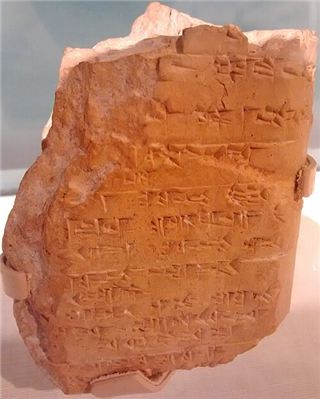
The Hittite political system centred on the Great King at Hattusa, whose authority was simultaneously military, judicial and religious. Unlike the Egyptian pharaoh, the Hittite king was not a living god but the earthly steward of the storm god Tarhun, becoming divine only after death, which created a more negotiated relationship between royal and priestly authority. The empire managed its periphery through a tiered vassal system, with subordinate rulers bound by formal treaties specifying military obligations, tribute and diplomatic restrictions. These vassal treaties, surviving in substantial numbers from the Hattusa archives, constitute one of the ancient world's most developed bodies of international law. The Hittite legal code, preserved on two tablets, was notably less brutal than contemporary Mesopotamian equivalents, favouring compensation and restitution over mutilation and death. Members of the royal family held key provincial positions, concentrating power within the dynasty but creating recurring succession tensions that periodically destabilised the central government.
Global & Regional Impact
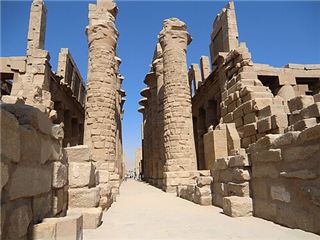
The Treaty of Kadesh, concluded between Hattusili III and Ramesses II around 1259 BCE, is the earliest peace treaty to survive in the versions of both parties: in Akkadian cuneiform at Hattusa and in Egyptian hieroglyphs at Karnak and the Ramesseum. A replica hangs today at the United Nations headquarters in New York. The diplomatic correspondence found at Amarna and Hattusa documents sophisticated great-power relations among the Hittites, Egypt, Babylon, Assyria and Mitanni, conducted in Akkadian as the Bronze Age international language. Anatolian ironworking contributed to the gradual diffusion of iron technology across the Near East. Religious and literary traditions absorbed from the Hattians and Hurrians were transmitted westward, and the Hurro-Hittite Kumarbi cycle, with its succession of warring sky gods, closely parallels Hesiod's Theogony, one of the earliest documented channels of cultural transmission between the Near East and Europe.
Decline & Fall
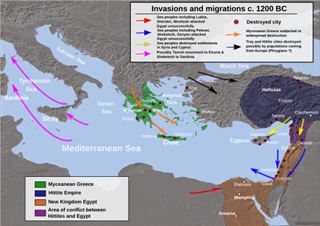
The Hittite Empire collapsed in the early twelfth century BCE as part of the broader Bronze Age Collapse, which destroyed or crippled most of the major states of the eastern Mediterranean within a generation. The Sea Peoples, migrating confederacies whose raids disrupted the coastal trade networks on which the Late Bronze Age international system depended, are traditionally cast as the immediate agents, though their exact role remains debated. Hattusa was abandoned and burned around 1180 BCE under the last known king, Suppiluliuma II, and never again served as a royal capital. Contributing factors included succession conflicts around the reign of Tudhaliya IV, prolonged drought and famine documented in correspondence requesting emergency grain shipments from Egypt, and the fragmentation of the vassal network that had sustained imperial revenues. Assyrian expansion westward added pressure on the eastern frontier. Neo-Hittite city-states in northern Syria and south-eastern Anatolia, including Carchemish and Malatya, preserved elements of Hittite political and artistic tradition for centuries before absorption into the Assyrian Empire, representing the civilisation's epilogue rather than its continuation.
The Hittite Empire's enduring significance lies in its demonstration that great-power competition could be managed through formal diplomacy as effectively as through military force, producing in the Treaty of Kadesh a model of negotiated international order whose conceptual descendants remain foundational to international law today.
References
- Beckman, G. (1996) Hittite Diplomatic Texts. Atlanta: Scholars Press.
- Bryce, T. (2005) The Kingdom of the Hittites. New edn. Oxford: Oxford University Press.
- Collins, B.J. (2007) The Hittites and Their World. Atlanta: Society of Biblical Literature.
- Gurney, O.R. (1990) The Hittites. Revised edn. London: Penguin.
- Hoffner, H.A. (1997) The Laws of the Hittites: A Critical Edition. Leiden: Brill.
- Singer, I. (2002) Hittite Prayers. Atlanta: Society of Biblical Literature.
Connections
Open the full connections map →