Social ladder · 1588–1629 (the reign of Abbas I)
Social Hierarchy of Safavid Iran
From Shah to Enslaved

Safavid Iran was ranked from the shah at the apex, through an aristocracy of soldiers, officials and clergy, down to the common people, merchants and peasants at the base. Its elite was divided by origin and calling. The Turkoman Qizilbash tribes, the “men of the sword”, had brought the dynasty to power in 1501 and governed most of the provinces; Persians, the “men of the pen”, staffed the bureaucracy and the religious establishment. From the 1540s the shahs built a third force of Georgians, Circassians and Armenians, captured or deported from the Caucasus: converted to Islam and trained as the shah’s own slaves, the ghulams, they took over much of the army and many high offices under Abbas I. Offices were given, in principle, for merit rather than birth, and every rank depended on the shah, who claimed descent from the Prophet Muhammad.
Period 1588–1629 (the reign of Abbas I)People 8–10 millionRanks 8Profile Safavid Empire
The ladder
By rank, the ladder is drawn as a pyramid. To scale, each bar is as wide as that rank’s share of the people. Shares marked est. are estimates where no count survives; their boxes and bars are dashed.
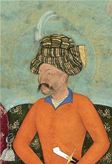
Ruler · One ruler
Shāh
shahanshah, morshed-e kamel
The shah ruled Iran with total power and built a splendid new capital at Isfahan.
The shah stood at the apex of the state with total power over it. He bore the old title of Shahanshah, King of Kings, and his legitimacy rested on his descent from Muhammad as a sayyid, a claim many scholars doubt. To the Qizilbash he was also the morshed-e kamel, the “Perfect Guide” of the Safavid Sufi order, so a follower’s disobedience was treason: Abbas I put some to death for it in 1614. Jean Chardin thought the shahs ruled with an iron fist. Abbas built an army paid by and loyal to himself, brought provinces under his direct rule and in 1598 moved the capital to Isfahan, where Naqsh-e Jahan Square set the mosque, the bazaar and his own Ali Qapu palace side by side.
Moving in or out. Only a prince of the Safavid house could reign. In the 16th century the Qizilbash chiefs had ruled for the ten-year-old Tahmasp I and assassinated Ismail II, and the shahs kept the princes of their own family confined to the harem.
How many? One shah, with the princes of the dynasty and the women of the royal harem.

Nobility and officials · c. 0.05–0.2% (est.)
Qizilbāsh (Qizilbash lords)
amir, khan, uymaq
The Qizilbash were warrior tribes in red caps who had helped the first Safavid shah win his throne.
The Qizilbash, “red heads” after their twelve-gored crimson caps, were mainly Turkoman tribes of Anatolia and Azerbaijan, sworn followers of the Safavid order, who had won the throne for Ismail I in 1501. The seven great tribes, Rumlu, Shamlu, Ustajlu, Afshar, Qajar, Takkalu and Zulkadar, supplied the army’s commanders, and their amirs governed most provinces as khans, “like petty shahs”: they spent the revenue in the province, sent the shah the balance and kept troops ready for his call. Abbas I cut their governorships, moved their governors away from their tribes and replaced most with ghulams. Yet the Qizilbash still gave more than half the army’s strength, many senior officers and great offices of the royal household.
Moving in or out. Rank came from the tribe and its leading clans, though the sons of nobles had to prove themselves worthy of their fathers’ posts. A tribesman who forsook his tribe for the shah alone could join the Shahsevans, the “Friends of the King”, 12,000 strong under Abbas.
How many? Estimate: the chiefs and leading families of the seven great tribes (uymaqs) and the lesser ones, with their households, among 8–10 million; the tribesmen who followed them are counted with the herders.
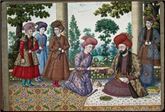
Nobility and officials · c. 0.05–0.2% (est.)
Tājīk (Persian officials)
Etemad-e Dowlat, mostoufi-ye mamalek, vak'anevis
Persian officials wrote the shah’s letters, kept his accounts and ran his government.
Persians, the “men of the pen”, filled the bureaucracy as they had under earlier rulers of Iran, while the Turkic-speaking soldiers were the “men of the sword”. Under Abbas they held the two highest offices of state: the grand vizier, the Etemad-e Dowlat, always chosen from among doctors of law, without whose counter-seal no act of the shah was valid, and the comptroller-general of the revenues, the mostoufi-ye mamalek. Every office had a deputy or superintendent who recorded its acts and reported to the shah. Persian was the language of government, letters and the coinage. The rivalry between pen and sword was old: between 1508 and 1524 the Qizilbash brought about the deaths of three of the five Persians whom Ismail I made vakil.
Moving in or out. Offices were given, in principle, for merit: sons of officials were considered for their fathers’ posts but had to prove themselves, and laymen are recorded rising to high office. From Tahmasp’s reign the sons of Turkic officers were educated in Persian in the royal household and began to take posts once kept for Persians.
How many? Estimate: the viziers, revenue officials, secretaries and recorders of the central and provincial offices, with their families.
Picture: The grand vizier Shah Quli Khan presents a ring, a painting attributed to Muhammad Sultani · Attributed to Muhammad Sultani (although the style and inscription points to Muhammad Zaman) · Public domain · Wikimedia Commons
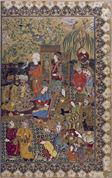
Nobility and officials · c. 0.4–1.5% (est.)
Gholām (The shah's slave soldiers and officers)
gholāmān-e khāṣṣa-ye sharifa
Ghulams were soldiers from the Caucasus who served only the shah, and some became generals and governors.
The ghulams, “slaves of the shah”, were Georgians, Circassians and Armenians brought from the Caucasus as captives and deportees, converted to Islam and trained for his service. Bound by no clan or tribe, they were loyal to him alone. Tahmasp I’s Caucasian campaigns of 1540–1554 began the corps; Abbas I enlarged it from a few hundred men to 15,000 cavalry and 3,000 royal bodyguards, part of a division of some 40,000 paid by the shah. Ghulams replaced most Qizilbash governors, and by the end of his reign a fifth of the high-ranking amirs were ghulams: the Georgian Allahverdi Khan became governor-general of Fars in 1595 and commander-in-chief in 1598. The palace eunuchs, “white” from the Caucasus and “black” from India and Africa, were ghulams too.
Moving in or out. Men entered as captives or deportees and, after special training, joined the new regiments or the royal household; from there the most favoured rose to govern provinces and command armies.
How many? Estimate: a Caucasian ghulam division of some 40,000 soldiers under Abbas, with the ghulams of the royal household and administration and their families, among 8–10 million.
Picture: Courtiers of Shah Abbas I (Walters Art Museum) · Anonymous (Iran) · Public domain · Wikimedia Commons
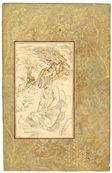
Religious and learned · c. 0.5–2% (est.)
ʿUlamā (Shi'i clergy and sayyids)
mujtahid, seyyed, qazi
Shi’i Muslim scholars served as judges and were seen as protectors of ordinary people.
Ismail I made Twelver Shi’ism the state religion and conversion mandatory for a largely Sunni population; Sunni scholars were killed or exiled, and Twelver scholars were brought in and given land and money in return for loyalty. As imams and judges the ulama applied the sharia, and qazis judged cases in the provinces, ranking under the governors. Mindful of their old role as a buffer between ruler and subjects, the religious officials usually did their best to shield ordinary people from oppressive government. Landowners fearing confiscation gave their lands to the clergy as vaqf, keeping title while the ulama took a share of the revenue, and in time mujtahids and seyyeds came to own many such lands outright.
Moving in or out. Rank among the ulama came by learning and the shah’s grants; a seyyed’s standing came by descent from the Prophet. Gifts of vaqf land turned many clerical families into landowners, a new and significant group in the words of the chronicler Iskandar Munshi.
How many? Estimate: the Shi’i scholars, judges and prayer leaders and the sayyid families, with their households.
Picture: A bearded shaykh, a drawing ascribed to Reza Abbasi, 1626 · Ascribed to Reza Abbasi · Public domain · Wikimedia Commons
Free commoners · c. 6–12% (est.)
Asnāf (Merchants and guild craftsmen)
futuvva, kadkhoda
Persian craftspeople made famous carpets and silks that were sold as far away as England.
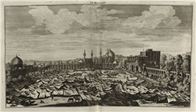
Merchants and craftsmen stood at the base of the hierarchy with the peasants, yet the bazaar was one of the three powers Abbas I gathered around Naqsh-e Jahan Square, beside the mosque and the palace. The trade and artisan guilds, the asnāf, appeared from the 1500s, as did the futuvva brotherhoods run by dervishes, and communities chose a kadkhoda to administer their customary law, under a kalantar whom the shah appointed to protect them from the governors. Abbas revived the Silk Road with roads, bridges, bazaars and caravanserais, which wealthy merchants built too, and sold carpets, silk and textiles to the English and Dutch. Carpet weaving became an industry, centred on Tabriz.
Moving in or out. Trade could make a fortune, but property was insecure, so many owners put their land in the clergy’s hands as vaqf. The alliance between the bazaar and the ulama became a lasting feature of Iranian society.
How many? Estimate: Isfahan alone had some 400,000 residents, about 4–5 per cent of 8–10 million, and Tabriz and the other towns many more; most townspeople lived by the bazaar and its crafts.
Picture: The great square of Isfahan, with its bazaar and mosques, around 1714 · Bruyn, Cornelis de (1652-1727) · Public domain · Wikimedia Commons
Free commoners · About 87% (the rest, est.)
Peasants and herders
-
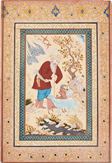
Most people in Safavid Iran were farmers who grew fruit, melons and tobacco, or herders who raised animals.
Pastoralism and agriculture were the twin bases of the economy, and the lower levels of society were divided like the upper: Turkoman tribes bred livestock and lived apart from their neighbours, while Persians farmed settled land. Farm produce paid most of the state’s taxes. Before Abbas most land was assigned to officials; he brought more under the crown. The harvest was shared between landlord and farmer in five parts of a fifth each, for land, water, plough animals, seed and labour, so a farmer who brought his labour and animals kept 40 per cent. Chardin judged Iran’s farmers better off than those of Europe’s most fertile lands; others found them well paid and well dressed, but subject to forced labour and heavy demands.
Moving in or out. The shahs moved whole peoples onto the land: under Abbas some 130,000–200,000 Georgians, about 300,000 Armenians and tens of thousands of Circassians were brought into Iran, many of them settled as farmers and cattle breeders. Under Shah Safi, the people put under royal commissioners in place of governors suffered from their rapacity and corruption.
How many? Everyone not counted in the other ranks: the great majority, the settled farmers and the tribal herders. Several of the other ranks are estimates, so this share is one too.
Picture: An old shepherd leaning on his staff, signed by Mu'in Musavvir, Isfahan, 1676 · Mu'in Musavvir · Public domain · Wikimedia Commons


Enslaved · c. 1–3% (est.)
Enslaved people
-
Many enslaved people were captives from the Caucasus mountains, made to serve in palaces and armies.
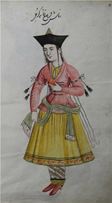
Most of the enslaved were captives from the Caucasus. Tahmasp I’s campaigns of 1540–1554 brought home more than 70,000 Christian Georgian, Circassian and Armenian slaves, and Ismail II another 30,000 Circassians and Georgians. Men who were converted and trained became ghulams. Women went into the harems of the shah and the elite, where Circassian and Georgian women came to hold prominent places, and many became wives and concubines of the shahs; the harem became an arena of ethnic politics, as cliques of Turkmen, Circassian and Georgian women and courtiers vied for the shah’s attention. Chardin noted that slaves, like women from the provinces, pierced their left nostrils for rings, which well-born Persian women would not do.
Moving in or out. People were enslaved by capture in war. Conversion and training could make a man a ghulam, and the shahs raised even queen mothers from the women of the harem.
How many? Estimate: Tahmasp I’s campaigns brought home more than 70,000 Christian captives and Ismail II another 30,000; most of the far larger numbers deported under Abbas were settled across Iran as farmers, craftsmen and traders.
Picture: A Georgian woman of Isfahan, drawn by Jani Farangi Saz for Engelbert Kaempfer, 1684–1685 · Jani Farangi Saz · Public domain · Wikimedia Commons

Born into history
Where would you have stood? Chance places you on the ladder, as birth placed most people: weighted by how many each rank held.
Moving up and down
The Safavid state was, in principle, a meritocracy: offices were not inherited as of right, and laymen are recorded rising to high posts. The great movements of the age were made by the shahs. Tahmasp I and Abbas I built a new layer of society out of Caucasian captives and deportees, who rose from captivity to command: by 1598 the Georgian Allahverdi Khan was commander-in-chief of the armed forces. Many hundreds of thousands of other deportees were settled across Iran and took every kind of role, from woodcutters and farmers to traders, generals and governors. The Qizilbash fell as the ghulams rose: their governorships were cut and their governors moved, and after the persecutions of Abbas and Shah Safi many of them turned against the dynasty. Tahmasp’s education of Turkoman officers’ sons in Persian opened the bureaucracy to them, and gifts of vaqf land made a new class of landowners of the clergy.
Women on the ladder
Women’s place followed their families’, and at the top the harem was a political arena. Tajlu Khanum, Ismail I’s queen, financed the Golden Iwan of the Fatima Masumeh Shrine at Qom in 1519, built her husband’s tomb at Ardabil and supported Tahmasp’s accession in 1524. From Tahmasp’s reign Circassian and Georgian women, brought as captives, became wives and concubines of the shahs, and the harem became, in the words of one modern account, “a competitive, and sometimes lethal, arena of ethnic politics”; the shahs drew queen mothers from these women. The dynasty itself had married into Turkoman, Georgian, Circassian and Pontic Greek families: Ismail I’s grandmother was Despina Khatun, a princess of Trebizond. Chardin described women who at home wore a veil over the hair and back only, but in public a cloak that hid all but the face, their hands and feet dyed with henna.
Compare with another society
Test yourself
4 questions on the ladder of Safavid Iran.
The questions open here once the page has loaded.
Sources and further reading
- Savory, R. (1980) Iran under the Safavids. Cambridge: Cambridge University Press.
- Jackson, P. and Lockhart, L. (eds) (1986) The Cambridge History of Iran, Volume 6: The Timurid and Safavid Periods. Cambridge: Cambridge University Press.
- Babayan, K. (2002) Mystics, Monarchs and Messiahs: Cultural Landscapes of Early Modern Iran. Cambridge, MA: Harvard University Press.
- Blow, D. (2009) Shah Abbas: The Ruthless King Who Became an Iranian Legend. London: I.B. Tauris.
- Streusand, D. E. (2011) Islamic Gunpowder Empires: Ottomans, Safavids, and Mughals. Boulder: Westview Press.
- Floor, W. and Herzig, E. (eds) (2012) Iran and the World in the Safavid Age. London: I.B. Tauris.
- Matthee, R. (ed.) (2021) The Safavid World. Abingdon: Routledge.
The shares are of the whole population, children included. Where a scholar has counted or estimated a rank, its share follows that work, named on the rank; where no count survives, the share is an estimate, marked est. and drawn dashed, made from what the rank was and did, from related figures and from the same rank in comparable societies, and its note says what it rests on. Population: the estimate the Safavid Iran article gives for 1650, against about 20 million for the Ottoman Empire in 1600: deserts and mountains kept the density of a large land very low.
Cite this page
- APA
- The Epoch Institute. (2026). Social Hierarchy of Safavid Iran. In Social Ladders. https://the-epoch-institute.org/societies/safavid-iran
- MLA
- “Social Hierarchy of Safavid Iran.” Social Ladders, The Epoch Institute, 2026, https://the-epoch-institute.org/societies/safavid-iran. Accessed .
- Chicago
- The Epoch Institute. “Social Hierarchy of Safavid Iran.” Social Ladders. 2026. https://the-epoch-institute.org/societies/safavid-iran.
- Harvard
- The Epoch Institute (2026) ‘Social Hierarchy of Safavid Iran’, Social Ladders. Available at: https://the-epoch-institute.org/societies/safavid-iran (Accessed: ).